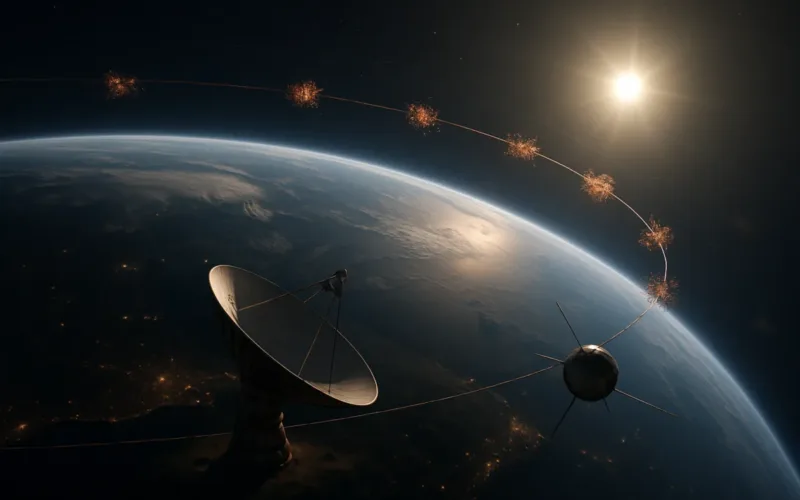
Ingenuity’s story is not merely a triumph of engineering ingenuity; it is an argument about how we choose trade-offs, assign mission roles and expand what we consider acceptable hardware for extraterrestrial exploration. When a 1.8 kilogram rotorcraft built partly from mobile-phone components was allowed to climb into a Martian sky and fly far beyond its five-flight brief, it forced NASA, engineers and the wider public to re-evaluate long-standing rules about conservatism, redundancy and the value of technology demonstrations.
The case Ingenuity makes: capability through pragmatic risk
Originally billed as a narrow experiment—five flights in thirty sols to prove that powered, controlled flight was possible in an atmosphere less than one percent as dense as Earth’s—Ingenuity instead completed 72 flights across nearly three years. It logged 128.8 minutes in the air, covered 17 kilometres, and operated from 48 distinct airfields. That scale of operational data transformed Ingenuity from a yes-or-no demonstration into an extended experiment about autonomy, operations and the use of commercial electronics in space.
Why using commercial components mattered
The engineering argument for including a Qualcomm-derived system-on-chip, commercial cameras, Linux, and the open-source F Prime framework was simple but radical: traditional space-grade electronics are heavy, conservative and limited in the kind of raw processing power needed for high-speed computer vision. Ingenuity needed to compare camera frames many times per second and run a control loop without human intervention. In that narrow mission, commercial off-the-shelf components offered a capability that radiation-hardened parts could not match within the same mass and power envelope.
Not a shortcut—an engineered trade
It would be facile to say engineers merely bolted a smartphone onto a rotorcraft and hoped for the best. The Qualcomm SoC sat inside a purpose-built avionics stack; custom microcontrollers managed critical real-time functions; flight software was developed and rigorously tested by JPL; radiation specialists modelled likely exposures; the craft flew within the protective cocoon of the Mars 2020 spacecraft. The decision to use commercial parts was intentional: it traded long-term pedigree for short-term, high-performance capability in a mission where failure would not imperil the Perseverance rover.
Evidence from performance: more than surviving
Ingenuity’s achievements were quantitative and qualitative. The very first flight—39.1 seconds, rising to three metres and returning—answered the fundamental aerodynamic question. But the subsequent dozens of flights added layers of evidence. Ingenuity became an aerial scout for Perseverance, an autonomous navigation testbed and a probe into how a small platform endures Martian winters, dust storms and software evolution. These are operational realities that wind tunnels and simulations alone cannot reproduce.
Adaptive operations and software as mission enablers
A surprising lesson is how much of Ingenuity’s success derived from people and software after it touched down. When a navigation sensor died, when winters reduced available solar energy and caused repeated reboots, the operations team rethought charging, waking and communications sequences. JPL pushed software updates that improved landing logic and allowed the helicopter to handle more challenging terrain. In other words, the aircraft was not just a designed artifact; it became a maintained and upgraded system, an idea at a distance that the ground team could iterate.
The accident: a cautionary datapoint, not a refutation
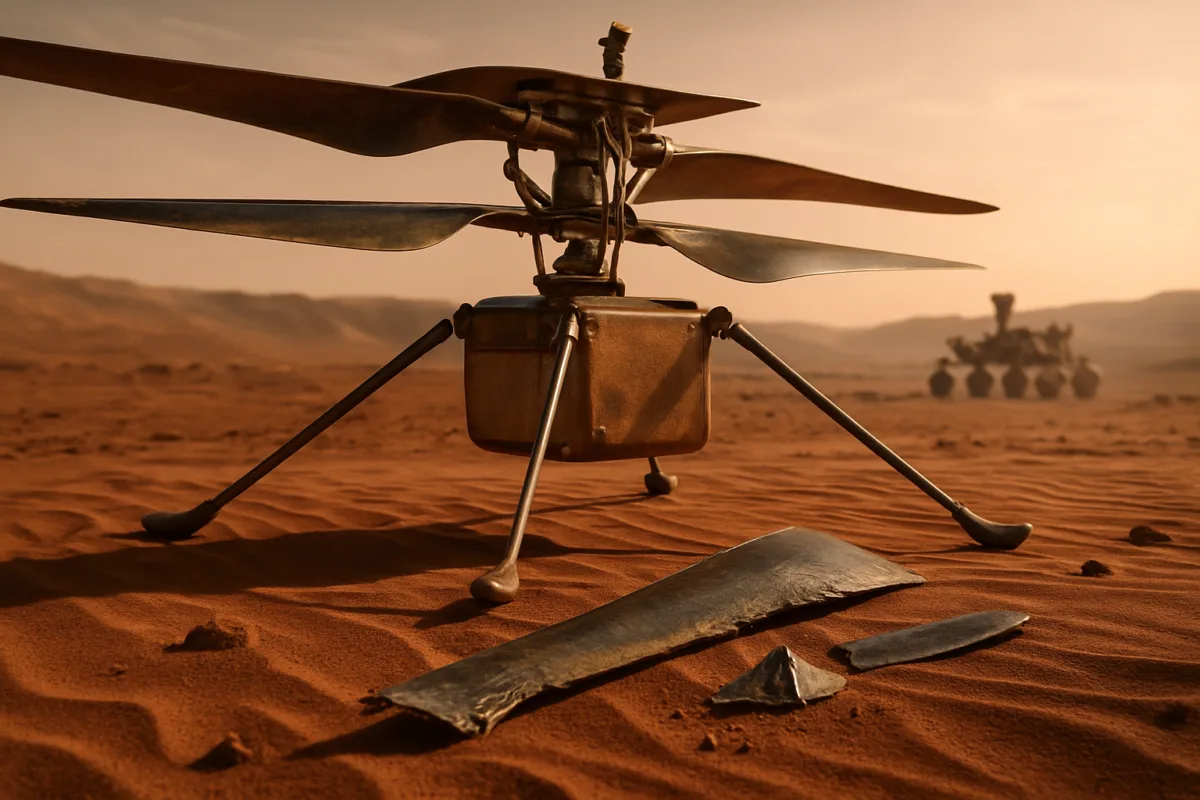
Flight 72 ended with a rotor tip touching the ground and catastrophic blade failure. The broadly reported summary obscures a more nuanced reconstruction: Ingenuity climbed to about 12 metres, hovered, photographed the terrain, and began its descent over relatively featureless sand ripples. Its visual odometry—estimating horizontal motion by tracking surface texture from camera frames—lost reliable features. The navigation system probably under-estimated lateral motion during touchdown on a sloping ripple, producing a hard landing that stressed the blades beyond their design point. All four blades snapped near a weak point; vibrations then tore another blade fragment free and disrupted communications. Images later showed a detached blade section about 15 metres away.
What the failure reveals about design limits
The accident underlines two criticisms frequently aimed at using commercial hardware and constrained-mass designs: they create narrower margins for unexpected conditions, and single-point navigation methods can be brittle when the environment departs from assumptions. But neither observation negates the broader argument that the program’s architecture intentionally accepted such trade-offs. Ingenuity’s brief allowed a higher risk tolerance—its failure did not threaten primary science—and the extended operations that followed were precisely what exposed the edge cases the original brief never budgeted to confront.
Data beats doctrine
Engineers had no cockpit voice recorder or direct inspection after the accident. Yet telemetry and rover-transmitted imagery enabled a credible accident reconstruction. That evidence matters more than theoretical arguments: it shows where visual navigation fails, where blade stress concentrates on touchdown, and how living systems cope with thermal cycles and dust. Those lessons will inform blade design, navigation redundancy (stereo vision, LIDAR, radar Doppler), and operational constraints for future rotorcraft on Mars or elsewhere.
Why this matters for future planetary aviation
Two broad claims follow from Ingenuity’s record and deserve arguing loudly. First: mission architects should no longer assume that small, highly autonomous flyers require purely space-grade electronics to be useful. Carefully selected commercial components, subjected to qualification and integrated with robust real-time subsystems, can deliver capabilities that open new mission classes—scouts, terrain recon, remote mapping—without disproportionate mass penalties. Second: technology demonstrations can become operational assets. If a demonstration is resilient and flexible enough, continuing to operate it yields exponentially more learning than a strictly time-boxed test.
Not every mission should mimic Ingenuity
These claims come with guardrails. A primary-science lander or a crewed mission cannot accept the same failure modes. Where human life, irreplaceable samples, or multimillion-dollar instruments are at stake, conservatism and redundancy remain essential. The proper conclusion is not that “phone parts are space-proof” but that mission design should explicitly choose which systems can carry controlled risk and which cannot. In many architectures, a lightweight, high-performance scout with commercial-grade processing can complement a heavy, conservative main spacecraft and broaden mission return.
Design recommendations implied by the evidence
The Ingenuity record suggests practical changes: build multi-sensor navigation stacks that do not rely solely on texture; design rotor blades with higher tolerance for off-nominal touchdown loads; include limited flight-data logging that can survive crashes to improve post-accident reconstruction; treat software updates and ground-in-the-loop operations as part of mission contingency planning; and explicitly budget for extended operations if a demonstration yields disproportionate value.
Ingenuity did something rare: it offered real, usable evidence that challenges an engineering doctrine rooted in decades of risk-averse practice. The helicopter’s longevity and utility were the product of an intentional trade: accept risk in a part of the system so that the mission as a whole could gain new capabilities and data. That model—provisioning demonstrators with strong performance characteristics, clear failure envelopes and the capacity to be iterated from Earth—should sit at the center of future exploratory strategies, not on their fringe.

Dr. Morgan directed the Archives Program from 2014 to 2017, gaining extensive experience in research documentation, information management, and the preservation of scholarly resources. Throughout her career, she has worked closely with academic publications and research materials, developing expertise in evaluating scientific sources and communicating complex topics to broad audiences.
Her primary areas of specialization include scientific publishing, research communication, editorial review, and the translation of technical research into accessible educational content. She has contributed to projects involving space science, astronomy, environmental science, history, archaeology, and emerging scientific discoveries, always emphasizing accuracy, transparency, and the responsible presentation of evidence.
As Editorial Director of Muskurahat.us, Dr. Morgan leads the editorial review process for scientific articles, ensuring that content is based on reputable sources, peer-reviewed research whenever available, and publications from recognized universities, research institutions, and international scientific organizations.
She is committed to promoting scientific literacy through clear, engaging, and well-documented articles that help readers better understand scientific discoveries and their impact on society. Her editorial philosophy is founded on accuracy, intellectual integrity, independent journalism, and continuous learning as scientific knowledge evolves.
Through her work at Muskurahat.us, Dr. Morgan supports the publication of trustworthy scientific content that makes complex research accessible to readers around the world while maintaining rigorous editorial standards.