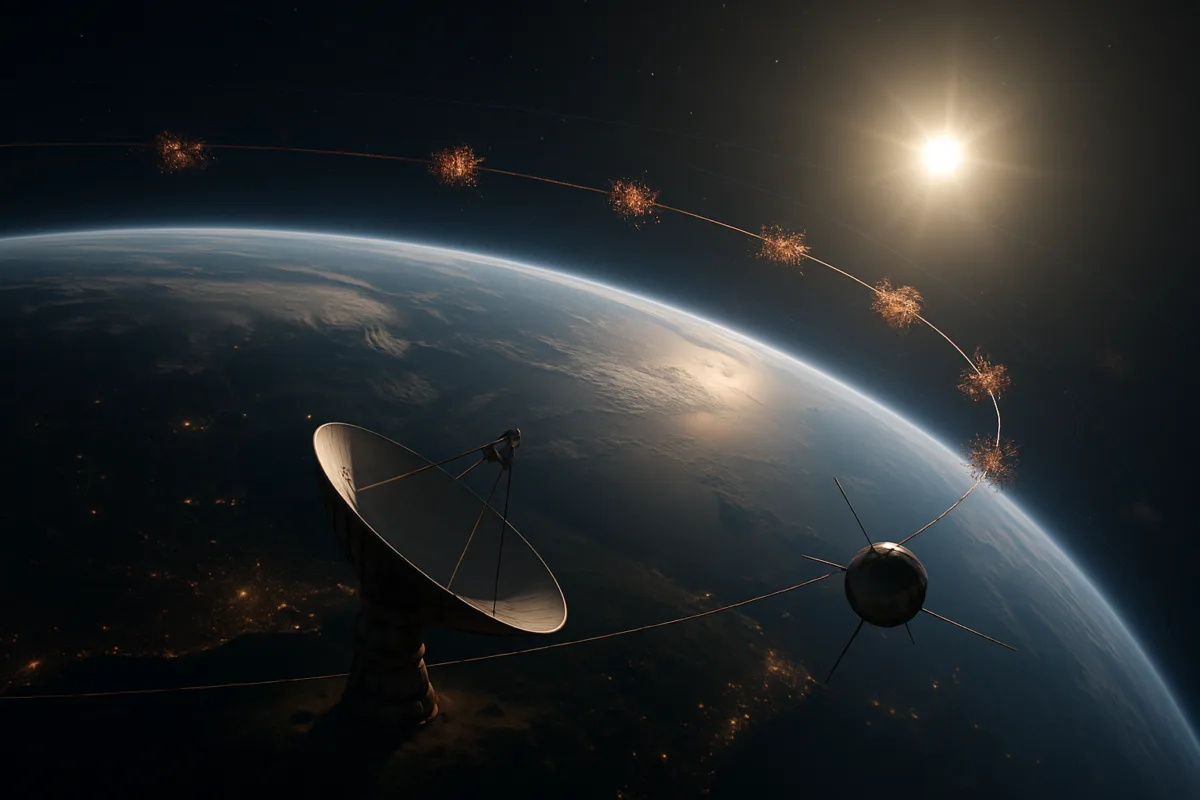
Project West Ford was a bold technical gamble: in May 1963, MIT’s Lincoln Laboratory released hundreds of millions of tiny copper dipoles into orbit to create an artificial ionosphere. That primary purpose—resilient, jam-proof long-distance radio—sounded defensible during the Cold War, but the experiment also left behind a stubborn legacy of orbital clumps that persist six decades later. The fact that more than 20 tangles of those needles still orbit Earth raises urgent questions about how we balance innovation, astronomy, and long-term stewardship of near-Earth space.
The experiment and its stated rationale: an artificial ionosphere to beat outages
Proponents framed Project West Ford as pragmatic engineering. The ionosphere, then the backbone of long-distance radio, could be degraded by solar flares and intentional jamming. A ring of half-wavelength copper needles would act as passive reflectors for X-band microwaves, making communications more resilient to both natural and hostile disruptions.
Technically the idea worked briefly: the dipoles formed a ring, and early tests transmitted voice and digitized data across continental distances. But the data rates collapsed within weeks, and after a few months the belt was too sparse for reliable operation. The experiment proved a concept, but it did not prove long-term viability.
Tracking the aftermath: how many West Ford clumps remain in orbit?
Decades after the experiment, public satellite catalogues still list dozens of West Ford objects. Sources such as CelesTrak and Jonathan McDowell’s GCAT show differing tallies—CelesTrak lists dozens under the label “Westford Needles,” while GCAT counts somewhat fewer. When you reconcile the two, roughly 20 to 40 clumps remain, with approximately 23 objects that both catalogues currently agree are still tracked.
That disagreement is not trivial. It exposes the limits of monitoring small, high area-to-mass debris and the cataloguing choices that shape our perception of risk. Transitional phrase: to understand why these clumps persist, we need to look at the science and the assumptions behind the mission.
Why a fraction of the needles never separated: physics, engineering, and prediction failures
The mission intended for nearly half a billion dipoles to disperse individually, then decay through solar radiation pressure and atmospheric drag. But post-mission investigations found that perhaps only 25–45% of the dipoles separated cleanly. The rest stayed bound in clumps that radar later catalogued as discrete objects.
Engineers predicted many clumps would reenter within a decade, but the record shows otherwise: the first documented reentry of a clump catalogued by CelesTrak occurred in 1974, more than a decade after launch, and others persisted into the 21st century. That gap between forecast and reality is more than an engineering footnote; it is evidence that risk assessments were optimistic and enforcement mechanisms for post-experiment remediation were absent.
Astronomers’ objections and the birth of modern space norms
Astronomers protested loudly at the time, warning that a global cloud of copper needles would pollute optical and radio observations. The International Astronomical Union and the US National Academy of Sciences intervened, and public debate followed. Those objections forced a rethink: the Outer Space Treaty and later international committees began to wrestle with potentially harmful experiments in orbit.
Yet the dispute revealed a deeper problem. The engineers relied on a physical decay mechanism—sunlight-driven orbital evolution—that proved unreliable for clustered objects. The broader lesson is normative: scientific communities cannot be treated as afterthoughts when experiments may impose persistent shared costs on the global commons.
Policy implications: who takes responsibility for temporary experiments that leave permanent debris?
Project West Ford illustrates a policy gap that persists today. When a state or institution conducts an experiment in orbit, the externalities are borne collectively: astronomers, satellite operators, and future generations inherit the risk. Article IX of the Outer Space Treaty encourages consultation when an activity might cause harmful interference, but compliance is often informal and post-hoc.
Transitional phrase: with the commercial space age accelerating, the West Ford precedent argues for firmer mechanisms—mandatory environmental assessments for space activities, stronger international consultation protocols, and clearly assignable liability for debris that outlives a project.
Debris tracking challenges: catalogues, detection limits, and uncertainty
Counting West Ford remnants is difficult. Public catalogues differ, entries can be reassigned, and small clumps with high area-to-mass ratios behave unpredictably under solar radiation pressure. The result is uncertainty in both inventory and risk modeling.
Operationally, this uncertainty matters. Small, under-tracked objects complicate collision avoidance for large satellites and increase the background of orbital debris. If we accept that one early Cold War experiment can leave dozens of long-lived objects, we must question how many future missions might do the same under laxer governance.
Argument: innovation must not outpace responsibility
Supporters of bold experiments argue that technological breakthroughs sometimes require risk-taking. That is true, but Project West Ford shows risk-taking without robust governance creates durable harms. The experiment offered temporary utility and a short-lived communications capability, yet it also produced decades of ambiguous debris records and a diplomatic headache for the international scientific community.
Transitional phrase: therefore, the case for stronger norms is not anti-innovation; it is pro-sustainability. We must reconcile daring engineering with stewardship, favoring designs and policies that internalize downstream costs.
Lessons for modern space operations: megaconstellations, cubesats, and active removal
Today’s challenges—mega-constellations, proliferation of small satellites, and more frequent orbital tests—parallel the conditions that produced the West Ford legacy. The difference is scale: modern constellations can add thousands of objects, and small satellites can fragment into clouds without adequate mitigation plans.
Actionable technical steps are clear: require demonstrated deorbit plans, accelerate funding for active debris removal, and expand radar and optical tracking capacity for small objects. Policy changes are equally necessary: international agreements should mandate pre-launch impact assessments and transparent notification, and national regulators should condition approvals on credible end-of-life strategies.
Practical changes regulators and operators should adopt
First, require independent environmental assessments for experiments likely to spread debris or affect astronomical observations. Second, mandate traceable commitments to deorbit or retrieve hardware, with escrowed funds to finance remediation if operators fail. Third, improve global tracking and data-sharing to reduce catalogue divergence and better inform collision-avoidance decisions.
Transitional phrase: these steps will not eliminate risk, but they will shift responsibility from speculative forecasts to enforceable commitments.
Why historical accountability matters for future governance
History informs policy. Project West Ford shaped international thinking about potentially harmful experiments and indirectly influenced later space stewardship institutions. Yet the gap between expectation and outcome—where many clumps outlived their predicted lifetimes—exposes the limits of voluntary standards.
If the international community treats historical precedents as mere curiosities rather than cautionary lessons, we risk repeating avoidable mistakes on a far larger scale. The better path blends scientific freedom with binding safety measures.
Project West Ford is not simply an odd footnote in space history; it is a cautionary tale with clear implications. The mission achieved a temporary technical objective but failed to anticipate the persistence of clustered debris and the governance vacuum that allowed it to remain. Policymakers, space operators, and the scientific community should treat West Ford as a model case: allow bold experiments, but only within a framework that ensures transparency, accountability, and measurable remediation. By insisting on enforceable pre-launch assessments, credible end-of-life plans, and improved global tracking, we can enable innovation without surrendering the orbital commons to long-lived, avoidable hazards.

Dr. Morgan directed the Archives Program from 2014 to 2017, gaining extensive experience in research documentation, information management, and the preservation of scholarly resources. Throughout her career, she has worked closely with academic publications and research materials, developing expertise in evaluating scientific sources and communicating complex topics to broad audiences.
Her primary areas of specialization include scientific publishing, research communication, editorial review, and the translation of technical research into accessible educational content. She has contributed to projects involving space science, astronomy, environmental science, history, archaeology, and emerging scientific discoveries, always emphasizing accuracy, transparency, and the responsible presentation of evidence.
As Editorial Director of Muskurahat.us, Dr. Morgan leads the editorial review process for scientific articles, ensuring that content is based on reputable sources, peer-reviewed research whenever available, and publications from recognized universities, research institutions, and international scientific organizations.
She is committed to promoting scientific literacy through clear, engaging, and well-documented articles that help readers better understand scientific discoveries and their impact on society. Her editorial philosophy is founded on accuracy, intellectual integrity, independent journalism, and continuous learning as scientific knowledge evolves.
Through her work at Muskurahat.us, Dr. Morgan supports the publication of trustworthy scientific content that makes complex research accessible to readers around the world while maintaining rigorous editorial standards.