When Melbourne gave each of its roughly 70,000 street trees a unique ID and an email address, it intended a maintenance tool—but what unfolded makes a far stronger case that Melbourne street trees can be a deliberate instrument of civic belonging. The first hundred words of this tale already reveal the paradox: a technical solution meant to streamline pruning became a public mailbox for affection, confession, and unexpected dialogue between citizens and the living city.
From bureaucratic tool to public intimacy: how the tree-inbox worked
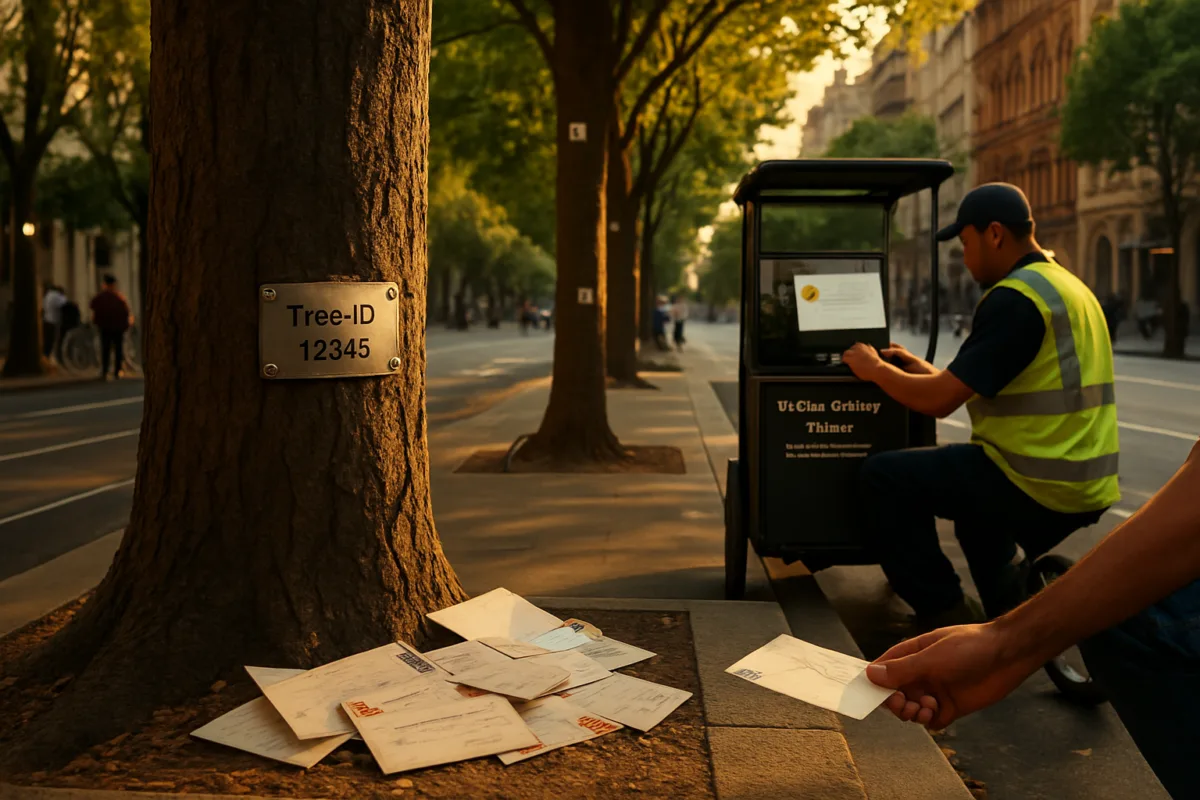
The program was simple: tag every public tree with an ID, map its species and age, and assign an email so residents could report hazards. At first, the objective was entirely practical—pinpoint a fallen limb, report disease, speed up arborist response times. Yet the interface that made reporting precise also granted trees an identity and an address.
Consequently, the maintenance inbox became a portal for emotions. Residents, and eventually people from around the world, wrote not about the trees but to them. Letters of thanks, personal confessions, and even political jokes poured into those mailboxes. The city staff sometimes replied—creatively, in the voice of the tree—bridging municipal service and human storytelling.
Why naming and addressing urban trees matters for civic engagement
At first glance one might dismiss the phenomenon as a whimsical aside. However, naming and addressing objects is a powerful social act. When something is given an identity, it moves out of abstraction and into relationship. That shift is not trivial; it changes behavior.
People care differently for a personified tree than for an anonymous strip of greenery. Giving trees email addresses effectively converted passive urban greenery into recipients of attention, which in turn created advocates. In short, the ID was maintenance infrastructure and also a catalyst for stewardship.
Emotional infrastructure: why people wrote love letters to trees
There are three interlocking reasons why people began to write to trees. First, proximity breeds attachment—daily encounters with an elm, gum, or peppermints make trees part of life’s rhythm. Second, modern urban life often lacks low-risk outlets for expressing affection toward the shared environment; a tree inbox provided that safe channel. Third, during periods of isolation such as long lockdowns, a writable tree became a proxy for connection.
Moreover, the practice tapped into deep cultural practices: letter-writing, totems, and the human tendency to anthropomorphize. Whether the writer sought solace, wanted to memorialize a moment, or simply said thank you, the tree-mailbox made it possible to externalize feelings to something living yet immobile.
The civic payoff: practical benefits beyond the romance
It is tempting to romanticize the story and ignore measurable outcomes. Yet the program retained its practical core: arborists still received hazard reports linked precisely to tree locations. That accuracy probably reduced response times and improved data quality.
Additionally, the flood of affectionate messages cultivated a constituency that values urban trees. That constituency can shift policy debates, protect funding for urban forestry, and resist inappropriate tree removals. In other words, the emotional responses converted into political capital for city canopy protection.
Furthermore, multilingual replies expanded inclusivity
The municipal team answered messages in multiple languages, which demonstrated cultural responsiveness. That small detail signals that the trees—and by extension the city—belong to a diverse population. Language-accessible civics increases participation and trust in public institutions.
Counterarguments and why they miss the point
Critics might argue this was frivolous spending of municipal resources, or that staff time answering sentimental emails diverted attention from real work. Such critiques misunderstand both scale and payoff. The number of genuine maintenance reports remained manageable, and the affectionate messages mostly required light-touch replies when any reply was needed at all.
Even more importantly, the cost-benefit analysis should include indirect returns: increased public vigilance, improved tree-care funding, and stronger civic bonds. Those returns are not only qualitative; they can lower long-term maintenance costs by fostering public stewardship.
How other cities can replicate Melbourne’s success
Replication is feasible and need not be resource-intensive. The essential elements are an accurate tree inventory, a simple digital interface that includes an identifier, and an inbox routing system for messages. The emotional surge that follows is a feature, not a bug.
To start, a city should pilot the program in a single district, document both maintenance and non-maintenance messages, and assess staff capacity. Importantly, prepare a light-touch reply protocol: factual answers for biological questions, empathetic acknowledgments for personal notes, and occasional in-character responses to foster delight.
Step-by-step rollout guidance
First, build or update an urban tree inventory that records species, age, condition, and GPS location. Second, assign unique IDs and map them to a simple web page that lists the tree’s basic information and an email contact. Third, route incoming messages to a small urban forest team trained in both arboriculture and community engagement.
Finally, publish a transparent triage policy so residents know how maintenance requests are handled and what kinds of non-urgent messages might receive a creative reply. Transparency reduces misuse and sets reasonable expectations.
Potential pitfalls and how to avoid them
Any civic tech project can be gamed, and a tree inbox is no exception. Cities should anticipate spam, offensive content, or unrealistic demands. To mitigate risks, implement spam filters, automated acknowledgment receipts, and human moderation for nuanced replies.
Another concern is data privacy. If letter-writers reveal personal details, staff must follow privacy policies and avoid storing sensitive information unnecessarily. The design should default to ephemeral, light-touch exchanges rather than creating new data liabilities.
Why this matters for urban policy and democracy
Urban planning too often treats infrastructure as inert: roads, pipes, and parks are objects to be optimized. Melbourne’s tree-email experiment insists that infrastructure can also be relational. Identity and address transformed a technical asset into a civic actor that drew citizens into conversation.
When governments provide simple affordances for affection—an ID, an address, a way to say thanks—they invite people to care. That invitation bolsters democratic engagement because it lowers the bar for participation: you don’t need to attend a council meeting to make a difference; you can write to a tree.
Moreover, small interventions can scale social norms
Giving trees an address normalized gratitude and curiosity about the urban forest. Social norms are subtle yet powerful levers for behavior change; once gratitude is normalized, people are likelier to advocate for canopy funding or volunteer for planting events.
Concrete actions readers and civic leaders can take now
If you live in a city with an urban tree inventory, ask your local council whether each tree has an ID and a reporting channel. If not, propose a pilot that pairs maintenance reporting with optional public messaging. For civic technologists, consider building a template for tree pages that include species info, a small map, and an inbox.
Community groups can also host letter-writing events to strengthen neighborhood attachment. Schools might incorporate tree correspondence into curricula to teach ecology, empathy, and civic participation simultaneously.
In practice: a short checklist
– Confirm or build a public tree inventory.
– Assign unique IDs and simple URLs for each tree.
– Provide an email or webform for both maintenance and messages.
– Train a small team to triage and reply, including occasional in-character responses.
– Publish response expectations and privacy guidelines.
Melbourne’s experiment demonstrates that public infrastructure can be both functional and relational. By giving trees a name and an inbox, the city unlocked latent human behaviors: people reached for expression, connection, and stewardship. It’s an approach that requires humility rather than heavy investment, and it pays dividends in civic engagement and urban forest resilience.
Ultimately, assigning identities and addresses to urban trees is less about indulging sentimentality and more about designing civic systems that recognize the emotional lives of residents. If your goal is stronger communities and healthier urban forests, start by giving living things a way to be known—and expect the love letters to follow, along with more vigilant stewardship and deeper democratic participation.

Dr. Morgan directed the Archives Program from 2014 to 2017, gaining extensive experience in research documentation, information management, and the preservation of scholarly resources. Throughout her career, she has worked closely with academic publications and research materials, developing expertise in evaluating scientific sources and communicating complex topics to broad audiences.
Her primary areas of specialization include scientific publishing, research communication, editorial review, and the translation of technical research into accessible educational content. She has contributed to projects involving space science, astronomy, environmental science, history, archaeology, and emerging scientific discoveries, always emphasizing accuracy, transparency, and the responsible presentation of evidence.
As Editorial Director of Muskurahat.us, Dr. Morgan leads the editorial review process for scientific articles, ensuring that content is based on reputable sources, peer-reviewed research whenever available, and publications from recognized universities, research institutions, and international scientific organizations.
She is committed to promoting scientific literacy through clear, engaging, and well-documented articles that help readers better understand scientific discoveries and their impact on society. Her editorial philosophy is founded on accuracy, intellectual integrity, independent journalism, and continuous learning as scientific knowledge evolves.
Through her work at Muskurahat.us, Dr. Morgan supports the publication of trustworthy scientific content that makes complex research accessible to readers around the world while maintaining rigorous editorial standards.