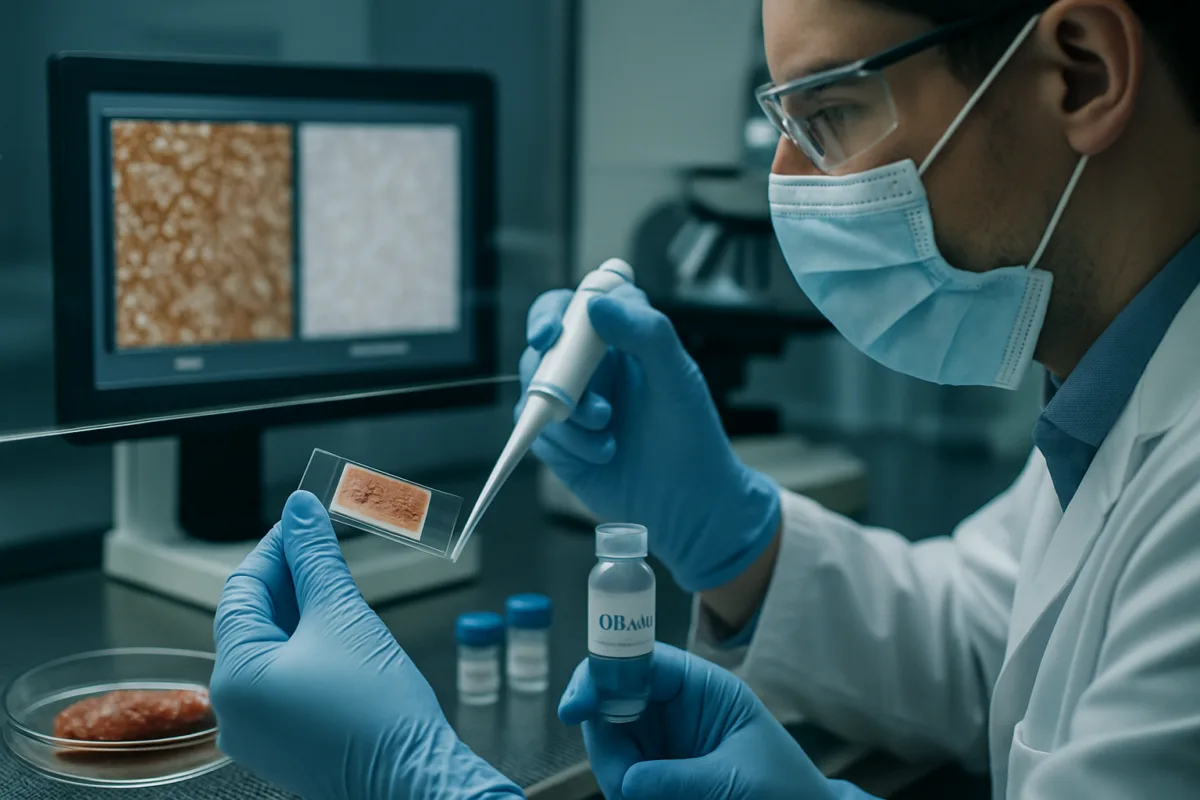
On 14 July 2026, a paper in Nature Communications reported an engineered enzyme that can selectively break down a chemical marker of protein aging, Nε-carboxymethyl-lysine (CML), in donated human tissues. The experiments reduced CML staining in thin sections of human skin to levels typically seen in the skin of a 31-year-old and cut CML in a 75-year-old donor’s aorta by more than seventy percent after overnight treatment. Those headline numbers are striking, but they are the result of a multi-step experimental process that deserves closer inspection. This article analyzes that process: how the enzyme was made, how it was tested, what assays measured, why the findings are important yet limited, and what methodological and translational steps will matter next.
Understanding the chemical target and the biological problem
AGEs (advanced glycation end-products) like CML form when reducing sugars react non-enzymatically with amino groups on proteins. The Maillard chemistry that browns bread is a convenient analogy: over time, proteins in extracellular matrices accumulate modifications that are slow, irreversible, and often cross-linking. Because the body lacks a dedicated enzymatic repair pathway for many AGE modifications, these chemical adducts are treated as a cumulative form of damage associated with aging tissues—collagen, arterial walls, and the eye lens among them.
The specific challenge posed by CML
CML is one well-characterized AGE but not the only one. It can accumulate on lysine residues across diverse proteins and contributes to altered tissue biochemistry and to receptor-mediated inflammatory signaling. Importantly, CML is a modification that can, in principle, be chemically recognized and cleaved by an appropriate catalyst. That theoretical possibility is the gateway for the work reported: instead of trying to prevent AGE formation, the team attempted to remove an existing modification enzymatically.
Engineering the enzyme: iterative directed evolution and selection
The authors started with a bacterial glycine oxidase—a soil microbe enzyme with baseline activity they could modify. The methodological core is directed evolution: introduce genetic diversity into an enzyme, express the variant proteins, test each for desired activity, and iterate the cycle to accumulate favorable mutations. According to the paper, the group screened on the order of 500 million variants to isolate an engineered enzyme they call CMLase, capable of recognizing and degrading CML modifications selectively.
Key steps in the directed evolution pipeline
From a process standpoint, their pipeline likely involved library generation (error-prone PCR, recombination), high-throughput expression (bacterial or yeast display, cell-free expression), and assays tailored to detect CML cleavage rather than general oxidative or proteolytic activity. Successful selection requires counter-screens to prevent off-target activity: variants that damage unmodified lysine or other amino acids would be rejected. The reported selectivity suggests the screening strategy included negative selection steps, but the paper’s supplemental methods are the place to examine those controls in detail.
Why selectivity matters
Unselective enzymatic activity risks collateral damage to intact proteins. The team’s claim of CML specificity rests on showing activity across a panel of purified proteins and on tissue staining patterns that decreased after treatment. The detailed results—a range of CML reductions across proteins, some near complete and others partial—are consistent with an enzyme tuned to the local chemistry of specific modification sites rather than a blunt, promiscuous catalyst.
From enzyme to ex vivo tissue: experimental progression and measurements
The paper describes a progression of assays: purified proteins in vitro, thin sections of donated human skin, isolated abdominal aorta from a 75-year-old donor, and lens tissue from another donor. For tissues, the readout was CML staining—immunohistochemical or similar—and quantification before and after enzyme exposure. On purified proteins, mass spectrometry and site-specific measurements allowed the team to report fractional reductions at particular modification sites.
Interpreting the reported figures
Two figures often quoted in media are the ‘‘below 31-year-old levels’’ for skin and ‘‘>70% reduction’’ for the 75-year-old aorta. These derive from separate tissues and donors. In skin sections, CML dropped more than fifty-five percent across epidermis and dermis and fell to levels below those typically observed in skin from a 31-year-old. In the aorta specimen, CML fell by more than seventy percent overnight. A lens sample showed reductions between 45 and 78 percent depending on assay method. Across purified proteins, reductions varied widely: roughly fifty percent on a common blood protein to nearly ninety-seven percent on casein. Those variances are informative: enzymatic access, local protein conformation, and the chemistry of the modification site all modulate activity.
What the experiments do and do not show: limits intrinsic to ex vivo work
The results demonstrate that CML is not chemically immutable in all contexts: an engineered catalyst can recognize and remove it in solutions and thin tissues. But ex vivo success is not a guarantee of in vivo efficacy. Thin tissue sections and isolated proteins offer maximal physical access to reaction sites; intact organs and living tissue present barriers—extracellular matrix density, tissue diffusion limits, protease inhibitors, immune surveillance, and biochemical compartmentalization. The paper acknowledges these gaps explicitly: penetration into intact tissues, functional restoration of mechanical properties, and the enzyme’s behavior in the context of blood and immune systems remain untested.
Historical cautionary lessons
This is not the first attempt to target AGE chemistry. ALT-711 (alagebrium) was a small-molecule cross-link breaker that showed early promise in small clinical studies but never completed late-stage development; the company that developed it folded. That history is a methodological caution: biochemical activity in vitro or in early clinical signals does not always translate into durable, safe benefit. The current team addresses the history in the paper—which is good practice—but the prior record argues for careful, staged validation rather than exuberant claims.
Translational pathway: necessary experiments before clinical testing
A clear process map emerges for next steps. First, reproducibility: independent labs repeating the core ex vivo assays on a broader set of donors will test robustness. Second, small animal models that reasonably replicate human AGE chemistry in target tissues are essential. Such models must assess pharmacokinetics and biodistribution (can the enzyme reach matrix-bound CML?), immunogenicity (will the immune system neutralize or react against a bacterial-derived enzyme?), and functional outcomes (does removing CML change tissue stiffness, elasticity, or organ function?).
Delivery, dosing, and safety considerations
Delivery will likely determine the therapeutic concept: topical formulations for skin, local catheter-based delivery for arteries, or systemic administration for widespread tissues. Each route has distinct risks. Systemic dosing raises immunogenicity concerns and off-target activity; local delivery constrains the clinical indications and development pathway. Safety testing must include assays for unintended proteolysis, oxidative byproducts of enzymatic activity, and long-term effects on extracellular matrix turnover.
Scientific and ethical context
Beyond the technical pipeline are questions about translational priorities and messaging. How should researchers balance excitement about a demonstrable biochemical reversal with the historical record of translational failures? How should industry and media avoid overstating ‘‘reversal of aging’’ when the experiments are ex vivo and limited to one modification? The paper’s measured tone—framing the work as a finding that challenges a long-held assumption about permanence rather than as a finished therapy—is a model for responsible communication.
There is also a practical ethical axis: donor tissue research relies on consent and transparent use of biological samples. As directions move toward animal and eventually human studies, trial designs must weigh potential benefits against the novelty and unknowns of immune responses, especially for a bacterial-derived biologic. Regulatory agencies will expect a clear preclinical package demonstrating safety, biodistribution, and mechanistic plausibility before human dosing.
Technically, the most consequential scientific questions that follow are whether removing CML measurably improves tissue mechanics and whether doing so affects clinical outcomes—reduced vascular stiffness, improved wound healing, or preserved lens transparency. Because glucosepane and other AGEs likely dominate cross-linking in aged collagen, a full therapeutic strategy may require a suite of approaches: prevention of new AGE formation, enzymatic removal of certain modifications, and methods to promote healthy matrix turnover and repair.
The Nature Communications paper adds an important datapoint: at least one class of AGE modification can be recognized and cleaved by an engineered catalyst in controlled laboratory conditions. Moving from that datapoint to a therapy is a process of layered validation—assay replication, animal models, delivery optimization, and carefully staged clinical testing—punctuated by safety and immunogenicity assessments. The promise is tangible but provisional, and the work demonstrates how modern protein engineering and high-throughput selection can revisit biochemical assumptions that persisted for decades. If subsequent research shows functional benefit in living systems with an acceptable safety profile, CMLase or its successors could become a tool for addressing one piece of the complex chemistry of aging. For now, the study is best read as a methodological advance: a clear, reproducible demonstration that a previously assumed permanent chemical modification can, under the right conditions, be chemically undone, opening a measured path forward for a suite of scientific and translational steps that must follow.

Dr. Morgan directed the Archives Program from 2014 to 2017, gaining extensive experience in research documentation, information management, and the preservation of scholarly resources. Throughout her career, she has worked closely with academic publications and research materials, developing expertise in evaluating scientific sources and communicating complex topics to broad audiences.
Her primary areas of specialization include scientific publishing, research communication, editorial review, and the translation of technical research into accessible educational content. She has contributed to projects involving space science, astronomy, environmental science, history, archaeology, and emerging scientific discoveries, always emphasizing accuracy, transparency, and the responsible presentation of evidence.
As Editorial Director of Muskurahat.us, Dr. Morgan leads the editorial review process for scientific articles, ensuring that content is based on reputable sources, peer-reviewed research whenever available, and publications from recognized universities, research institutions, and international scientific organizations.
She is committed to promoting scientific literacy through clear, engaging, and well-documented articles that help readers better understand scientific discoveries and their impact on society. Her editorial philosophy is founded on accuracy, intellectual integrity, independent journalism, and continuous learning as scientific knowledge evolves.
Through her work at Muskurahat.us, Dr. Morgan supports the publication of trustworthy scientific content that makes complex research accessible to readers around the world while maintaining rigorous editorial standards.