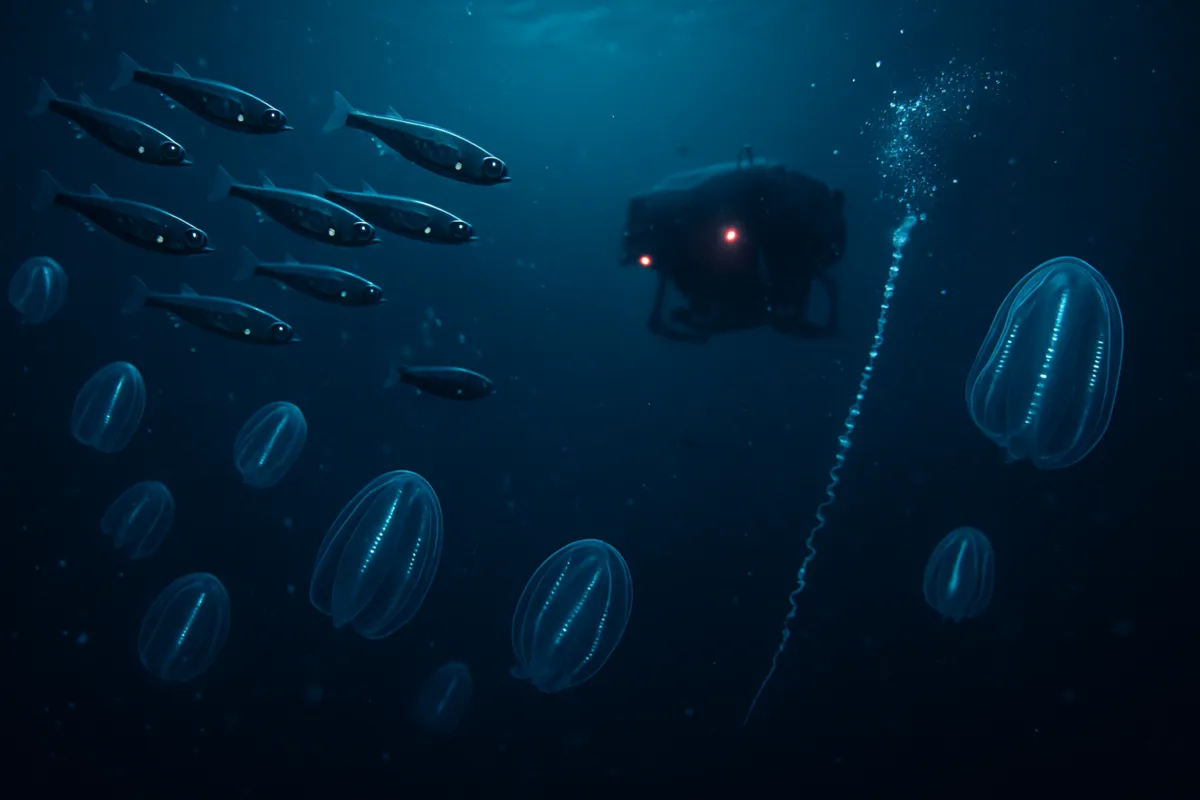
We have long described the deep ocean as dark and silent, a vast blackness under the waves; that description is no longer adequate. Recent syntheses of observational and experimental data compel a different, bolder claim: bioluminescence is not a marginal oddity but the dominant mode of visual signalling in the ocean’s twilight. If the water column between 200 and 1,000 metres — the mesopelagic zone — is home to animals where roughly 80 percent can produce light, then living light is not merely present, it is the medium through which much of that realm operates.
Reframing darkness: why the mesopelagic demands a new mental model
Describing the mesopelagic as simply ‘dark’ encourages two convenient but false assumptions. First, that absence of sunlight implies absence of information; second, that non-acoustic environmental cues are negligible. Both are wrong. The twilight zone is better described as a different lighting system, one where photons are generated by organisms rather than the sun. That reframing matters because it changes what questions scientists ask and how policymakers, technologists and conservationists value the midwater environment.
Evidence for a living lightscape
The assertion that most mesopelagic animals are bioluminescent is not hyperbole. NOAA’s synthesis, reinforced by long-term remotely operated vehicle (ROV) datasets, points to prevalence: estimates put the bioluminescent-capable fraction of midwater animals in the 70–80 percent range. A prominent study analyzing 17 years of ROV observations off California documented that roughly 76 percent of observed individuals could emit light. Those numbers are persuasive because they are drawn from broad, direct observations across depths and taxa. Taken together, they convert anecdote into pattern: the capacity for light production is a widespread, phylogenetically distributed trait in the open ocean.
Bioluminescence as behaviour, not decoration
It is tempting to treat bioluminescence as an exotic ornament — pretty flashes in a strange environment. That stance misses the point. Bioluminescence is behaviourally functional. Organisms use it to startle predators, create luminous decoys, lure prey, spotlight environments with searchlight-like organs, and—crucially—communicate with conspecifics. Counterillumination, where an animal matches the faint downwelling light to mask its silhouette, is a tactical use of emitted light for concealment. Luring and mating displays demonstrate intentional signalling. In aggregate, these behaviours functionally resemble the communicative channels we recognize on land, but they are tuned to a different physical and sensory context.
Blue rules: physics shaping biology
Why do ocean bioluminescent displays skew blue and blue-green? Because seawater is a selective medium. Shorter wavelength blue photons travel farther through clear seawater than red or yellow photons. Evolution exploits physics: if a signal must propagate, it pays to emit the colour that travels best. This constraint yields predictable outcomes — convergent evolution toward blue-biased emissions across diverse lineages — and explains why the ocean’s visual language differs so starkly from terrestrial visual signalling dominated by long wavelengths and pigment-based displays.
Methodological paradoxes and observational bias
Ironically, a major reason this living-light world remained underappreciated is the very act of studying it. Bright shipboard lights and ROV lamps can drive animals away, damage sensitive photoreceptors and conceal transparent or low-contrast organisms. Early deep-sea exploration created an observer effect: the illumination necessary to see also altered the scene. Modern approaches — low-light cameras, red illumination where appropriate, patient observation and specialized sensors — alleviate but do not eliminate the problem. Consequently, our picture, while far richer than a generation ago, still underrepresents subtle behaviours and temporal dynamics. The inference that bioluminescence is the ocean’s primary visual language rests on large datasets, but it must be read with humility about what remains unseen.
Counterarguments and limits
Skeptics might reasonably push back. They can point out that the 80 percent figure is depth- and region-specific and that freshwater and terrestrial habitats do not display comparable rates of luminous organisms. They could also note that emission capability does not equal constant signalling; animals may light only in particular contexts. These objections are valid, but they do not undermine the central claim. The ocean is Earth’s largest contiguous habitat; even if bioluminescence is concentrated in specific depth bands or episodic in practice, the absolute scale of the water column means that living light has a planetary-level communicative footprint unmatched by land-based visual systems.
Implications for ecology, policy and conservation
If bioluminescence is an ecological primary — a central mode of interaction — then managing the ocean requires integrating that reality. Anthropogenic brightness and noise, light pollution from surface activities, and new technologies such as deep-sea mining could scramble luminous signals or selectively advantage species with certain emission strategies. Conservation frameworks traditionally prioritize habitat, species and chemical pollution; they must also consider sensory habitats. Protecting the integrity of visual channels is as essential as preserving water quality when organisms rely on light for survival and reproduction.
Practical steps
Policies can incorporate low-impact monitoring standards for deep-sea research, restrictions on persistent artificial lighting in ecologically sensitive regions, and environmental impact assessments that include sensory disruption metrics. Moreover, long-term monitoring using minimally invasive tools should be prioritized to detect shifts in bioluminescent community composition that could signal broader ecosystem change.
Technological and philosophical consequences
Recognizing bioluminescence as a dominant communication form invites technological and conceptual innovation. Biomimetic engineers can look to efficient chemical light production for low-energy signaling and sensing systems. Optical ecologists can design detectors tuned to ecologically relevant wavelengths and temporal patterns. Philosophically, acknowledging a planetary-scale visual language that humans cannot naturally perceive forces a reckoning about anthropocentrism in biology: much of life’s information exchange occurs in modalities and scales we hardly notice. Expanding our sensory empathy is not just poetic but practical; it reshapes research priorities and ethical obligations toward environments whose chief signs are beyond unaided human vision.
We must also adjust how we educate and narrate natural history. Textbooks, documentaries and policy briefs that present the deep ocean as emptiness do a disservice to both science and stewardship. Recasting the mesopelagic as a luminous, behaviourally active zone reframes ethical responsibility: when we alter the lightscape, we alter language itself for millions of organisms.
The sea’s twilight layer demonstrates a simple but profound lesson: communication is context-dependent. In air and daylight, pigment, posture and sound dominate; in the dim midwater, chemistry and photon economy govern interaction. Treating bioluminescence as peripheral neglects how environment sculpts the very modalities of life. Embracing this perspective leads to better science, smarter policy, more creative technology and a deeper humility about the limits of human perception. Ultimately, the idea that the planet’s most widespread visual conversations flicker in blue beneath the waves should not make us feel excluded; it should catalyze curiosity. If most midwater animals speak in living light, then learning their language requires not only better instruments but a willingness to let go of terrestrial metaphors and to value a different kind of darkness: one that is alive and speaking in flashes.

Dr. Morgan directed the Archives Program from 2014 to 2017, gaining extensive experience in research documentation, information management, and the preservation of scholarly resources. Throughout her career, she has worked closely with academic publications and research materials, developing expertise in evaluating scientific sources and communicating complex topics to broad audiences.
Her primary areas of specialization include scientific publishing, research communication, editorial review, and the translation of technical research into accessible educational content. She has contributed to projects involving space science, astronomy, environmental science, history, archaeology, and emerging scientific discoveries, always emphasizing accuracy, transparency, and the responsible presentation of evidence.
As Editorial Director of Muskurahat.us, Dr. Morgan leads the editorial review process for scientific articles, ensuring that content is based on reputable sources, peer-reviewed research whenever available, and publications from recognized universities, research institutions, and international scientific organizations.
She is committed to promoting scientific literacy through clear, engaging, and well-documented articles that help readers better understand scientific discoveries and their impact on society. Her editorial philosophy is founded on accuracy, intellectual integrity, independent journalism, and continuous learning as scientific knowledge evolves.
Through her work at Muskurahat.us, Dr. Morgan supports the publication of trustworthy scientific content that makes complex research accessible to readers around the world while maintaining rigorous editorial standards.