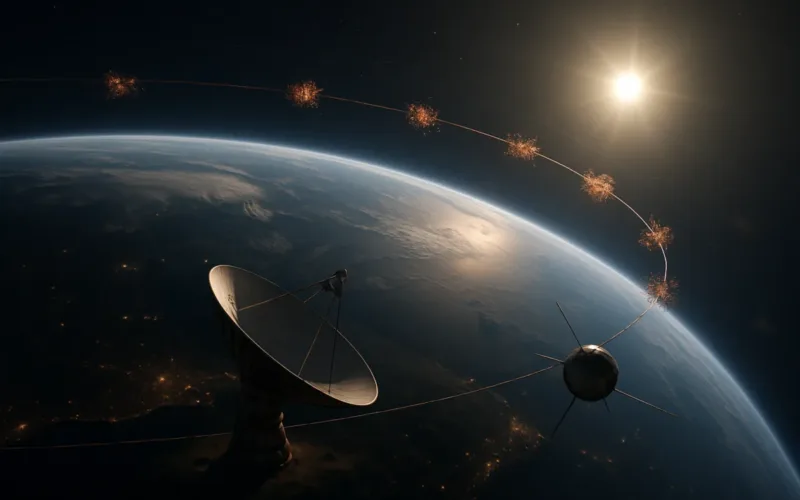
What happens when a leading newspaper publicly ridicules a scientist, only to be proven spectacularly wrong decades later? The New York Times correction 1920 remains a potent example of how journalistic arrogance can harm both people and progress. This episode — a sneering editorial about rockets and a belated three-paragraph apology after Apollo 11 — is more than an amusing historical footnote; it is an argument about responsibility, expertise, and the real costs of ridicule.
The 1920 editorial and the false physics that cost more than pride
In January 1920, an anonymous editorial in a major paper declared that rockets could never work in the vacuum of space because ‘there would be nothing to push against.’ That claim was wrong on its face: Newton’s laws had established the principle of action and reaction centuries earlier. Moreover, Robert Goddard had even demonstrated thrust in a vacuum in his lab.
Yet the editorial did more than misstate physics; it publicly humiliated a scientist by suggesting he ‘lacked the knowledge ladled out daily in high schools.’ The editorial’s tone amplified its error and set a dangerous precedent: when authority mocks expertise, the damage extends beyond embarrassment.
Robert Goddard, rocketry, and the human cost of media ridicule
Goddard was not a crank. He pioneered liquid fuel, gyroscopic stabilization, steering vanes, and fuel pumps — innovations foundational to modern rocketry. When the press ridiculed him, he retreated from public life and became secretive, publishing less and working in isolation.
As a result, many of Goddard’s ideas went underused in the U.S., while foreign engineers studied and adopted his published work. The editorial’s mockery arguably slowed the pace of American rocketry by discouraging collaboration and openness at a critical time.
Therefore: ridicule has practical consequences
Beyond personal harm, the editorial illustrates a systemic problem: media-driven dismissals can chill innovation. When respected outlets substitute ridicule for rigorous critique, talented practitioners may stop sharing their work, to the detriment of scientific progress.
Forty-nine years later: a three-paragraph correction and an embarrassing timing
On July 17, 1969, the Times published a terse ‘A Correction’ that acknowledged rockets could function in a vacuum. The apology quoted the original 1920 piece, then dryly noted that later investigation and experimentation confirmed the physics, ending with ‘The Times regrets the error.’ The wording and timing — the day after Apollo 11 lifted off — made the correction famous for its understatement.
Ironically, the piece never mentions that a crewed Apollo mission was underway as the correction ran. The omission deepens the lesson: institutions may take a long time to admit mistakes, and when they do, the apology may feel performative rather than responsible.
Why the Times episode still matters for modern media accountability
Fast forward to today: digital platforms amplify assertions and mockery at unprecedented speed. The same dynamics that silenced Goddard can operate now, but on a far broader scale. When influential voices deride new ideas without understanding them, the consequences are magnified.
Moreover, the case shows that expertise cannot be judged by tone alone. A loud dismissal is not evidence; reproducible experiments and peer review are. Those are the standards journalism should respect when covering science and technology.
Additionally, institutional trust is fragile
Readers trust major outlets to check facts and avoid gratuitous insult. When a highly visible editorial behaves otherwise, trust erodes. Restoring that trust requires more than a brief correction — it requires transparent processes for fact-checking, corrections, and accountability.
Arguing for a better editorial ethic: humility, verification, and reparative action
First, editors should adopt humility as a public principle. Humility does not mean never taking a position; it means recognizing where expertise sits and deferring to it. That includes consulting qualified scientists before publishing confident dismissals of technical claims.
Second, verification must be prioritized. Before ridiculing a novel idea, a newsroom should attempt to verify the claim or at least present dissenting views from appropriate experts. Speculation framed as certainty is the root of many public errors.
Furthermore: corrections should match the scale of the error
A short buried paragraph weeks or decades later is not reparative when reputations and careers were damaged. News organizations should develop correction policies that consider impact, prominence, and the need for public remediation.
How the Goddard story reshapes our view of scientific progress and cultural gatekeeping
Some historians argue the paper’s mockery cost decades of progress; others caution against simplistic counterfactuals. Either way, the episode highlights how cultural gatekeepers — editors, columnists, influencers — exercise power over which ideas receive attention and which are marginalized.
When gatekeepers lazy-apply common-sense metaphors to technical problems, they can misinform rather than illuminate. Rockets are a clear example: the ‘you need something to push against’ intuition is familiar, but physics operates beyond everyday metaphors.
On the other hand, experimentation resolves disputes
Goddard conducted experiments that spoke louder than editorials. Practical demonstration, peer review, and reproducibility are the antidotes to rhetorical dismissal. The Apollo era finally made the abstract tangible for the public, but scientists had been making that case in quieter ways for decades.
Practical steps for journalists, scientists, and readers
Journalists should build routine scientist consults into coverage on technical topics. That means creating beats or partnerships where reporters can quickly access qualified experts and clear up misunderstandings before publishing.
Scientists, for their part, can be more proactive about public outreach. Sharing experiments, open data, and simple demonstrations reduces the chance that complex ideas are misrepresented by metaphor or mockery.
Finally, readers have agency
Readers should demand accountability: look for corrections, ask whether controversial claims were vetted, and favor outlets that transparently document errors and remedial actions. Collective scrutiny raises the cost of sloppy dismissal.
Why this matters beyond a single historical embarrassment
The story of the Times and Goddard is not a quaint lesson in journalistic fallibility. It is a template for what goes wrong when confident institutions mock unproven ideas without due diligence. In fields from biotech to climate science to artificial intelligence, the social cost of premature ridicule can be measured in lost opportunities, slowed innovation, and demoralized experts.
Moreover, the cultural habit of equating confidence with correctness is dangerous. A loud, polished voice can sway audiences even when it lacks substance. The antidote is institutional humility and procedural rigor that privileges evidence over swagger.
Ultimately, the 1920 editorial and the 1969 correction teach a sustained lesson: experiments and evidence outlast snarky headlines. If we want faster, safer progress, the rule should be simple — check the physics, consult the experts, and correct transparently when wrong. That approach protects both truth and the people who pursue it, and it ensures that the next generation of innovators won’t be silenced by the very platforms meant to inform them.

Dr. Morgan directed the Archives Program from 2014 to 2017, gaining extensive experience in research documentation, information management, and the preservation of scholarly resources. Throughout her career, she has worked closely with academic publications and research materials, developing expertise in evaluating scientific sources and communicating complex topics to broad audiences.
Her primary areas of specialization include scientific publishing, research communication, editorial review, and the translation of technical research into accessible educational content. She has contributed to projects involving space science, astronomy, environmental science, history, archaeology, and emerging scientific discoveries, always emphasizing accuracy, transparency, and the responsible presentation of evidence.
As Editorial Director of Muskurahat.us, Dr. Morgan leads the editorial review process for scientific articles, ensuring that content is based on reputable sources, peer-reviewed research whenever available, and publications from recognized universities, research institutions, and international scientific organizations.
She is committed to promoting scientific literacy through clear, engaging, and well-documented articles that help readers better understand scientific discoveries and their impact on society. Her editorial philosophy is founded on accuracy, intellectual integrity, independent journalism, and continuous learning as scientific knowledge evolves.
Through her work at Muskurahat.us, Dr. Morgan supports the publication of trustworthy scientific content that makes complex research accessible to readers around the world while maintaining rigorous editorial standards.