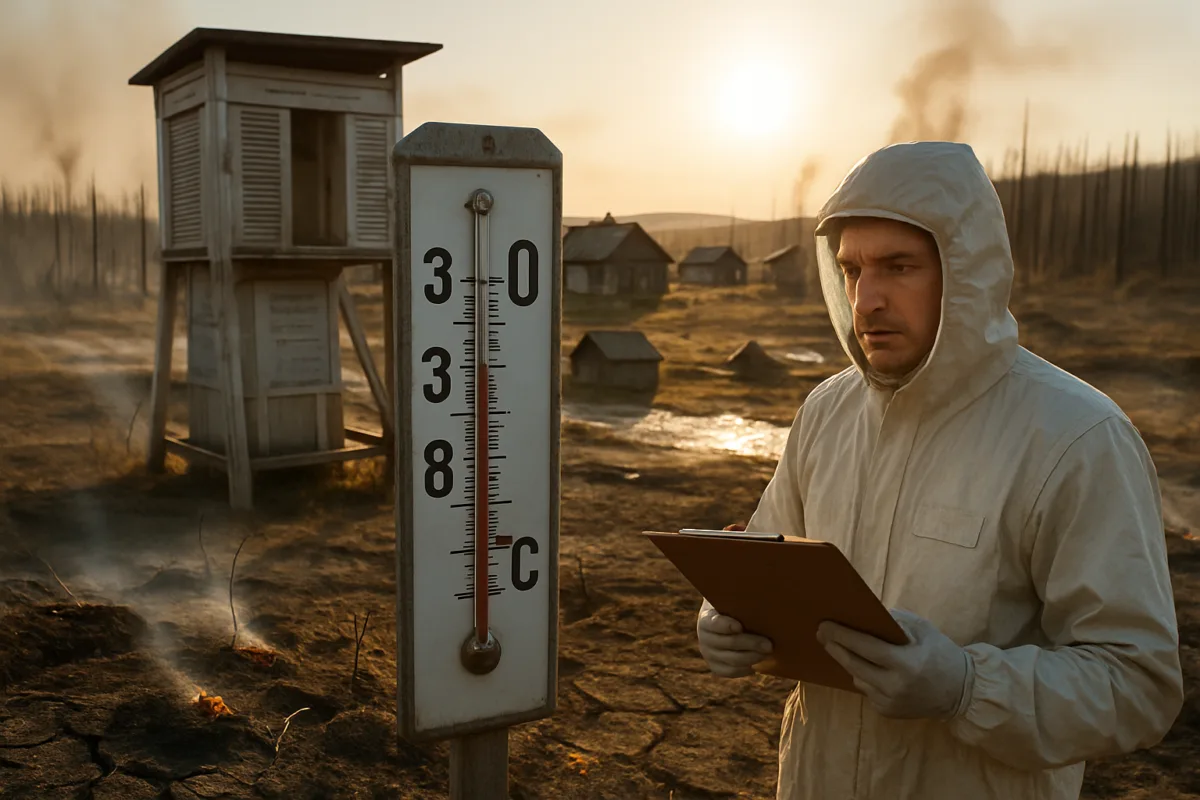
The Arctic temperature record set in Verkhoyansk — a staggering 38°C in June 2020 — is not just an oddity in meteorological archives; it is a pivotal piece of evidence in the debate over human-driven climate change and Arctic vulnerability. This single reading, verified by the WMO, grabbed headlines because the same town also logged roughly −67.8°C more than a century earlier, making Verkhoyansk the holder of the largest recorded temperature range on Earth. That contrast forces a hard question: can we treat extremes like curiosities when they foreshadow systemic risk?
Why the Verkhoyansk Arctic temperature record matters for policy
The verification of a 38°C day north of the Arctic Circle is more than a new entry in a database. It demonstrates how rapidly and unevenly the planet is changing, with local consequences that cascade into global impacts. Moreover, the WMO’s decision to create a new archive category for temperatures at or north of 66.5° latitude signals institutional recognition that these extremes are becoming a distinct phenomenon that deserves targeted attention.
Given that the Arctic controls unique climate feedbacks — from permafrost carbon release to changes in albedo — a single extreme temperature event should shift how policymakers prioritize mitigation and adaptation. Therefore, arguing that this is merely an isolated anomaly ignores both the meteorological context and the human influence teased out by attribution studies.
Meteorology and the Siberian heatwave: what actually happened
To understand the significance of the 38°C reading, we must look at the synoptic setup that produced it. A blocking pattern in early June 2020 stalled the subpolar jet stream, leaving a persistent high-pressure ridge over eastern Siberia. That ridge funneled tropical air northward and combined with an unusually long, dry spell to elevate temperatures substantially above the 1960–2010 norm.
In practical terms, a stationary anticyclone reduced cloud cover and rainfall for weeks, letting solar radiation heat a landscape normally buffered by cold soils and moisture. The result was not only a record daily maximum but a multi-week anomaly: regional mean temperatures ran more than ten degrees above normal at times. This is relevant because climate extremes are typically not the result of single causes; they are the product of atmospheric patterns amplified by global warming.
What attribution science tells us about human influence
Attribution research provides a caution and a verdict at once. A rapid study published in Climatic Change analyzed the January–June 2020 warm anomaly across Siberia and found that human influence made that six-month event many times more likely — by factors ranging from hundreds to tens of thousands. In other words, the regional warm spell would have been virtually impossible in the climate of 1900.
Turning to the 38°C single-day reading, the statistics get noisier because daily maxima at a single station are more variable. The researchers therefore express lower confidence in probability estimates for that solitary extreme, but they do estimate that human-driven warming increased the hottest June day at Verkhoyansk by roughly 1 to 1.5°C. So while natural variability shaped the immediate weather pattern, anthropogenic climate change elevated its intensity.
Why that distinction matters for decisions
Policy responses differ depending on whether extremes are framed as rare, natural events or as amplified symptoms of systemic warming. If the latter is accepted, then investment priorities must shift toward emission reductions and Arctic-specific adaptation measures. Conversely, if extremes are dismissed as one-off anomalies, infrastructure, emergency response, and mitigation will likely remain underfunded.
Real-world consequences: fires, permafrost, and infrastructure failure
The 38°C headline understates the season’s broader damage. Dry, persistent heat turned boreal forests into tinder: by late June 2020, Siberian burned area estimates reached roughly 7,900 square miles. These fires released tens of megatons of carbon in a matter of weeks, contributing to atmospheric greenhouse gases and forming smoke plumes that degraded air quality across large regions.
At the same time, permafrost thaw manifested in acute local disasters. In May 2020, a fuel storage tank near Norilsk collapsed after permafrost that had supported it melted, releasing significant quantities of diesel into a river. This incident showed how warming soils can instantly convert long-term infrastructure into environmental hazards.
The greater temperature range: a moving target
Verkhoyansk’s dual records of −67.8°C and 38°C make for a striking headline, but that contrast also reveals a temporal asymmetry. The cold record dates back to the late nineteenth century and is a fixed historical observation. The warm extreme, by contrast, is recent and vulnerable to further upward movement. Climate projections suggest that similarly rare hot spells in Siberia could be roughly 2°C warmer by mid-century.
Consequently, what appears as a static record — the largest temperature range on Earth — is actually a time-evolving metric. If Arctic summers warm further, Verkhoyansk’s range will only grow, shifting the baseline for what we consider “extreme.” That puts the focus squarely on the need for dynamic risk assessment rather than static assumptions about past norms.
Transitional perspective: what this means for global climate discourse
Furthermore, this shifting baseline undermines complacency in global climate discourse. Regions once considered immune to heat extremes now face novel combinations of fire, drought, and infrastructure collapse. As a result, adaptation strategies developed for past climates will be insufficient unless they account for accelerating change and rising variance in temperature extremes.
Arguments for immediate, targeted action
Because attribution science points to a clear human fingerprint on the intensity of the event, the most defensible policy position is proactive mitigation coupled with Arctic-specific adaptation. First, accelerating reductions in greenhouse gas emissions will reduce the magnitude and frequency of such extremes over the long term. Second, immediate adaptation measures — permafrost monitoring, resilient infrastructure design, expanded firefighting capacity, and local early-warning systems — can limit human and environmental harm today.
In addition, international cooperation is essential. The Arctic’s feedbacks affect global systems, and emissions from boreal fires are not confined to national borders. Therefore, policies that treat the Arctic as a local concern will fail to prevent downstream consequences elsewhere.
Practical policy levers
Governments and organizations should prioritize robust permafrost mapping, mandatory climate-proofing standards for Arctic infrastructure, and increased funding for rapid attribution research. Such measures will give communities a better chance of anticipating and responding to heat- and thaw-driven hazards. Moreover, investing in local capacity for firefighting and emergency response will reduce the immediate toll of future heat-amplified fire seasons.
Addressing skepticism responsibly
Some critics will point to the variability inherent in weather and argue that a single extreme should not drive policy. That is a reasonable caution, but it becomes less tenable when extremes are embedded in a pattern of changed averages and increased variance. The combination of persistent regional warmth, extended drought, unprecedented fire activity, and infrastructure failures makes the case for action more compelling.
Therefore, skepticism should be met with rigorous science — not delay. Rapid attribution studies, long-term observational records like that from Verkhoyansk, and climate model projections together provide the evidentiary basis for policy. Ignoring those lines of evidence amounts to willful neglect of foreseeable risk.
What communities and decision-makers can do now
Local governments should expand monitoring networks and integrate permafrost dynamics into building codes. At the national level, prioritizing emissions reductions and funding adaptation science are logical next steps. Internationally, Arctic-focused cooperative agreements can help share data, resources, and best practices for dealing with the complex mixture of heat, thaw, and fire risk.
Citizens and NGOs also have roles: advocacy for stronger climate targets, support for research organizations, and pressure on industries that accelerate warming are all practical levers. Ultimately, if Verkhoyansk’s 38°C day teaches us anything, it is that the costs of inaction are already materializing and will compound unless addressed.
Verkhoyansk’s record is not only an extraordinary meteorological footnote but a clear signal that extremes are intensifying in a warming world. The evidence suggests human influence has intensified the event and will likely make future extremes more severe. Acting on that reality means combining rapid emission cuts with targeted adaptation for Arctic regions — measures that protect people, ecosystems, and infrastructure now while reducing the risk of worse outcomes later. Policymakers, scientists, and communities should treat this record as an actionable alarm rather than a curiosity, because timely investments in resilience and mitigation will reduce harm and unlock co-benefits for health, security, and the environment.

Dr. Morgan directed the Archives Program from 2014 to 2017, gaining extensive experience in research documentation, information management, and the preservation of scholarly resources. Throughout her career, she has worked closely with academic publications and research materials, developing expertise in evaluating scientific sources and communicating complex topics to broad audiences.
Her primary areas of specialization include scientific publishing, research communication, editorial review, and the translation of technical research into accessible educational content. She has contributed to projects involving space science, astronomy, environmental science, history, archaeology, and emerging scientific discoveries, always emphasizing accuracy, transparency, and the responsible presentation of evidence.
As Editorial Director of Muskurahat.us, Dr. Morgan leads the editorial review process for scientific articles, ensuring that content is based on reputable sources, peer-reviewed research whenever available, and publications from recognized universities, research institutions, and international scientific organizations.
She is committed to promoting scientific literacy through clear, engaging, and well-documented articles that help readers better understand scientific discoveries and their impact on society. Her editorial philosophy is founded on accuracy, intellectual integrity, independent journalism, and continuous learning as scientific knowledge evolves.
Through her work at Muskurahat.us, Dr. Morgan supports the publication of trustworthy scientific content that makes complex research accessible to readers around the world while maintaining rigorous editorial standards.