The Ames impact has been pushed forward by about 100 million years to roughly 370 million years ago, and that simple revision demands a serious rethink of both deep-time extinction causes and modern resource narratives. This recalibration — from an Ordovician classification to a Late Devonian age — places the buried Ames crater tantalizingly close to the Frasnian-Famennian mass extinction and forces geoscientists to ask whether an extraterrestrial blow helped tip ancient seas into collapse. The stakes are scientific and practical: the new radiometric evidence is precise, but interpretation is not automatic.
How zircon dating overturned the old Ames crater timeline
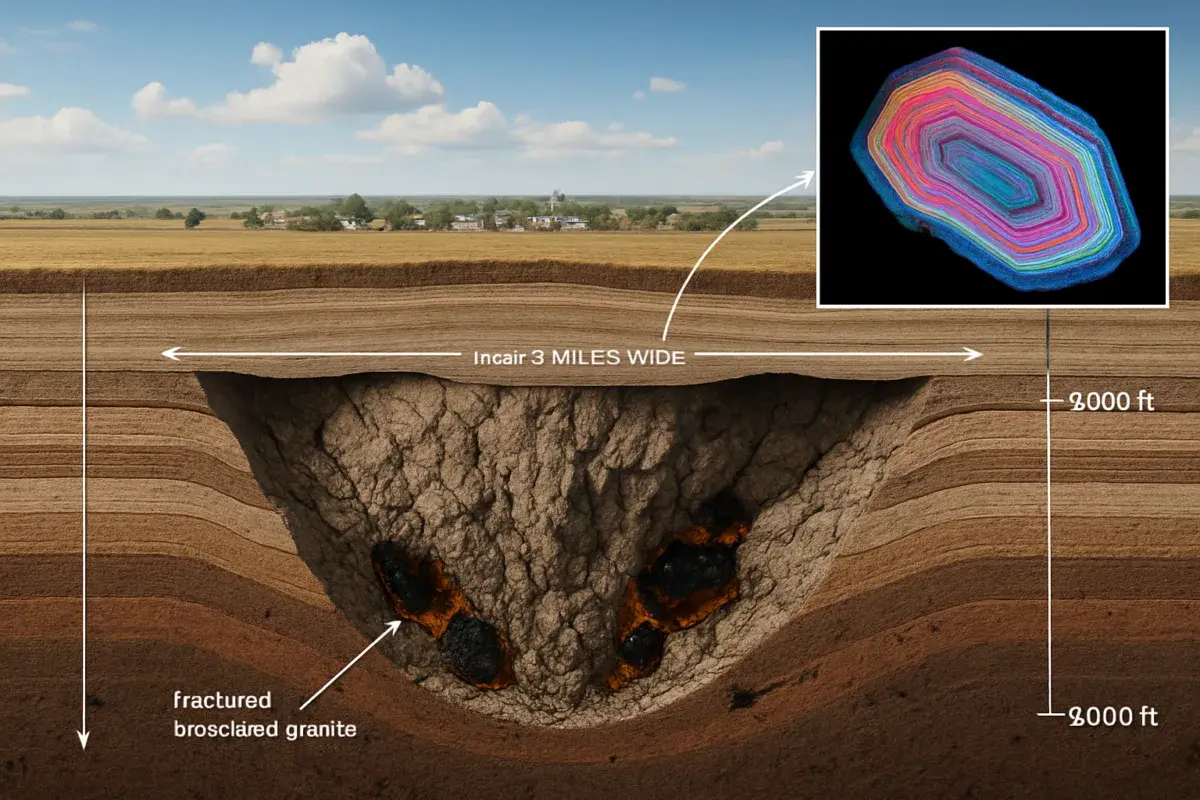
Direct uranium-lead dating of zircon crystals extracted from the impacted granite is the turning point. Using two independent techniques — laser ablation and ion-beam methods — researchers dated zircons that show recrystallization and shock signatures consistent with an impact event, producing a Late Devonian age near 370 million years.
Moreover, imaging approaches such as cathodoluminescence and electron backscatter diffraction revealed microstructures in the zircons that are diagnostic of shock metamorphism. Consequently, the team had strong internal consistency across analytical methods, which strengthens the argument that the zircons actually record the event rather than pre-existing, unrelated mineral ages.
Why shifting Ames into the Late Devonian matters for mass extinction theory
The Late Devonian interval, particularly the Frasnian-Famennian boundary at about 372 million years ago, is characterized by a series of devastating losses among marine organisms. Placing Ames at roughly 370 million years resurrects a plausible temporal overlap between an impact and this extinction episode — a connection that had not been seriously entertained when Ames was thought to be Ordovician.
That proximity is not proof of causation, but it changes the null hypothesis. Instead of treating impacts and extinction as unrelated in this case, researchers must now consider impact-driven environmental perturbations as a viable hypothesis worth rigorous testing.
The limits of biochronology in impact contexts
Previously, the Ames structure was tied to the Ordovician via conodont teeth found in site sediments. Yet these microfossils may have been reworked and mixed into the impact deposit from older strata, undermining their reliability for dating the event itself. In short, biochronological markers are powerful but vulnerable to stratigraphic reworking — a common complication at high-energy impact sites.
Therefore, the insistence on direct radiometric ages from shocked minerals represents a methodological pivot that should be standard practice when possible. This isn’t academic hairsplitting: misdating an impact can propagate incorrect correlations across continents and skew interpretations of Earth’s crisis events.
Impact versus internal drivers: revisiting the extinction causation debate
For decades, the Devonian extinctions have been attributed to internal Earth processes — massive volcanism, prolonged anoxia, and sea-level changes. Those mechanisms remain plausible and well-supported in certain respects, but introducing a chronologically coeval impact complicates the narrative in an intellectually productive way.
Specifically, an impact could have delivered a short, severe pulse of environmental stress: dust and aerosols that dim sunlight, regional wildfires, acid rain, or ocean mixing that exacerbated anoxia. When combined with existing volcanic or climatic stresses, such an event might have acted as the final nudge toward large-scale biotic turnover.
What would prove an impact-extinction link?
To move from hypothesis to causation, scientists need multidisciplinary, geographically widespread evidence. Useful lines of proof include finding impact ejecta, spherules, or shocked minerals directly within Late Devonian marine strata, discovering other coeval craters, and identifying global geochemical anomalies such as elevated iridium or mercury spikes tied to the time of extinction.
Until these data accumulate, the Ames impact remains a compelling possibility — a missing piece that deserves targeted fieldwork rather than premature inclusion in extinction dogma.
Practical consequences: why the new age matters for petroleum geology
The Ames astrobleme is not just a paleoscientific curiosity; it is an active oil and gas producer, buried under roughly 9,000 feet of sediment and spanning more than eight miles. Thus, refining its age and formation history matters for reservoir modeling, basin evolution studies, and exploration strategies. Impact structures often create complex structural traps and enhance porosity through fracturing and brecciation, making them prime hydrocarbon targets.
Consequently, accurate geochronology can change subsurface models that guide drilling and reservoir management. If the impact occurred in the Late Devonian rather than the Ordovician, sedimentation rates, burial histories, and thermal maturation models for the overlying strata may need revision.
Methodological lessons for impact science and geochronology
There is a clear takeaway: where possible, direct dating of impacted lithologies should be prioritized over indirect biochronological inferences. Zircon is exceptionally useful here because it tolerates high temperatures and preserves shock microstructures that can be imaged and interpreted. That durability makes zircon U-Pb dating the gold standard for constraining the timing of impact events.
Furthermore, collaborative access to industry cores — like those that originally revealed Ames’ hydrocarbon potential — should be a research priority. These datasets are often the only route to deeply buried impact structures and can transform regional stratigraphic frameworks when made available.
What researchers should do next to test the Devonian link
First, targeted field campaigns should seek impact-related material in Late Devonian sedimentary sequences across North America and beyond. This means systematic sampling for shocked minerals, microspherules, and geochemical markers at stratigraphically constrained horizons. Second, other purported Ordovician-age craters merit re-examination with the same rigorous zircon-based approaches used at Ames.
Moreover, integrating multidisciplinary data — paleontological turnover timing, geochemical proxies for anoxia and volcanism, and high-precision radiometric dates — is essential. Funding agencies and academic consortia should prioritize coordinated programs that link impact chronologies to extinction models rather than treating them as separate specialties.
Policy and stakeholder implications
Policy-makers and industry stakeholders should care because accurate geologic timelines inform resource management, risk assessment, and educational outreach. For energy companies, a refined age helps calibrate subsidence and maturation models. For governments and museums, it informs stewardship of scientific heritage and public understanding of Earth history.
Therefore, mechanisms for data sharing between industry, academic institutions, and government surveys should be strengthened. This would accelerate discovery and reduce redundant sampling efforts while respecting proprietary concerns.
Honoring the work and the people behind the discovery
The project that re-dated Ames traces back to graduate research and collaborative lab work. Andrew Parisi, who collected the core and helped extract the zircons, and co-author Michael Brookfield have since passed away. Their contributions underscore that major scientific advances often rest on painstaking fieldwork and the commitment of individuals whose names appear in the methods rather than headlines.
Respecting those contributions means making datasets and samples available for reanalysis and follow-up studies, and ensuring that future researchers can build on their foundational work rather than having to replicate it from scratch.
Why this single re-date matters beyond one crater
Re-dating Ames is not only about one isolated astrobleme; it exposes a broader vulnerability in how the geoscience community correlates events across deep time. Misassignments can propagate through literature and affect large-scale syntheses of Earth history. Once corrected, however, they open new research pathways and sharpen the questions scientists can ask about causation, timing, and mechanism.
Accordingly, the Ames story is a call to action: prioritize direct dating where possible, integrate datasets across disciplines, and treat new, robust dates as opportunities to reassess long-held views rather than as mere footnotes.
Ultimately, the revised age of the Ames impact reframes a familiar landscape of hypotheses into a narrower, testable set of possibilities. By focusing fieldwork, geochemistry, and modeling on the Late Devonian window and by sharing industry cores and high-resolution dates, researchers can move from provocative suggestion to demonstrable connection — or rule it out with confidence. Either result advances our understanding of how Earth’s biosphere responds to shocks, and that outcome is of real significance to both science and society.

Dr. Morgan directed the Archives Program from 2014 to 2017, gaining extensive experience in research documentation, information management, and the preservation of scholarly resources. Throughout her career, she has worked closely with academic publications and research materials, developing expertise in evaluating scientific sources and communicating complex topics to broad audiences.
Her primary areas of specialization include scientific publishing, research communication, editorial review, and the translation of technical research into accessible educational content. She has contributed to projects involving space science, astronomy, environmental science, history, archaeology, and emerging scientific discoveries, always emphasizing accuracy, transparency, and the responsible presentation of evidence.
As Editorial Director of Muskurahat.us, Dr. Morgan leads the editorial review process for scientific articles, ensuring that content is based on reputable sources, peer-reviewed research whenever available, and publications from recognized universities, research institutions, and international scientific organizations.
She is committed to promoting scientific literacy through clear, engaging, and well-documented articles that help readers better understand scientific discoveries and their impact on society. Her editorial philosophy is founded on accuracy, intellectual integrity, independent journalism, and continuous learning as scientific knowledge evolves.
Through her work at Muskurahat.us, Dr. Morgan supports the publication of trustworthy scientific content that makes complex research accessible to readers around the world while maintaining rigorous editorial standards.