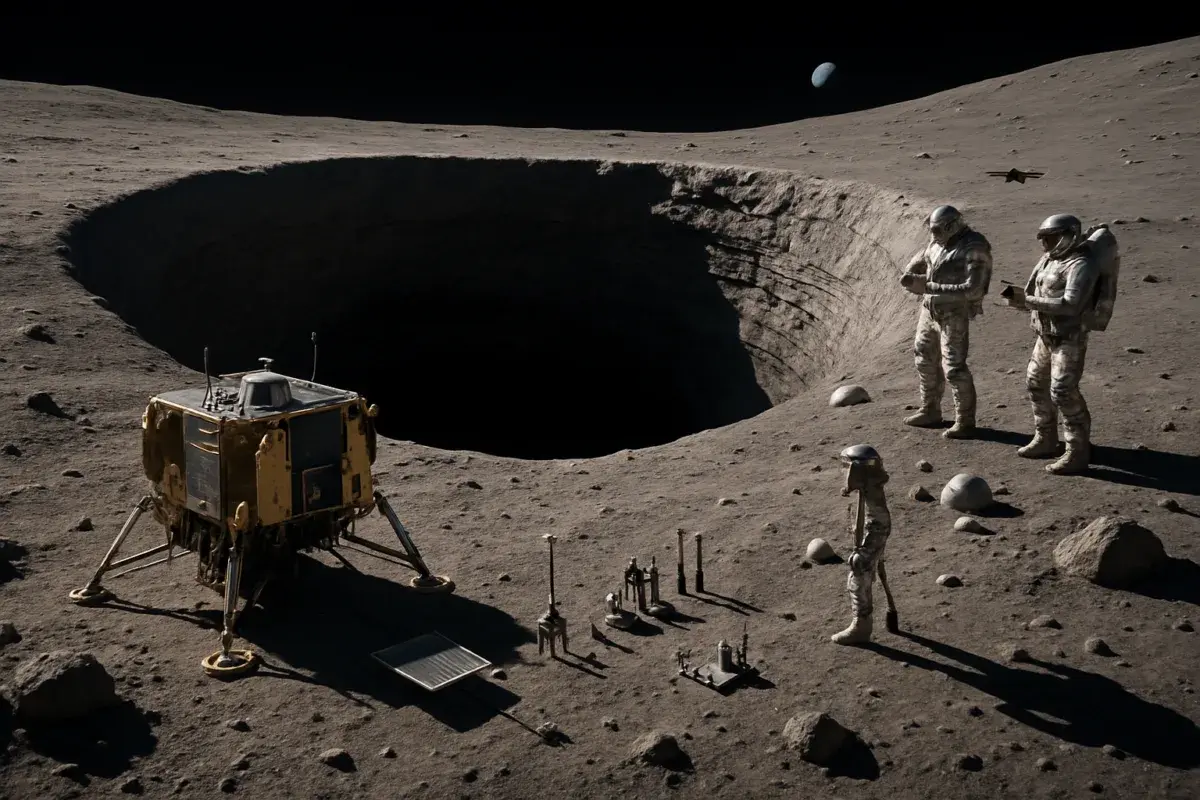
The Marius Hills Pit lava tube hypothesis is no longer just a tantalizing theory; it is a testable target. NASA’s selection of the GIMLI geophysical suite to probe beneath the Marius Hills Pit brings the prospect of natural moon shelters from radiation, micrometeoroids and extreme temperatures into sharp focus. Early confirmation or refutation will reshape how engineers and planners design a sustainable presence on the Moon.
Why the Marius Hills Pit lava tube matters for lunar habitats
Few discoveries would alter human plans for lunar bases more than finding a viable lava tube at Marius Hills. Lava tubes promise thermal stability, shielding from ionizing radiation and protection against micrometeoroid impacts—threats that otherwise require heavy, expensive shielding. Therefore, validating whether the pit opens into a larger void could redirect investments from surface-built habitats to adapted subterranean shelters.
Moreover, the geological exposure provided by pit walls could accelerate scientific understanding of lunar volcanism and stratigraphy. For these reasons, the stakes of GIMLI’s mission extend beyond academic curiosity to immediate engineering and policy decisions.
GIMLI instruments: ground-penetrating radar, seismic and gravity for lava tube detection
GIMLI combines ground-penetrating radar, an active-source seismic system, a gravimeter and high-resolution cameras to probe the subsurface. Each instrument is tailored to detect the signature of void space in a different physical domain: electromagnetic, acoustic and mass distribution. Put together, these data sets can converge on a robust interpretation.
Specifically, the radar—supplied by the Norwegian Space Agency—is expected to produce strong reflections at the interface between rock and vacuum if a lava tube exists. Likewise, the seismic source from Honeybee Robotics should show reflected and refracted waves around any cavity, while the gravimeter would detect a localized negative gravity anomaly where dense rock is missing. If the instruments corroborate each other, the combined evidence will be compelling.
Translating instrument responses into confidence
It is not enough to record anomalies; interpretation matters. Ground-penetrating radar can produce ambiguous echoes in fractured or layered rock. Seismic waves can be scattered by heterogeneities that mimic void signatures. Gravity anomalies require careful modeling to exclude alternative mass deficits. Consequently, the argument for a lava tube must rest on convergent multi-instrument evidence rather than on any single measurement.
Furthermore, calibration and on-site control experiments will be essential. For example, repeated traverses over the same profile and cross-validation between methods will reduce false positives. Thus, GIMLI’s strength is its multidisciplinary approach, which mitigates the interpretative weaknesses of isolated techniques.
Scientific implications: volcanic history and resource potential of lunar pits
Beyond habitat considerations, confirming a lava tube at the Marius Hills Pit would rewrite portions of lunar volcanology. Pit walls expose layered outcrops that record eruption sequences and emplacement styles. GIMLI’s cameras are designed to document these layers and help reconstruct the volume and timing of ancient lava flows.
In addition, a connected lava tube could host accessible regolith and mineralogical variations that inform in-situ resource utilization (ISRU). For example, localized deposits of ilmenite or ilmenite-bearing basalts could be easier to access in sheltered contexts, making the case for early ISRU experiments within such cavities.
Engineering challenges to converting a lava tube into a livable shelter
Even if GIMLI confirms a submarine-like void, turning a lava tube into a pressurized habitat is nontrivial. The pit itself features a drop estimated between roughly 34 and 60 meters; practical access will require solutions ranging from aerial drones to elevators. Installing a sealed, pressurized habitat would demand robust walling, sealing of cross-cutting fractures, and reliable airlocks.
Moreover, ensuring long-term habitability inside a lava tube raises issues such as dust control, structural stability, thermal management and human logistics. It is therefore premature to assume a discovered tube eliminates all surface infrastructure needs. Instead, a lava tube would become a complementary asset—and one whose integration will require significant engineering innovation.
Operational design trade-offs
Using a lava tube as a habitat shifts the burden from radiation shielding mass to access and sealing technology. For mission planners, this creates a debate: invest in heavy shielding for surface modules or prioritize deployment of elevators, sealing materials and subterranean air-handling systems. Each path has different cost, launch mass, and technological risk profiles.
Consequently, GIMLI’s results should inform scenario planning rather than provide a single, definitive roadmap. Planners must model multiple contingencies that incorporate both surface and subsurface architectures.
Policy and programmatic implications for the Moon Base effort
GIMLI was selected under NASA’s PRISM program and will fly on a Commercial Lunar Payload Services lander. This choice underscores a broader policy shift toward agile, commercial partnerships for lunar science and infrastructure scouting. If GIMLI yields positive evidence for a lava tube, it will strengthen arguments for commercial-led, iterative reconnaissance missions as a cost-effective pathway to more ambitious bases.
However, the contrary is also true: a null result would be informative by narrowing search areas and refining theories of pit formation. Therefore, policymakers should treat GIMLI as a high-value reconnaissance step that de-risks larger investments, regardless of whether a tube is found.
What to expect from GIMLI and how results will be interpreted
Expect a phased analysis. Initial imagery and radar returns will provide rapid situational awareness: pit geometry, overhangs and near-surface reflectors. Subsequently, seismic and gravity surveys will build a more detailed subsurface model. Cross-checks between datasets will determine the confidence level of any lava tube interpretation.
Moreover, the team will need to publish uncertainty estimates and alternative models. For example, isolated volcanic-tectonic cavities can mimic lava tubes, and mass deficits might reflect porous or fractured materials rather than open voids. Rigorous statistical and geophysical modeling will be central to convincing the broader community.
Null results are still progress
Importantly, a failure to detect a continuous lava tube is not a failure for science. Null results refine hypotheses about pit formation and the prevalence of subsurface cavities. They also help focus follow-on missions on more promising locales, thereby optimizing scarce resources in lunar exploration.
Strategic recommendations for engineers, scientists and policymakers
First, maintain a dual-path strategy that preserves both surface infrastructure options and subterranean contingency plans. Diversification reduces program risk. Second, invest in technology demonstrators for access systems—lightweight elevators, tethered descent vehicles and deployable seals—that could be applicable across multiple pits.
Third, require multidisciplinary data products and open data sharing from GIMLI to enable independent verification and rapid follow-up. Fourth, foster international cooperation: lunar subsurface assets present shared opportunities and risks that benefit from collaborative governance and resource-sharing frameworks.
How GIMLI could change the calculus for human lunar return
If GIMLI confirms an extensive, sealable lava tube, the economics of lunar habitation shift dramatically. Habitat mass requirements could fall, surface launch cadence could relax, and mission durability could increase due to longer-lived shelters. Consequently, plans for sustained human presence would become more feasible and cost-effective.
However, this optimistic scenario should be tempered by realistic engineering timelines and the need for in-situ verification missions. Transformative potential exists, but only if the community pairs discovery with rapid technology maturation and pragmatic operational plans.
Ultimately, GIMLI represents an essential test that will either validate a transformative asset or sharpen our understanding of lunar geology. Either outcome is valuable; the former could accelerate safe, long-term human occupation under the Moon’s surface, while the latter will prevent wasted investments in unsuitable shelters. Therefore, the mission deserves careful support, rigorous analysis, and rapid translation of findings into demonstrator projects that move humanity from theoretical opportunity to practical capability.
For engineers and planners, actionable next steps include designing modular access systems adaptable to varying pit depths, prioritizing materials and seals that work in fractured basalt, and developing rapid, standards-based data products from GIMLI to support international follow-on missions. By treating the GIMLI results as a decisive reconnaissance phase, stakeholders can convert scientific knowledge into concrete infrastructure choices that make lunar habitation safer, more affordable and more sustainable.

Dr. Morgan directed the Archives Program from 2014 to 2017, gaining extensive experience in research documentation, information management, and the preservation of scholarly resources. Throughout her career, she has worked closely with academic publications and research materials, developing expertise in evaluating scientific sources and communicating complex topics to broad audiences.
Her primary areas of specialization include scientific publishing, research communication, editorial review, and the translation of technical research into accessible educational content. She has contributed to projects involving space science, astronomy, environmental science, history, archaeology, and emerging scientific discoveries, always emphasizing accuracy, transparency, and the responsible presentation of evidence.
As Editorial Director of Muskurahat.us, Dr. Morgan leads the editorial review process for scientific articles, ensuring that content is based on reputable sources, peer-reviewed research whenever available, and publications from recognized universities, research institutions, and international scientific organizations.
She is committed to promoting scientific literacy through clear, engaging, and well-documented articles that help readers better understand scientific discoveries and their impact on society. Her editorial philosophy is founded on accuracy, intellectual integrity, independent journalism, and continuous learning as scientific knowledge evolves.
Through her work at Muskurahat.us, Dr. Morgan supports the publication of trustworthy scientific content that makes complex research accessible to readers around the world while maintaining rigorous editorial standards.