Two-handed coordination in microgravity emerged as a clear weak spot in a recent parabolic-flight study: participants maintained timing but lost force and smoothness when gravity vanished. This finding matters not just for experimental neuroscience but for operational tasks on spacecraft and planetary surfaces, because subtle declines in bimanual control can cascade into mission risk. The study’s design, comparing 0g to 0.25g, 0.5g, 0.75g and 1g, offers provocative evidence that partial gravity more closely preserves Earth-like motor control than true weightlessness does.
Why two-handed coordination in altered gravity deserves urgent attention
Astronauts routinely perform complex bimanual tasks—operating panels, handling tools, stabilizing delicate equipment—so any decline in coordinated force can have outsized operational consequences. The study shows that while timing may survive gravity changes, the quality of force production degrades in 0g, which means tasks that require delicate pressure or steady muscle output could become unreliable.
Moreover, this is not only an astronaut problem. The underlying neuroscience of motor control, proprioception, and sensory integration has broad relevance to rehabilitation and human-machine interfaces on Earth. Therefore, dismissing the practical implications of altered gravity effects would be short-sighted.
How parabolic flights recreated five gravity levels and why that matters
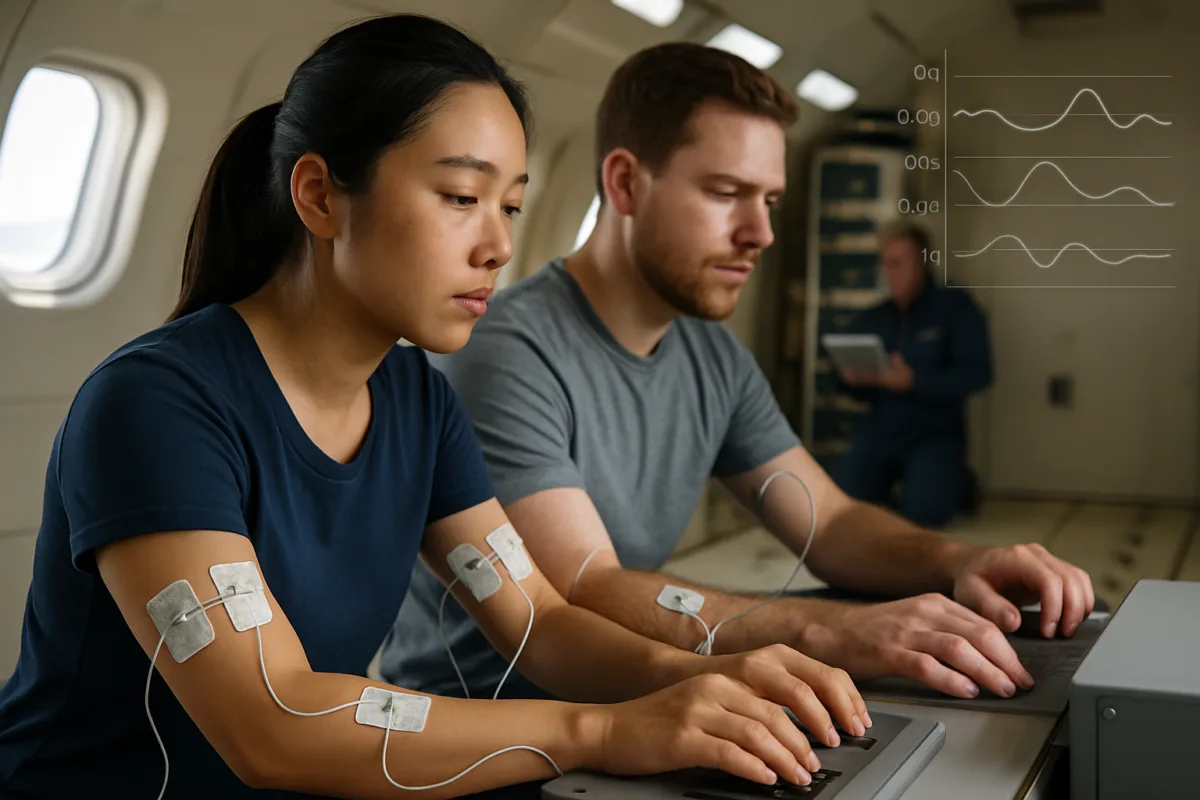
To test motor control across gravity, researchers used parabolic flight arcs to create brief periods at 0g, 0.25g, 0.5g, 0.75g and 1g. These short exposures allow direct study of immediate sensorimotor responses without needing orbital infrastructure. Importantly, testing several intermediate gravity levels reveals whether performance degrades linearly or whether there are thresholds.
Because each arc is brief, participants had to initiate movements quickly—mimicking real operational windows where crews must act promptly after a transition. This immediacy strengthens the study’s relevance: astronauts often need to perform useful work soon after a gravity change, not after weeks of adaptation.
Task design: isometric bimanual force tests
The experiment used isometric two-handed tasks where participants pressed force sensors in rhythmic patterns. A simple 1:1 rhythm required symmetrical pulses, while a harder 1:2 pattern demanded the right hand pulse twice per left-hand pulse. Electromyography (EMG) captured muscle activity, enabling the team to link behavior to potential neural mechanisms.
Such tasks are ideal for isolating force control and coordination without confounds of large limb motion. Consequently, the findings reflect pure changes in force production and shared neural drive rather than kinematic compensations alone.
Zero gravity reduced force and smoothness — an argument for operational caution
The most striking result was that 0g produced lower mean force and reduced harmonicity of force pulses. In other words, participants pressed less strongly and less smoothly during weightlessness, especially in the challenging 1:2 coordination pattern. This matters because precision force control often matters more than timing alone in task success.
Timing largely held up across gravity levels, which might at first seem reassuring. However, accurate timing without smooth or sufficient force can still fail a mission task—for example, when manipulating fragile instruments or docking operations where applied force must be well controlled. Therefore, operational readiness based on timing tests alone would be an incomplete metric.
Why weightlessness disrupts force production
Gravity is not just a load; it is continuous sensory input. The vestibular system, muscle spindles, tendon organs and joint receptors feed the brain a steady stream of information about orientation and loading. Abruptly removing that stream forces the nervous system to revise movement predictions on the fly, reducing the accuracy of force scaling and the smoothness of motor output.
Consequently, weightlessness imposes a dual burden: altered sensory feedback and compressed adaptation time. Together these make precise bimanual force control harder, an argument in favor of designing missions and tasks with that limitation in mind.
Partial gravity preserved Earth-like control — evidence for targeted mission planning
Importantly, the study shows that partial gravity (0.25–0.75g) generally trended toward 1g performance. Even modest downward loading delivered enough proprioceptive cues for muscles and receptors to better guide force production. This suggests that crews working in partial gravity—such as on Mars or in certain lunar scenarios—may retain more usable manual dexterity than in microgravity.
However, the trend is not absolute. Performance did not vary along a perfect linear gradient, which implies task-specific, individual, and time-dependent factors will shape actual outcomes. Even so, the overall tendency supports the argument that designing habitats, suits, and tools to enhance load sensation in partial gravity can materially improve performance.
Implications for Moon (0.16g) and Mars (0.38g)
The experiment did not test the Moon’s exact gravity of 0.16g, but it did sample surrounding levels. Mars’ 0.38g falls within the tested range, and the results suggest Mars surface operations could preserve more Earth-like bimanual control than an orbital microgravity environment. Still, nuances remain: transitions between 0g, cabin gravity, and surface gravity may produce cumulative adaptation demands.
Therefore, mission planners should not assume immediate operational equivalence to Earth just because a surface gravity is partial; training and equipment design still matter.
Muscle signals and the beta band: cautious but compelling neural evidence
EMG analyses revealed decreased shared muscle-signal power in the beta band (13–30 Hz) at 0g, hinting that common neural input to both arms weakened during weightlessness. Beta-frequency activity is often related to steady-state control and coordinated movement, so a reduction could help explain the force-smoothness decline.
Yet this neural finding requires careful interpretation. It arose from exploratory analysis after a mathematical transform, and a traditional coherence test showed no significant gravity effect. Hence, the beta-band result is a promising clue but not definitive proof of a central mechanism.
Why this nuance matters for research and application
The tentative neural result calls for follow-up studies with larger samples, longer exposures, and perhaps more direct neural measures. Until then, engineers and trainers should treat beta-band findings as an informative hypothesis rather than a design prescription.
Nevertheless, linking EMG changes to behavior provides a mechanistic bridge between observed performance declines and potential neural adjustments—an important step toward targeted interventions.
Practical implications: training, tooling and mission design
The evidence argues for three interrelated actions. First, incorporate complex two-handed force tasks into astronaut training under variable-gravity simulations. Repeated exposure could help crews develop new sensorimotor predictions and strategies that minimize the smoothness loss seen in 0g.
Second, design spacecraft controls and surface tools with clear haptic feedback and resistance so that proprioceptive cues remain informative. Tactile cues and force-feedback interfaces can mitigate the sensory loss that accompanies reduced gravitational loading.
Third, plan operational timelines to allow rapid adaptation after gravity transitions. Even modest delays or procedural checklists that acknowledge degraded force control in the first minutes after a change may prevent avoidable errors.
Limitations of the short flight experiment and directions for stronger evidence
Parabolic flights are inherently brief, limiting adaptation time. The nervous system would likely show different patterns after days or weeks in altered gravity. Larger samples and participants of varied experience—including trained astronauts and novices—would reveal how training modifies the observed effects.
Additional work should also test gravity levels closer to the Moon’s 0.16g, extend exposure durations, and use ecologically valid tasks that mirror spacecraft interfaces and surface tools. Such studies would convert initial clues into operationally actionable knowledge.
Research priorities that follow from this study
Prioritize longitudinal exposure experiments, higher-sample neural recordings during extended partial gravity, and interventions that enhance proprioceptive feedback. These efforts would clarify how and when the nervous system rebuilds reliable force control after a gravity shift.
Only with that evidence can mission planners make confident choices about timelines, crew selection, and the design of tactile interfaces for exploration hardware.
Weightlessness exposes a fragile dependency: the human nervous system exploits constant gravitational loading to produce smooth, robust force. The parabolic-flight results make a clear, actionable point—partial gravity generally preserves Earth-like bimanual force control whereas true 0g does not—and thus mission design, training, and tool engineering should be oriented around preserving or simulating load-related sensory cues. Adopting targeted training regimens, enhancing haptic feedback in controls, and allowing short adaptation windows after gravity transitions are practical steps that can reduce risk and improve performance on the Moon, Mars, and beyond.

Dr. Morgan directed the Archives Program from 2014 to 2017, gaining extensive experience in research documentation, information management, and the preservation of scholarly resources. Throughout her career, she has worked closely with academic publications and research materials, developing expertise in evaluating scientific sources and communicating complex topics to broad audiences.
Her primary areas of specialization include scientific publishing, research communication, editorial review, and the translation of technical research into accessible educational content. She has contributed to projects involving space science, astronomy, environmental science, history, archaeology, and emerging scientific discoveries, always emphasizing accuracy, transparency, and the responsible presentation of evidence.
As Editorial Director of Muskurahat.us, Dr. Morgan leads the editorial review process for scientific articles, ensuring that content is based on reputable sources, peer-reviewed research whenever available, and publications from recognized universities, research institutions, and international scientific organizations.
She is committed to promoting scientific literacy through clear, engaging, and well-documented articles that help readers better understand scientific discoveries and their impact on society. Her editorial philosophy is founded on accuracy, intellectual integrity, independent journalism, and continuous learning as scientific knowledge evolves.
Through her work at Muskurahat.us, Dr. Morgan supports the publication of trustworthy scientific content that makes complex research accessible to readers around the world while maintaining rigorous editorial standards.