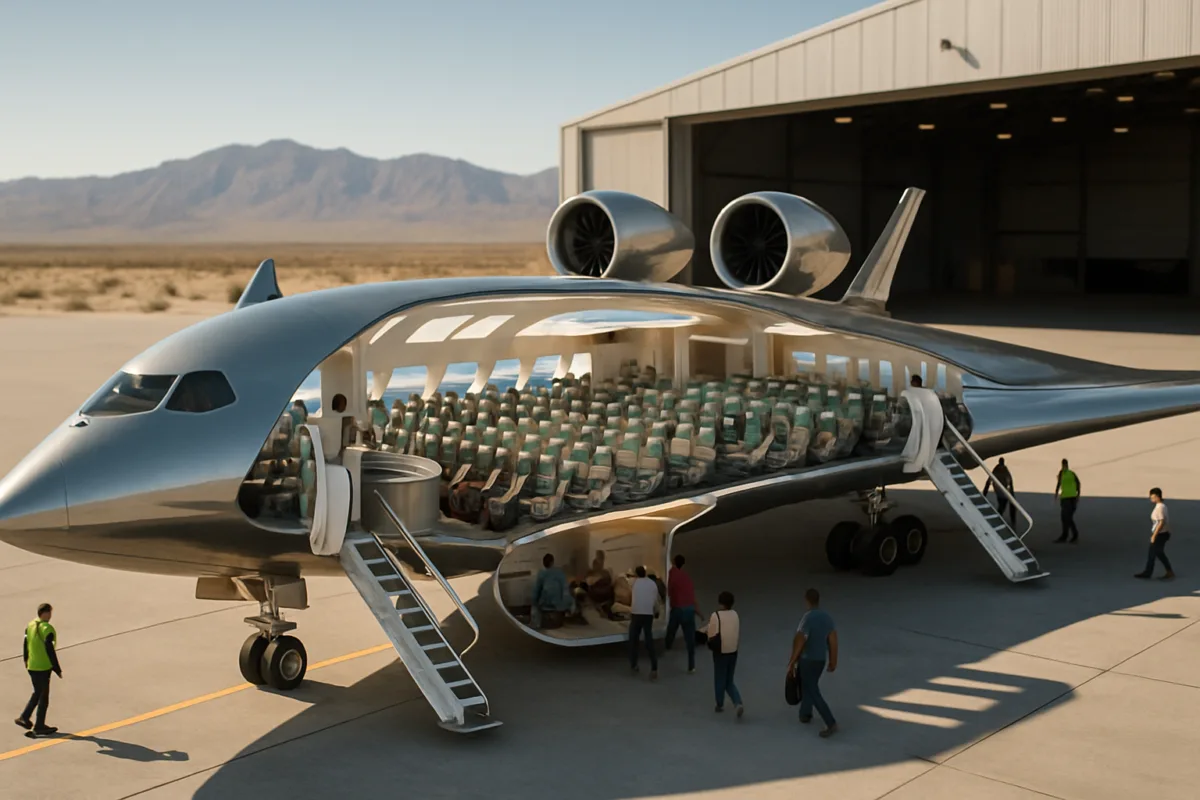
Imagine boarding a 250-seat jet where the cabin feels less like a narrow tube and more like a wide, open lounge. The blended wing body concept, now embodied in JetZero’s Z4 demonstrator, promises exactly that: a radical reshaping of aircraft to squeeze large fuel savings from a design that spreads lift across a wide, manta ray–like body.
Why the blended wing body matters for fuel efficiency and emissions
The primary appeal of a blended wing body aircraft is efficiency. By merging wings and fuselage into a single lifting surface, designers reduce drag and make most of the aircraft contribute to lift rather than act as dead weight.
Consequently, JetZero claims fuel savings of 30 to 50 percent compared with conventional tube-and-wing jets of similar capacity. With fuel representing airlines’ largest operating expense and aviation under growing pressure to cut emissions, those percentages are not a marginal improvement; they are potentially industry changing.
Four aisles and a different passenger geometry
Because the Z4’s body is so wide, its cabin layout rejects the familiar central corridor. Instead, the floor is divided into bays with four parallel aisles, more like a modern cinema than a traditional airliner cabin.
This approach solves a simple geometric problem: you cannot reasonably cram fourteen passengers across a single row and expect them to access one narrow corridor. As a result, the Z4 proposes fewer rows, multiple boarding doors, wider aisles, and more personal overhead storage per passenger.
Implications for boarding, comfort, and interiors
On the positive side, more doors and parallel aisles should speed up boarding and deplaning, cutting turnaround times and improving on-time performance. Wider aisles and dedicated overhead bins could also relieve the chronic crowding that plagues many narrow- and widebody jets today.
However, there are trade-offs. A wide cabin means most seats will not have direct external windows. The design therefore leans on digital displays and skylights to recreate an outside view. For some passengers that could be an acceptable swap; for others, the absence of real windows may intensify anxiety or motion discomfort.
Why airlines and governments are betting on the Z4
Investors, carriers, and the U.S. government have already put meaningful capital and credibility behind JetZero. The U.S. Air Force funded a full-size demonstrator, and airlines such as United have conditional purchase agreements that would total hundreds of aircraft.
Moreover, preliminary federal financing of up to 3 billion dollars indicates that policymakers are willing to back riskier, potentially higher-reward aerodynamic innovations to meet climate and industrial objectives. In short, the Z4 has traction that earlier blended-wing proposals did not.
The engineering and certification challenges are substantive
That said, the physics are not trivial. Studies such as the one from Hamburg University of Applied Sciences question whether the theoretical fuel savings translate cleanly from cargo or military prototypes to full passenger operations.
Certification is another mountain. No regulatory framework currently exists for an airliner of this geometry. Emergency evacuation procedures, ditching behavior, structural crashworthiness, and systems redundancy must be rethought and proven for a four-aisle, highly integrated airframe.
Human factors and passenger physiology
Passengers far from the aircraft centerline will experience different motion cues, which can intensify the sensation of turns and turbulence. This raises human factors issues that aviation medicine and ergonomics teams must address through simulation, cabin layout adjustments, and possibly new seat restraints or damping technologies.
Further, windowless cabins could affect circadian cues and passenger wellbeing, making lighting, visual displays, and cabin climate control part of the critical design brief rather than decorative afterthoughts.
Operational realities: airport gates, logistics, and fleet replacement
Operational adoption is not simply a matter of buying aircraft. Airports, ground handling systems, and gate infrastructure are optimized for tube-and-wing dimensions that have dominated for decades. Wide, flattened bodies with multiple boarding doors may require terminal retrofits and new ground service vehicles.
Airlines will also evaluate fleet commonality. Replacing fleets of 757s and 767s makes sense only if the blended wing body integrates with existing maintenance, pilot training, and route structures. These transition costs will temper how quickly carriers push for adoption even if the fuel math is compelling.
The economic argument: disruptive gains vs incremental risk
Proponents argue that if the Z4 delivers a third or more in fuel savings, the capital expenditure and transition headaches are justified. Lower fuel burn reduces unit costs, supports lower fares or better margins, and accelerates emissions reductions.
Opponents point out that aircraft programs fail for reasons beyond aerodynamic promise. Cost overruns, certification delays, and unforeseen human factors problems can convert a compelling technical case into a commercial failure. The history of aviation is dotted with promising concepts that never scaled.
Why this attempt is different
Three factors make this phase of blended wing development distinct: mature computational tools, substantial airline and government financial backing, and a regulatory environment under pressure to decarbonize. These create a stronger ecosystem for innovation than past attempts enjoyed.
Still, neither computational models nor demonstrators automatically solve the messy realities of passenger acceptance and regulatory approval. The Z4 will need to deliver real-world performance gains, not just renderings and lab results.
What regulators, airlines, and designers must do next
First, regulators should engage early and create modular certification pathways that allow safety cases to be built iteratively. This reduces the risk of late-stage redesigns and gives airlines clearer timelines for fleet planning.
Second, airlines must fund long-duration passenger trials and invest in simulated cabin experiences to understand motion, comfort, and psychological responses to windowless interiors. Data from these programs should inform cabin layout and digital window design.
Third, designers and engineers should prioritize maintainability and retrofit paths for airports. A disruptive airframe that cannot slot into existing ground operations will face prohibitive indirect costs, negating fuel savings.
Why passengers should care now
Passengers are not passive stakeholders in this debate. The success of a blended wing airliner depends on market acceptance as much as engineering triumphs. Early adopters will shape cabin norms: whether passengers accept digital windows, four-aisle boarding, and different motion sensations.
Therefore, airlines and regulators should provide transparent communication and consumer trials so that passengers arrive at gates informed rather than surprised. Clear messaging can turn curiosity into goodwill rather than resistance.
Balancing ambition with realism
The Z4 and blended wing body approach represent an ambitious, arguably necessary shift if aviation is to decarbonize at scale. The potential fuel savings are large enough to justify the risks of experimentation.
At the same time, aviation is a conservative industry for good reason: safety and predictability save lives and billions of dollars. Anyone advocating for the Z4 must therefore pair bold technical claims with conservative, evidence-driven testing and regulatory engagement.
If the demonstrator flying in the Mojave Desert in 2027 meets expectations, then 2030 as an earliest commercial target is plausible. If it does not, the program will provide lessons that can still move the industry forward by refining what works and discarding what does not.
Ultimately, the blended wing body is not a guaranteed revolution, but it is a focused answer to a clear problem: the tube-and-wing architecture has squeezed most of its efficiency out of the old formula. The path forward requires coordinated investment, rigorous human factors research, and staged regulatory frameworks that reward demonstrable performance.
For decision makers and frequent flyers alike, the most practical step is to follow the demonstrator closely, support transparent trials, and demand objective metrics on fuel burn, turnaround time, and passenger wellbeing. Those measures will decide whether the Z4 becomes a transformative airliner or an instructive experiment whose lessons feed the next generation of designs.

Dr. Morgan directed the Archives Program from 2014 to 2017, gaining extensive experience in research documentation, information management, and the preservation of scholarly resources. Throughout her career, she has worked closely with academic publications and research materials, developing expertise in evaluating scientific sources and communicating complex topics to broad audiences.
Her primary areas of specialization include scientific publishing, research communication, editorial review, and the translation of technical research into accessible educational content. She has contributed to projects involving space science, astronomy, environmental science, history, archaeology, and emerging scientific discoveries, always emphasizing accuracy, transparency, and the responsible presentation of evidence.
As Editorial Director of Muskurahat.us, Dr. Morgan leads the editorial review process for scientific articles, ensuring that content is based on reputable sources, peer-reviewed research whenever available, and publications from recognized universities, research institutions, and international scientific organizations.
She is committed to promoting scientific literacy through clear, engaging, and well-documented articles that help readers better understand scientific discoveries and their impact on society. Her editorial philosophy is founded on accuracy, intellectual integrity, independent journalism, and continuous learning as scientific knowledge evolves.
Through her work at Muskurahat.us, Dr. Morgan supports the publication of trustworthy scientific content that makes complex research accessible to readers around the world while maintaining rigorous editorial standards.