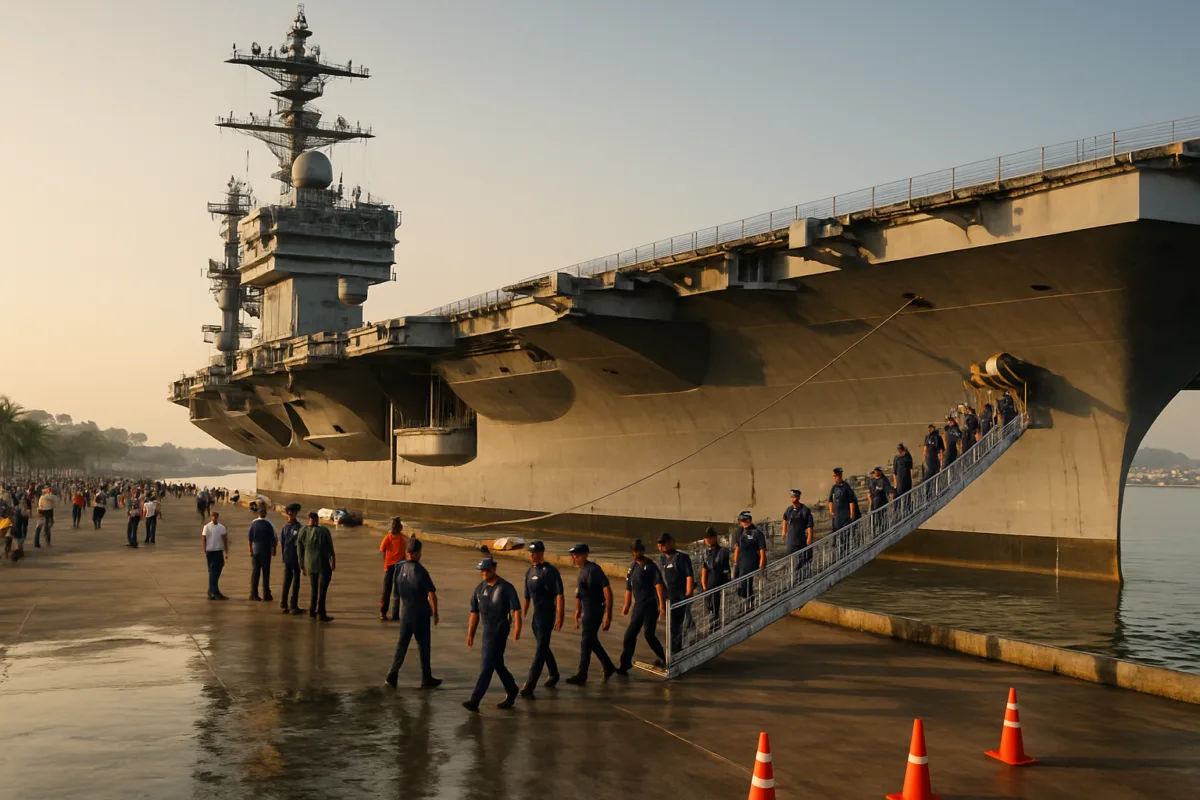
The USS Abraham Lincoln arrived in Laem Chabang on Sept. 2, 2026, and that arrival illustrates why presence matters in modern naval warfare: a Nimitz-class supercarrier does more than project firepower — it projects influence, economic stimulus, and, crucially, a test of discipline. The USS Abraham Lincoln (CVN-72) has been at sea for 285 days and its first extended port call in roughly 200 days puts a spotlight on how carrier operations intersect with local law, public safety, and regional geopolitics.
Why aircraft carrier port calls remain central to naval warfare and diplomacy
Aircraft carriers are not just floating airbases; they are mobile instruments of statecraft. A carrier strike group represents hard power and, when it docks, an opportunity for soft power outreach. The presence of the Abraham Lincoln in Thailand is therefore both a tactical element of US 7th Fleet operations and a calculated diplomatic gesture.
Moreover, in a contested maritime theater such as Southeast Asia, visible deployments signal commitment to allies and deterrence to potential adversaries. The carrier’s arrival communicates that the United States can sustain long deployments and maintain forward presence — a concept intrinsic to modern naval warfare strategy.
Local economic impacts: short-term windfall, long-term expectations
From the perspective of Pattaya’s economy, the carrier’s sailors and Marines create an immediate economic surge. Pop-up beer bars, restaurants, and entertainment venues commonly open to serve thousands of service members on shore leave, providing overdue business for a sluggish tourist season.
Yet this influx raises a normative question: should short-term revenue be prioritized when the social and legal implications are significant? Pattaya’s history as a wartime rest-and-recreation destination illustrates the duality: economic opportunity versus the risk of exacerbating illicit markets.
The math is simple — and compelling
A single carrier visit can generate revenue that offsets months of slow commerce for local businesses. Consequently, municipal leaders will welcome these port calls. At the same time, the transience of the benefit means local authorities must manage spikes in demand without sacrificing public order.
Rules, health, and legal boundaries: navigating Thailand’s regulations
When a U.S. warship docks overseas, the crew is expected to respect host-nation laws. In Thailand, that expectation translates into very specific behavioral constraints. Local officials this time have restricted parasailing, jet-skiing, and other high-risk water sports for safety and to avoid disputes.
Furthermore, Thai law complicates typical tourist behavior: cannabis use requires a medical prescription, vaping is illegal, and lèse-majesté rules carry heavy penalties. These regulations are non-negotiable and underscore that a carrier’s liberty schedule must include rigorous legal and cultural briefings.
Operational discipline as a strategic necessity
Enforcing discipline aboard ship is not merely about good order; it is about preserving strategic relationships. If sailors routinely flout local laws, the goodwill generated by a port visit quickly evaporates and the carrier turns from an asset into a liability.
Managing risks: sex tourism, public safety, and reputational concerns
Pattaya’s reputation for sex tourism presents obvious risks when thousands of uniformed personnel are ashore. Local police increases patrols and enforces curfews — like the 2 a.m. rule on Walking Street — to curb illegal activities and protect both residents and visitors.
Consequently, this port call highlights a decisive argument: presence without proactivity invites problems. The U.S. Navy must anticipate not just accidents and scams, but the broader social dynamics that a sudden influx of military tourists creates.
Preventive measures that actually work
Short-term measures such as staggered liberty, pre-departure briefings, liaison officers, and visible shore patrols reduce incidents. In addition, partnering with local businesses to encourage responsible service — for instance, refusing service to obviously intoxicated patrons — lowers the operational risk for both host communities and the visiting force.
Geopolitical signaling: more than a visit
Beyond the economic and social effects, this visit must be read as part of a broader security architecture. Operating within the US 7th Fleet area of operations, the Abraham Lincoln represents continuity of presence in a region where maritime competition is intensifying.
Moreover, the simultaneous presence of the destroyer USS Frank E. Petersen Jr. in another Thai port enhances the message: this is a coordinated posture, not a single-ship spectacle. For regional partners, such coordination reassures; for strategic competitors, it complicates calculations.
Naval presence and maritime stability
Predictable, law-abiding port calls also strengthen the normative framework around freedom of navigation and cooperative security. If carriers operate with respect and restraint, they sustain long-term access and partner trust — essential elements in naval diplomacy.
Arguments for stricter enforcement and better preparation
The arrival of the Abraham Lincoln invites a policy debate: should the U.S. Navy tighten control over shore leave, or is local flexibility more beneficial? My contention is that stricter enforcement of norms coupled with smarter preparatory measures yields the best strategic payoff.
First, enhanced pre-port cultural and legal briefings must be standardized and backed by accountability mechanisms. Second, naval leadership should expand liaison roles with host cities to design activity lists that are both safe and culturally respectful. These steps reduce friction and protect the carrier’s diplomatic value.
A balanced approach beats blunt instruments
Complete lockdowns or overly punitive measures breed resentment and morale problems. Conversely, lax enforcement risks legal infractions and diplomatic incidents. A balanced approach — clear rules, consistent enforcement, and access to safe options — preserves both mission readiness and civil-military relations.
Actionable recommendations for future carrier port calls in Southeast Asia
Practically speaking, a few policies could be implemented immediately. Require mandatory legal briefings with local law summaries, issue easy-reference pocket cards for prohibited activities, and maintain robust shore patrols with language-capable liaison officers.
Furthermore, invest in local partnerships that create vetted entertainment options near the port. These vetted venues can offer safe, regulated environments where service members spend money without increasing risk to the host community.
Longer-term steps
For sustained strategic benefit, integrate port call planning into broader theater engagement. That means aligning diplomatic outreach, economic exchanges, and cultural programs with carrier visit schedules so that naval presence becomes a predictable, mutually beneficial routine.
In addition, collect and analyze data from each port call — incidents, economic impact, local feedback — to refine policies and demonstrate value to both U.S. commanders and host-nation officials.
Ultimately, the USS Abraham Lincoln’s visit to Thailand is a microcosm of how naval warfare and diplomacy intersect in peacetime. With targeted preparation, disciplined conduct, and genuine partnership with local communities, carrier port calls can remain strategic assets rather than sources of friction. Readers who track naval affairs should therefore watch how the Lincoln’s crew, Thai authorities, and local businesses manage this visit: the lessons learned here will shape how forward presence is executed across Southeast Asia in the years ahead.

Dr. Morgan directed the Archives Program from 2014 to 2017, gaining extensive experience in research documentation, information management, and the preservation of scholarly resources. Throughout her career, she has worked closely with academic publications and research materials, developing expertise in evaluating scientific sources and communicating complex topics to broad audiences.
Her primary areas of specialization include scientific publishing, research communication, editorial review, and the translation of technical research into accessible educational content. She has contributed to projects involving space science, astronomy, environmental science, history, archaeology, and emerging scientific discoveries, always emphasizing accuracy, transparency, and the responsible presentation of evidence.
As Editorial Director of Muskurahat.us, Dr. Morgan leads the editorial review process for scientific articles, ensuring that content is based on reputable sources, peer-reviewed research whenever available, and publications from recognized universities, research institutions, and international scientific organizations.
She is committed to promoting scientific literacy through clear, engaging, and well-documented articles that help readers better understand scientific discoveries and their impact on society. Her editorial philosophy is founded on accuracy, intellectual integrity, independent journalism, and continuous learning as scientific knowledge evolves.
Through her work at Muskurahat.us, Dr. Morgan supports the publication of trustworthy scientific content that makes complex research accessible to readers around the world while maintaining rigorous editorial standards.