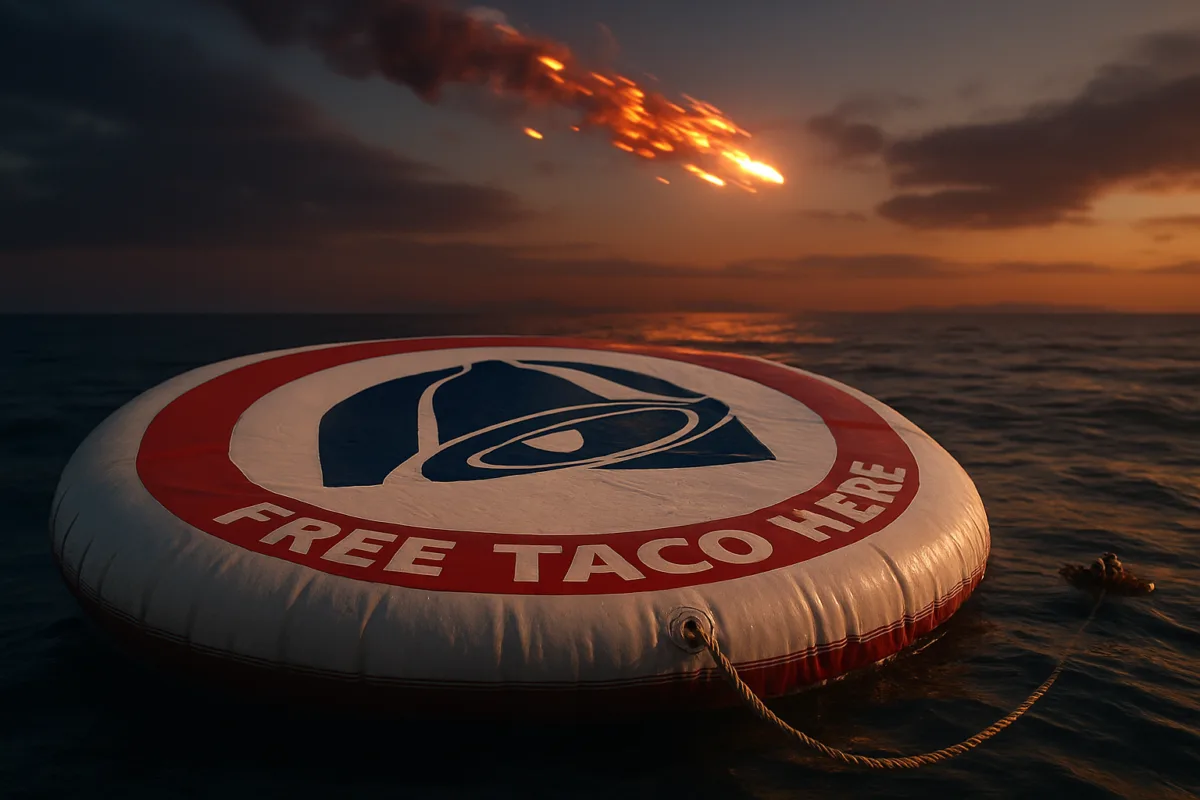
The Taco Bell Mir stunt read like a madcap translation of modern marketing logic: a 40-foot vinyl bullseye anchored in the South Pacific, a promise of a free taco for every American, and the falling Russian space station Mir as the improbable dart. The phrase Taco Bell Mir stunt became shorthand for audacity because the company dangled an eye-popping prize while quietly converting astronomical risk into a modest insurance premium.
Why the stunt grabbed global attention
At first glance this was a publicity stunt in the purest sense: a bold, bizarre act meant to force media coverage. Yet it succeeded not merely because it was strange, but because it tapped into several potent drivers of virality—novelty, stakes, and narrative drama.
Novelty mattered. There was simply no precedent for a fast-food chain staging a bet with a collapsing space station. Stakes mattered too: the promise of a free taco for millions created a symbolic, share-worthy headline. Finally, narrative drama—humanizing a technical event by turning it into a contest—made national newsrooms and social feeds hungry for more.
How prize-indemnity insurance made audacity affordable
Crucially, the stunt relied on prize-indemnity insurance. Taco Bell didn’t actually accept the open-ended liability of providing a taco to every American. Instead, the company retained SCA Promotions to underwrite the improbable payout for a fixed premium.
This matters because it reframes the insurance as the engine of audacity rather than an act of cowardice. By transferring catastrophic but unlikely risk to a specialist insurer, Taco Bell converted a terrifying potential liability into a small, predictable expense—and freed itself to make a headline-grabbing promise.
Risk transfer as strategic leverage
From a strategic perspective, that risk transfer is textbook leverage: for a modest outlay, you can amplify perceived value exponentially. The insurer accepts actuarial odds; the brand accepts the optics. When Mir missed the raft, Taco Bell still cashed in on brand salience while only incurring the limited cost of the premium and the vinyl target.
Moreover, the guarantee of a payout—however unlikely—creates credibility. Audiences are more likely to engage when a company seems willing to bet big, even if that bet is actuarially safe. That psychological payoff is the true explosion of value in prize-indemnity marketing.
Why this was more than a cheap stunt: it was disciplined creativity
It’s easy to dismiss such campaigns as gimmicky. However, the Taco Bell maneuver displays disciplined creativity: the brand linked itself to a genuine news event, structured the promise to be newsworthy, and mitigated financial exposure through professional underwriting.
Discipline comes from controls—clear terms, contingency plans, and fallback promotions. When Mir splintered and missed the raft, Taco Bell launched a consolation two-for-99-cents offer. The brand didn’t flounder; it executed Plan B and preserved momentum. That kind of planning differentiates stunt from strategic activation.
Ethical trade-offs: publicity versus responsibility
However, the stunt prompts an important ethical debate. Is it responsible for brands to attach themselves to a potentially hazardous event—even one tightly controlled by space agencies—to drive publicity? On the one hand, Mir’s controlled re-entry was managed to minimize risk to people, and the target was anchored in a sparsely populated oceanic corridor.
On the other hand, transforming a complex engineering operation into a spectacle reads as commodifying risk and public attention. Brands are increasingly adept at turning real-world events into promotional theaters. That raises questions about taste, respect, and the public good when marketing piggybacks on rare or serious occurrences.
Public perception and corporate responsibility
Public perception can be fickle. A stunt that feels playful to some may feel exploitative to others. Therefore, marketers must balance the upside of earned media against potential backlash—especially when the campaign touches on national sentiment, scientific achievement, or global cooperation.
In Taco Bell’s case the net was broadly positive. But the broader lesson is simple: if you’re going to use high-profile events, you must do so with contextual sensitivity and contingency thinking. That’s not merely moral posturing; it’s brand risk management.
Lessons for modern marketers and brand strategists
If there is a single lesson from the 2001 stunt, it’s that perceived generosity is a marketing multiplier when combined with smart risk management. You don’t have to actually accept unbounded liability to promise the moon; you need only to make a credible promise and then make a modest investment to hedge the unlikely payoff.
Furthermore, linking your brand to a compelling narrative amplifies recall. Taco Bell didn’t need Mir to strike the raft; it needed the world to talk about Tacobell and a falling space station in the same breath. That association created a multi-day conversation it could never have bought at equivalent cost.
Practical tactics to apply today
First, consider using prize-indemnity structures for high-visibility offers. For a small premium you can underwrite seemingly extravagant promises that convert into earned media.
Second, always design a fallback. Whether it’s a consolation promotion or an alternative narrative, plan how you’ll keep momentum without relying on low-probability outcomes.
Third, craft the narrative to serve broader brand goals. A stunt that raises short-term awareness but damages long-term trust fails. Ensure your activation aligns with brand values and customer expectations.
Why the stunt still matters in the attention economy
Today’s attention economy is noisier and more fragmented, but the underlying mechanics remain the same. Exceptional ideas that provoke curiosity and emotion cut through. What changed is scale and speed: social media magnifies both reward and risk.
Therefore, modern equivalents must be even more disciplined. Use data to anticipate audience sentiment, legal review to reduce liability, and insurance where necessary to make big promises feasible. Above all, be ready to pivot if events unfold differently than planned.
Examples of modern prize-indemnity thinking
You’ll see this approach in sweepstakes that promise huge cash prizes, sporting promotions that guarantee ticket refunds if certain outcomes occur, and viral experiments that hinge on improbable results. The mechanics are identical: convert low-probability, high-impact outcomes into marketable narratives by hedging risk with an indemnity partner.
As a result, brands can be daring without flirting with insolvency. That is the precise trade Taco Bell engineered in 2001—and why marketers still cite the stunt as a case study.
Balancing boldness with ethics and practicality
Bold marketing and ethical sensitivity are not mutually exclusive. If you intend to attach your brand to big events—be they sports finals, natural phenomena, or controlled technical operations—ask whether the campaign respects stakeholders and contributes value beyond mere spectacle.
Practically speaking, that means running scenario analyses, consulting legal and PR advisors, and choosing partners who can underwrite improbable liabilities. It also means preparing authentic, helpful alternatives for consumers if the headline promise doesn’t materialize.
What marketers should take away from the Mir episode
The Mir episode proves you can buy global attention for the price of discipline, creativity, and a modest insurance premium. It also proves that responsible planning—fallback offers, transparent terms, and contingency PR—turns risky theater into repeatable strategy.
Therefore, marketers who want comparable impact need three things: an arresting idea, a discrete way to limit downside, and a narrative that invites public participation. Without those, stunts are noise; with them, they become cultural moments that move the needle.
Ultimately, the Taco Bell Mir stunt is a reminder that marketing is partly about shaping probability. By understanding and managing risk, brands can make bolder promises, earn more attention, and still sleep at night. Take that logic, apply it ethically, and you’ll create campaigns that are audacious, defensible, and genuinely effective.

Dr. Morgan directed the Archives Program from 2014 to 2017, gaining extensive experience in research documentation, information management, and the preservation of scholarly resources. Throughout her career, she has worked closely with academic publications and research materials, developing expertise in evaluating scientific sources and communicating complex topics to broad audiences.
Her primary areas of specialization include scientific publishing, research communication, editorial review, and the translation of technical research into accessible educational content. She has contributed to projects involving space science, astronomy, environmental science, history, archaeology, and emerging scientific discoveries, always emphasizing accuracy, transparency, and the responsible presentation of evidence.
As Editorial Director of Muskurahat.us, Dr. Morgan leads the editorial review process for scientific articles, ensuring that content is based on reputable sources, peer-reviewed research whenever available, and publications from recognized universities, research institutions, and international scientific organizations.
She is committed to promoting scientific literacy through clear, engaging, and well-documented articles that help readers better understand scientific discoveries and their impact on society. Her editorial philosophy is founded on accuracy, intellectual integrity, independent journalism, and continuous learning as scientific knowledge evolves.
Through her work at Muskurahat.us, Dr. Morgan supports the publication of trustworthy scientific content that makes complex research accessible to readers around the world while maintaining rigorous editorial standards.