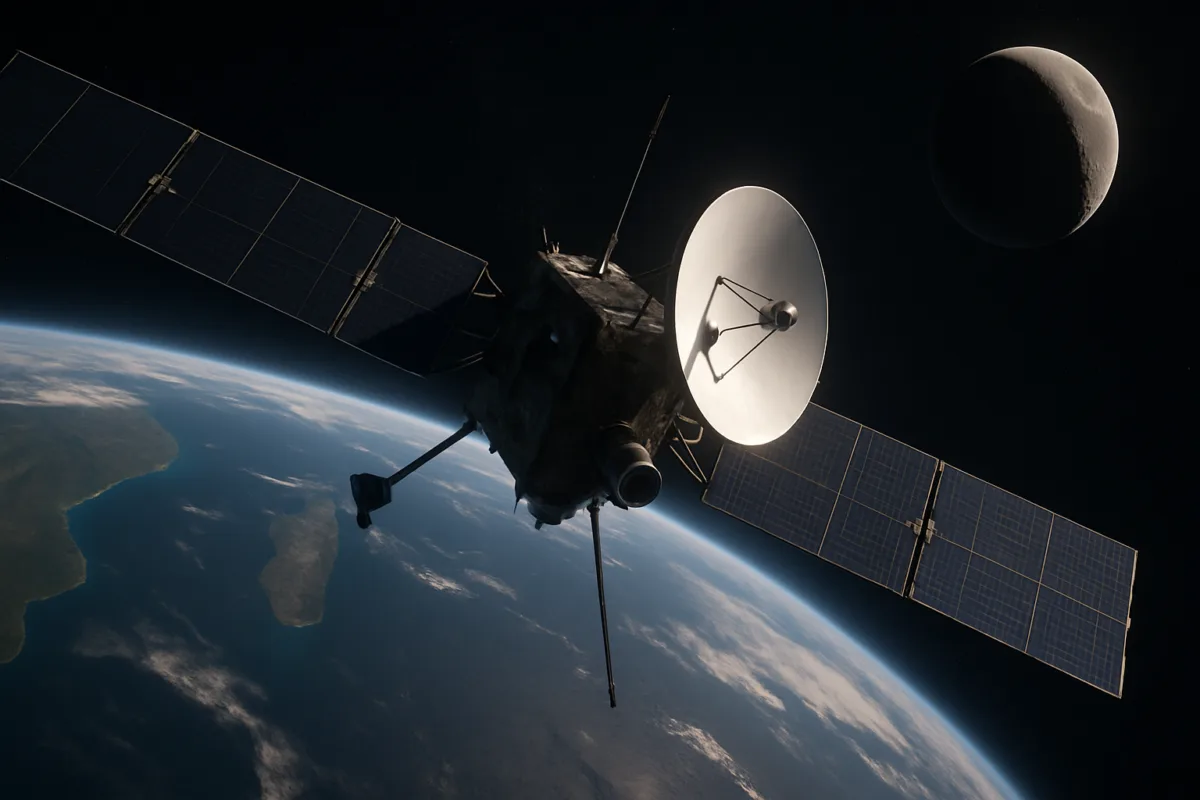
Few space maneuvers spark more debate than the Juice mission’s seemingly inefficient detour past Venus and a return to Earth. That narrative—distance equals inefficiency—misses the engineering logic that makes gravity assists and on-the-fly rehearsals indispensable for complex deep-space tours. If we accept the premise that missions are judged by scientific return and survival, then Juice’s route is not a detour but a deliberate investment in capability.
Why the Juice mission took a Venus detour and Earth flyby
The primary reason for the Venus and Earth flybys was not sightseeing; it was energy management. A direct flight to Jupiter would have required an enormous launch impulse and a prohibitive propellant mass to brake or steer for capture. Therefore, the use of planetary gravity assists is a pragmatic alternative.
Moreover, gravity assists are a momentum exchange: the spacecraft trades a tiny fraction of momentum with a moving planet to adjust heliocentric speed and trajectory. In Juice’s case, the Venus pass and subsequent Earth encounters re-shaped the spacecraft’s orbit while saving hundreds of kilograms of fuel—mass that would otherwise be unavailable for instruments, shielding, or later maneuvers.
Gravity assists and fuel savings: an engineering argument
Critics sometimes call long, looping trajectories inefficient because they increase travel distance. However, distance is a poor proxy for mission efficiency when propellant constraints and launch vehicle limits dominate the trade space. Juice’s lunar–Earth–Venus sequence was chosen because it reduced the energy budget imposed on the launch and spacecraft.
Specifically, the mission gained and shed heliocentric speed in controlled steps: an initial lunar-assisted tweak in 2024, a Venus pass in 2025, and the recent Earth encounter in 2026 that increased heliocentric speed by 3.5 km/s and deflected the path by 20 degrees. Those vector changes are not free in energy terms, but they are far cheaper than carrying the equivalent delta-v as onboard propellant.
Countering the “inefficient distance” narrative
Consider the alternative: a heavier launch or a larger propulsion stage, which would increase mission cost and complexity and likely reduce scientific payload. The gravity-assist approach preserves science mass and longevity, which is precisely what a long, instrument-heavy mission to Jupiter’s icy moons requires.
Thus, while the spacecraft travels farther through space, it arrives with more instruments, more shielding, and more operational flexibility—an outcome that strictly improves mission value.
Using the Moon to rehearse optical navigation for icy moon flybys
Beyond trajectory shaping, Juice used the Earth encounter as an operational rehearsal. NavCam imaged the Moon’s limb to test optical navigation techniques that will be crucial during the 35 planned flybys of Ganymede, Callisto, and Europa. This rehearsal on a known target is a strategic practice run rather than a mere calibration exercise.
The argument here is straightforward: when you’re planning centimetre- or kilometre-scale targeting at hundreds of millions of kilometres away, you need to validate methods under real conditions. The Moon provided a bright, well-characterized horizon—an ideal test object for the EAGLE limb-extraction system and related onboard processing.
Why optical navigation matters near Jupiter
Ground-based radio tracking is precise but inherently delayed: communications round-trips to Jupiter take roughly an hour. Optical navigation supplies immediate, local relative-position estimates that can be used during fast, risky encounters. In other words, you cannot rely solely on Earth for split-second decisions when a tens-of-kilometre targeting error could mean missing a scientifically vital close pass.
Therefore, rehearsing NavCam limb imaging on the Moon is not a luxury—it is a necessity for safeguarding mission science and for enabling tighter targeting during the Jovian tour.
Technical constraints: eclipse, power, and instrument prioritization
One practical objection to intensive observational campaigns during Earth flybys is the power limitation imposed by eclipses. Juice spent over eight hours in Earth’s shadow during the 2026 approach, operating on batteries rather than solar power. That limited the continuous operation of high-draw payloads.
Still, mission planners turned a constraint into an opportunity. Teams prioritized critical calibration and navigation observations during battery operation and scheduled broader instrument usage across a wider window. The result was a focused, high-value dataset while preserving spacecraft health.
Balancing science and spacecraft safety
Additionally, Juice’s large high-gain antenna was deliberately pointed sunward during the Venus pass to act as a heat shield. Instruments were intentionally inactive in the hotter near-Sun environment. Such trade-offs show how operational discipline enables ambitious mission architecture without compromising hardware.
Optical navigation technology: NavCam, EAGLE, and autonomy
NavCam is an engineering camera optimized for wide-field limb detection rather than high-resolution science imaging. Its purpose is to provide geometric information to onboard algorithms such as EAGLE (Enhanced Attitude Guidance through Limb Extraction), which can extract limb edges and refine the spacecraft’s local position estimate.
Argumentatively, the addition of autonomous optical navigation does not remove human control; it augments it. Ground controllers still design trajectories and command maneuvers. Optical navigation supplies timely corrections when communication delays would otherwise make those corrections impractical or impossible.
When autonomy is appropriate
Mission planners will choose case-by-case when to rely on EAGLE during the sequence of 35 flybys. The technique is intended for inbound legs where local geometry matters most. That conservative, hybrid approach—autonomy as a supporting tool, not a replacement—respects both engineering prudence and the operational realities of the Jovian system.
Implications for navigating Jupiter’s icy moons
Juice is slated to arrive at Jupiter in July 2031 and to begin a demanding tour culminating in Ganymede orbit insertion in 2034. Each encounter in the tour must simultaneously satisfy navigation, power, radiation, and instrument-pointing constraints. Precision navigation is therefore a mission enabler, not an optional refinement.
Rehearsals like the September 2026 lunar limb campaign reduce operational risk by validating both hardware and software in space conditions more complex than laboratory tests. The Moon offered a real horizon; the lab offered simulated images. Both are necessary steps toward robust performance near Jupiter.
What Juice proves for future deep-space missions
First, clever use of gravity assists remains a cornerstone of cost-effective deep-space exploration. Second, integrating optical navigation with traditional radio tracking creates a resilient navigation stack tailored for time-critical encounters. Third, rehearsing techniques on familiar bodies before committing to distant, high-stakes operations increases the likelihood of scientific success.
These are not speculative claims but operational lessons demonstrated by Juice’s campaign: mission design that balances physics, hardware limitations, and scientific ambition yields the best chance of transformative discoveries at distant worlds.
Actionable takeaways for mission planners and enthusiasts
For mission designers: prioritize early-flight validation for autonomous subsystems and build flexible observation schedules that convert constraints into rehearsal windows. For the public and advocates: support architectures that favor long-term scientific return over short-term speed; the extra years and detours often translate into more instruments and better science.
For students and early-career engineers: study hybrid navigation systems that combine ground tracking and onboard vision-based methods. The future of complex planetary tours will demand this multidisciplinary expertise.
Ultimately, Juice’s route and lunar rehearsal are not signs of inefficiency; they are evidence of rigorous systems engineering aimed at maximizing scientific return under real-world constraints. The mission’s careful choreography—Venus, Earth, and lunar-limb optics—demonstrates how thoughtful trade-offs, tested under live-space conditions, increase the odds that Juice will return unprecedented insights about Ganymede, Callisto, and Europa.
As we watch Juice continue toward its final Earth assist in 2029 and its eventual arrival at Jupiter in 2031, the broader lesson is clear: strategic detours and rehearsals are investments in mission success. Readers who follow the mission can look for upcoming data releases, NavCam image sets, and performance evaluations of EAGLE—each will reveal how well the rehearsal paid off and will inform the next generation of outer-planet explorers.

Dr. Morgan directed the Archives Program from 2014 to 2017, gaining extensive experience in research documentation, information management, and the preservation of scholarly resources. Throughout her career, she has worked closely with academic publications and research materials, developing expertise in evaluating scientific sources and communicating complex topics to broad audiences.
Her primary areas of specialization include scientific publishing, research communication, editorial review, and the translation of technical research into accessible educational content. She has contributed to projects involving space science, astronomy, environmental science, history, archaeology, and emerging scientific discoveries, always emphasizing accuracy, transparency, and the responsible presentation of evidence.
As Editorial Director of Muskurahat.us, Dr. Morgan leads the editorial review process for scientific articles, ensuring that content is based on reputable sources, peer-reviewed research whenever available, and publications from recognized universities, research institutions, and international scientific organizations.
She is committed to promoting scientific literacy through clear, engaging, and well-documented articles that help readers better understand scientific discoveries and their impact on society. Her editorial philosophy is founded on accuracy, intellectual integrity, independent journalism, and continuous learning as scientific knowledge evolves.
Through her work at Muskurahat.us, Dr. Morgan supports the publication of trustworthy scientific content that makes complex research accessible to readers around the world while maintaining rigorous editorial standards.