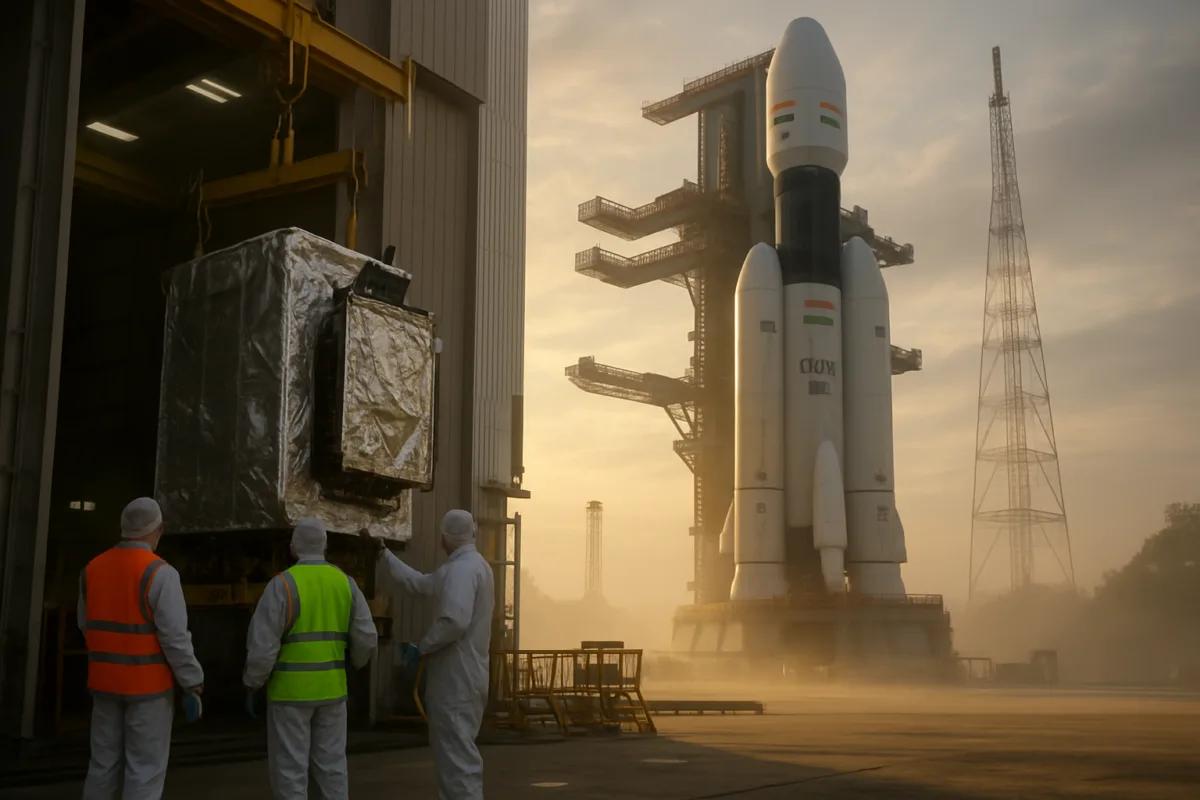
The NVS-03 launch is being targeted for mid-October 2026, and that deadline is more than a schedule item — it is the first practical chance to restore NavIC’s standalone positioning capability. With the primary keyword “NVS-03 launch” placed front and center, the stakes are clear: NavIC needs a fourth operational satellite to meet the geometric requirements for independent three-dimensional positioning, and that makes this campaign both urgent and unforgiving of complacency.
NVS-03 launch timeline and why the October window matters
Sources cite a 15–20 October 2026 window for the GSLV-Mk2 lift-off from Sriharikota. The campaign reportedly began in mid-September with the vehicle’s first stage stacked and the spacecraft already at the Satish Dhawan Space Centre. Therefore, the mid-October target is internal and conditional, not yet an ISRO-issued countdown date.
Moreover, this timing pressure is not arbitrary: government clearance in September unlocked a campaign that must now move quickly because NavIC currently lacks the minimum four satellites required for standalone positioning. Consequently, NVS-03 is not merely another payload — it is the linchpin for restoring full positioning service to users in India and the surrounding region.
GSLV-Mk2 readiness and vehicle-vs-spacecraft responsibility
It is important to distinguish between a launch vehicle problem and a spacecraft malfunction. GSLV-Mk2 has been the standard for second-generation NavIC satellites and the vehicle integration at Sriharikota reportedly proceeds at pace. Stacking of the first stage and standard checkouts are positive signs for vehicle readiness.
However, the last mission that carried an NVS satellite — NVS-02 on GSLV-F15 — demonstrated that a healthy launch and correct injection do not guarantee mission success. The GSLV performed as intended; the failure occurred in the satellite’s propulsion chain during orbit-raising. Thus, accountability, resources, and intense scrutiny need to be focused as much on the spacecraft as on the rocket.
NVS-02 failure: lessons that must shape the next campaign
NVS-02 was delivered to a transfer orbit with healthy separation and deployed solar panels, but it failed to execute the apogee motor burns required to circularise into geostationary slot. Investigations pointed to a pyro system anomaly — specifically a pyro valve and drive signal problem in the propulsion chain. This is an engineering failure in discrete hardware and control signalling, not a vehicle delivery fault.
Consequently, rigorous testing of pyro-actuated elements, redundant firing logic, and command signal integrity must be prioritized for NVS-03. If those steps are skipped in the interest of schedule, the campaign risks repeating an outcome that would keep NavIC below the four-satellite threshold and deepen operational vulnerabilities.
Why NavIC needs four satellites and what that means for users
Navigation systems like NavIC require at least four satellites to resolve a receiver’s three spatial coordinates plus the clock bias. Currently, after IRNSS-1F reached end-of-life, only three satellites are providing positioning and navigation timing (PNT) services. Timing distribution remains functional, but standalone positioning is degraded.
This degradation is not abstract: government agencies, critical infrastructure, and commercial users that rely on independent regional positioning — an alternative to foreign GNSS — lose redundancy and resilience. Therefore, NVS-03’s successful transfer to operational slot is essential to restore the system’s strategic rationale and service reliability.
Redundancy, resilience, and the path forward
Even if NVS-03 reaches its slot successfully, the constellation will still be barely above the minimum. NVS-04 and NVS-05 are in advanced stages and must follow quickly to create operational margin. In short, re-establishing a comfortable redundancy buffer must be part of campaign planning, not an afterthought.
To achieve that, ISRO and relevant ministries should maintain campaign flexibility, prioritize spacecraft health verification, and ensure launch cadence planning accounts for spare satellites and contingencies.
Why transparency and communication matter during the campaign
When service shortfalls are formally acknowledged by government, as happened with a written reply circulated by the Press Information Bureau, public trust and stakeholder confidence are at stake. Vague schedules and opaque internal targets increase speculation and risk eroding confidence in the program.
Therefore, a more transparent, technical update cadence — including milestones post-injection like apogee burn confirmations and payload commissioning status — would serve national and international stakeholders. Clarity is a stabilizer; it reduces misinformation, supports dependent industries, and signals that lessons from NVS-02 have been adopted.
Operational checkpoints to communicate
Short, actionable updates should be provided on: successful transfer orbit injection, solar panel deployment, first apogee burn completion, subsequent apogee motor sequence, payload activation, and final slot stabilisation. Each checkpoint reduces uncertainty and provides verifiable indicators of progress.
In addition, sharing high-level test outcomes on pyro systems and redundant controls would directly address public concerns raised by the NVS-02 anomaly.
Risk mitigation: technical and programmatic recommendations
Given the pyro valve and drive signal issue identified in NVS-02, NVS-03 must undergo targeted corrective verification. This includes bench testing of pyro actuation under flight-like conditions, cross-checks of flight software commanding sequences, and independent validation of redundant circuits.
Additionally, programmatic responses are necessary. First, maintain schedule flexibility: the launch window should be treated as a working target that can slip to allow for exhaustive verification. Second, accelerate the final assembly and testing of NVS-04 and NVS-05 to minimize the time NavIC spends at minimal operational capacity.
On-orbit contingency planning
Mission operations must have contingency scripts ready in case the apogee motor does not respond as planned — including alternative firing sequences, reliance on reaction control thrusters where possible, and plans for extended transfer orbits. Ground teams should rehearse these scenarios and confirm telemetry and command paths are robust.
Finally, consider augmenting future satellites with additional redundancy in propulsion initiation systems and telemetry that can more precisely isolate failures in near-real time.
Balancing urgency with engineering caution
There is a legitimate argument for speed: NavIC’s strategic and commercial value is best served when baseline capabilities are restored quickly. But there is also a compelling technical argument for caution: repeating a spacecraft-side failure while rushing to fill a service gap would be costly and demoralizing.
Therefore, the appropriate stance is deliberate urgency — accelerate what can be accelerated without compromising verification of the pyro system and mission-critical command sequences. Experience shows that an honest delay is preferable to a repeat failure that prolongs the crisis.
What stakeholders should watch during the campaign
Stakeholders should expect public confirmation of key milestones, and they should watch for specific language on verification of the pyro and propulsion command chains. Additionally, monitoring the pace of NVS-04 and NVS-05 progress will indicate whether NavIC will regain robust redundancy or remain marginally operational for an extended period.
In effect, the pace and transparency of these activities are measurable proxies for program health and institutional learning from past anomalies.
The NVS-03 launch represents both an urgent fix and a test of lessons learned. If ISRO and the government maintain a disciplined focus on spacecraft propulsion verification, communicate clear operational milestones, and preserve programmatic flexibility for NVS-04 and NVS-05 follow-ons, NavIC can be returned to full operational capability with reduced risk. The sensible path forward is to treat mid-October as a working target while refusing to trade engineering rigor for calendar certainty; that balance will deliver dependable positioning services and actionable reassurance to users who rely on an indigenous navigation system.

Dr. Morgan directed the Archives Program from 2014 to 2017, gaining extensive experience in research documentation, information management, and the preservation of scholarly resources. Throughout her career, she has worked closely with academic publications and research materials, developing expertise in evaluating scientific sources and communicating complex topics to broad audiences.
Her primary areas of specialization include scientific publishing, research communication, editorial review, and the translation of technical research into accessible educational content. She has contributed to projects involving space science, astronomy, environmental science, history, archaeology, and emerging scientific discoveries, always emphasizing accuracy, transparency, and the responsible presentation of evidence.
As Editorial Director of Muskurahat.us, Dr. Morgan leads the editorial review process for scientific articles, ensuring that content is based on reputable sources, peer-reviewed research whenever available, and publications from recognized universities, research institutions, and international scientific organizations.
She is committed to promoting scientific literacy through clear, engaging, and well-documented articles that help readers better understand scientific discoveries and their impact on society. Her editorial philosophy is founded on accuracy, intellectual integrity, independent journalism, and continuous learning as scientific knowledge evolves.
Through her work at Muskurahat.us, Dr. Morgan supports the publication of trustworthy scientific content that makes complex research accessible to readers around the world while maintaining rigorous editorial standards.