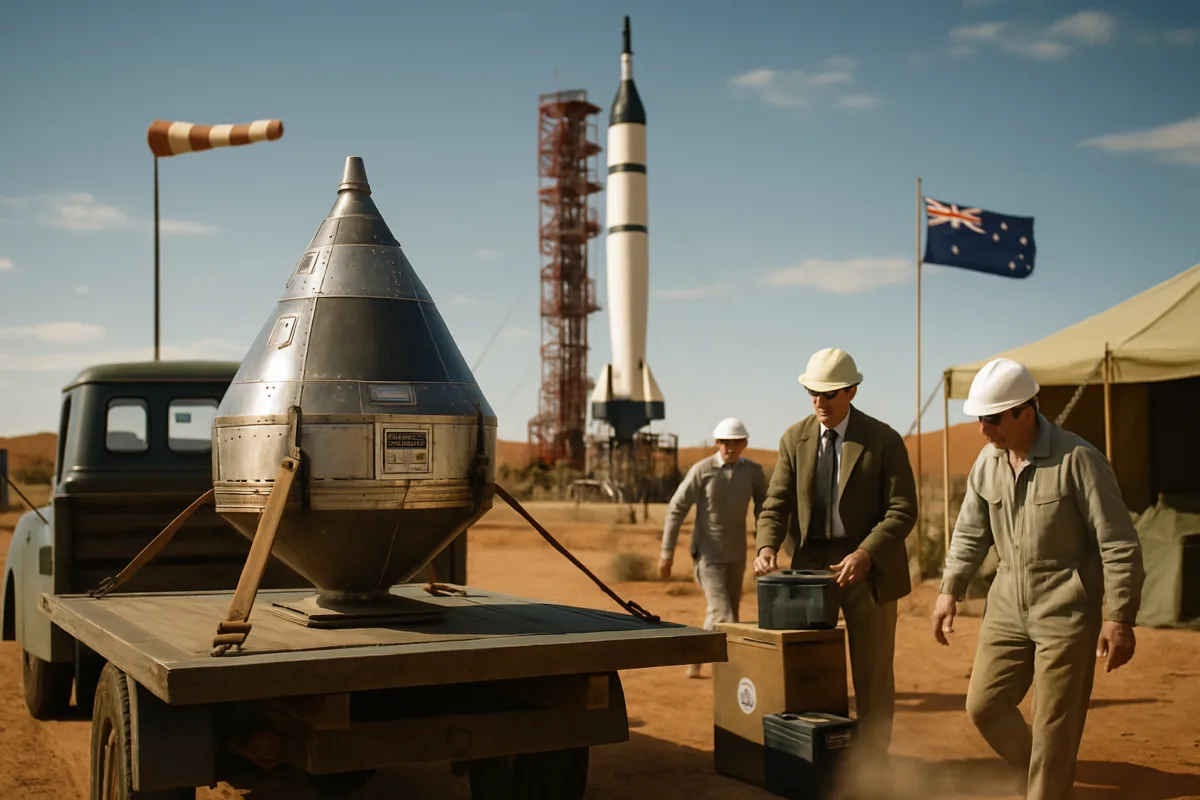
Imagine a spare American Redstone rocket sitting in the Australian outback, an eleven-month countdown, and a scrappy team that built WRESAT in time to ride it into orbit. WRESAT — Australia’s first satellite — was not the product of a grand national program; it was the result of necessity, international goodwill, and a ruthless focus on getting useful science into space quickly.
WRESAT and the 1967 Woomera launch: a case for pragmatic space policy
The launch at Woomera in November 1967 was not meant to be glamorous. It was the tail end of a weapons test program and an unused Redstone rocket — obsolete, expensive to ship home, and offered as a goodwill gesture. The United States supplied the vehicle and launch crew; NASA offered tracking. Australia supplied a tiny, 45-kilogram satellite built on a deadline.
The lesson here is clear: when policy prioritizes practicality and partnerships over prestige projects, small teams can deliver meaningful science rapidly. WRESAT’s story challenges the assumption that meaningful space achievements require decades of planning and massive budgets.
How Australia built a satellite in eleven months
Design work began in early 1967 as a collaboration between the Weapons Research Establishment and the University of Adelaide. The team converted years of sounding-rocket experience into an orbital payload. Rather than inventing from scratch, they adapted existing instruments designed to measure ultraviolet and X-ray emissions.
Necessity created speed. With the American launch team leaving at the end of the year, the timetable could not slip. That constraint forced pragmatic choices: battery power instead of solar panels, proven instrument designs rather than experimental systems, and a minimalist approach to structure and testing.
Why constraints produced value
Constraints are often vilified in program management, but in the case of WRESAT they focused effort and limited scope creep. The satellite operated long enough to gather data over dozens of orbits, validating sounding-rocket results and delivering new measurements of the upper atmosphere and solar radiation.
Put differently, a short operational life does not equal zero value. WRESAT transmitted useful science for roughly five days, completing 73 transmitting orbits. This outcome shows that targeted objectives, executed quickly, can be scientifically significant even when lifetime is limited.
International cooperation: the donated Redstone and shared expertise
No single country built WRESAT in isolation. The Americans provided the Redstone rocket — the last known Redstone ever flown — and the experienced TRW launch team. NASA’s global tracking network helped collect data. The UK’s longstanding Woomera support smoothed operations. Australia provided the scientific instruments and the manufacturing know-how.
When arguing for national space capability, defenders often emphasize sovereign launch infrastructure and indigenous rockets. WRESAT reminds us that partnerships and shared resources can be a faster, lower-cost route to capability, especially for scientific missions with limited budgets.
Shared assets, multiplied impact
Using donated hardware and international tracking reduced costs and accelerated timelines. That trade-off carried risks — for example, the US-imposed schedule left no time to build solar panels, shortening the satellite’s life. Nevertheless, the collaborative model enabled Australia to join the “space club” at a fraction of the cost.
Therefore, modern policy should treat shared assets and international teams as strategic enablers rather than second-best options.
Technical choices: a lightweight cone, a dead-stage companion, and a polar orbit
WRESAT was a cone about 1.6 meters long and 45 kilograms on its own; attached to the burned-out third stage it weighed roughly 72.5 kilograms. The package entered a near-polar, elliptical orbit that traversed high northern and southern latitudes, ideal for repeated observations of the upper atmosphere and solar emissions.
The decision to keep design simple — a battery-powered instrument suite transmitting on 136.350 MHz — reduced technical risk and testing time. The trade-off was a brief operational window, but the mission still made an important step beyond what brief-sounding rockets could provide.
From sounding rockets to orbit: incremental innovation
The University of Adelaide and WRE leveraged years of sounding-rocket experience. That incremental approach meant they were not learning everything for the first time; they were scaling a proven instrument platform for continuous orbital observations. This low-risk path yielded immediate scientific returns.
Consequently, the WRESAT model favors incremental scaling over grand, high-risk leaps when the objective is timely scientific data.
Myth-busting: why WRESAT was not mere luck
Some tell WRESAT as a quirk of history: a leftover rocket, a lucky deadline, a makeshift satellite in a truck. But reducing the mission to luck ignores the deliberate choices and institutional capacities that enabled success. Australia had trained personnel, university partnerships, and years of instrument development behind the scenes.
Moreover, coordination across three countries required negotiation, mutual trust, and clear roles. The US didn’t just hand over a rocket — they committed a launch team and global tracking support. The interplay of capability and cooperation, not chance, produced the outcome.
What WRESAT teaches modern space programs
First, rapid, focused goals can yield high-value science without heroic budgets. Second, international partnerships can substitute for domestic capability when timelines or funding make indigenous solutions impractical. Third, leveraging existing technical lines — such as repurposing sounding-rocket instruments — compresses development time.
Policymakers and program managers should therefore prioritize modular instrument development, invest in university-lab collaboration, and maintain diplomatic channels that can unlock shared launch and tracking resources.
Policy implications and practical steps
For governments: create frameworks that encourage sharing surplus launch hardware and international tracking networks for targeted scientific missions. For universities: design instruments for modularity and rapid integration. For industry: offer launch and integration expertise as a service to accelerate small national missions.
These are not abstract prescriptions; they are practical measures that would have made WRESAT easier and more impactful if applied then — and they remain relevant today.
Preserving the spirit of WRESAT without repeating the mistakes
WRESAT’s success came with the cost of limited operational life because of battery power. Modern programs should preserve the agility and partnership model while avoiding avoidable constraints. That means planning for sustainment — solar arrays, redundancy, and longer ground support — when marginal costs are justified by the science.
At the same time, not every mission needs maximum longevity. Short-term missions can validate concepts, collect calibration data, and build institutional capacity quickly. The key is matching mission design to clear, achievable objectives.
Therefore, the balanced approach is to keep deadlines short and objectives focused, but to budget for essential sustainment where it materially affects science return.
WRESAT’s legacy: a model for nations and small teams
WRESAT proves that a small team, clear goals, and international cooperation can achieve orbit and deliver science in under a year. That model is actionable for modern nations and organizations seeking fast progress in space science or capability demonstration.
To replicate the model: identify existing instrument heritage, secure access to launch or track assets through partnerships, set a concise scientific mission, and accept tight trade-offs that favor schedule and reliability over novelty. These are steps any pragmatic program can follow to produce real results quickly.
WRESAT was neither an accident nor an outlier; it was a demonstration of how constraints, when managed intelligently, become advantages. The combination of local ingenuity and international goodwill offers a blueprint that remains as relevant for 2026 as it was in 1967. Readers involved in space policy, university research, or small-satellite development can adopt these principles right away: prioritize partnerships, reuse proven instruments, set tight, measurable objectives, and allocate modest but critical sustainment to maximize science return.

Dr. Morgan directed the Archives Program from 2014 to 2017, gaining extensive experience in research documentation, information management, and the preservation of scholarly resources. Throughout her career, she has worked closely with academic publications and research materials, developing expertise in evaluating scientific sources and communicating complex topics to broad audiences.
Her primary areas of specialization include scientific publishing, research communication, editorial review, and the translation of technical research into accessible educational content. She has contributed to projects involving space science, astronomy, environmental science, history, archaeology, and emerging scientific discoveries, always emphasizing accuracy, transparency, and the responsible presentation of evidence.
As Editorial Director of Muskurahat.us, Dr. Morgan leads the editorial review process for scientific articles, ensuring that content is based on reputable sources, peer-reviewed research whenever available, and publications from recognized universities, research institutions, and international scientific organizations.
She is committed to promoting scientific literacy through clear, engaging, and well-documented articles that help readers better understand scientific discoveries and their impact on society. Her editorial philosophy is founded on accuracy, intellectual integrity, independent journalism, and continuous learning as scientific knowledge evolves.
Through her work at Muskurahat.us, Dr. Morgan supports the publication of trustworthy scientific content that makes complex research accessible to readers around the world while maintaining rigorous editorial standards.