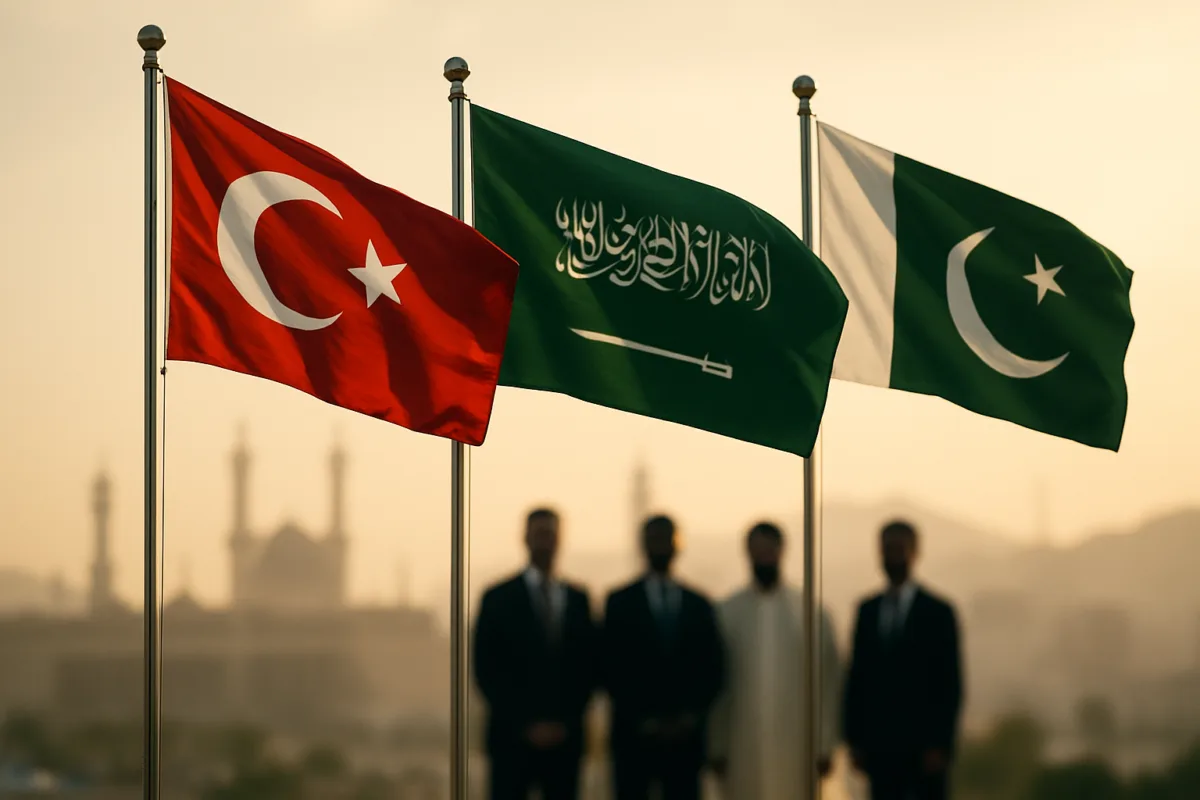
The Mecca Joint Defence Agreement signed by Saudi Arabia, Pakistan and Turkey has been instantly recast in headlines as a nascent “Sunni NATO.” That shorthand captures attention, but it is analytically lazy. Reducing the pact to a sectarian bloc not only misreads the agreement’s logic; it risks encouraging policies that further polarize the MENA region. A sober assessment shows a pragmatic, interest-driven hedging strategy more than a cohesive, ideological alliance aimed at Tehran.
Real interests trump sectarian scripts
Arguments that the Mecca Pact amounts to a Sunni counterweight to Iran rely on a shallow correlation: all three signatories are majority-Sunni states. But international politics does not operate by religious arithmetic alone. Realist theory reminds us that states pursue security, influence and survival. Saudi Arabia seeks reliable deterrence after years of drone and missile attacks targeting Gulf infrastructure. Turkey doubts the reliability of fellow NATO members to defend its interests in Syria and the Eastern Mediterranean. Pakistan brings conventional muscle and a nuclear deterrent—assets of value to any partner worried about conventional coercion. Those incentives explain alignment far better than a shared sectarian identity.
To call the Mecca Pact a Sunni NATO is to assume a level of cohesion—mutual trust, institutional depth, interoperability—that simply does not exist on paper. NATO’s endurance rests on decades of integrated command structures, shared doctrine, and a web of political and economic ties. The Mecca agreement is a declaration of mutual defense intent, not a functioning military alliance. Without robust institutions, transparent burden sharing, and mechanisms to manage crises, it remains an aspirational instrument rather than an operative bloc.
Hedging, not encirclement
The language chosen by Islamabad and Ankara is instructive. Pakistan emphasized that the pact is “purely defensive,” while Turkey explicitly stated it is not targeted at Tehran. These disclaimers matter: both countries maintain substantial ties with Iran. Pakistan borders Iran, trades with it, and shares tribal dynamics across the frontier. Turkey maintains energy and commercial links, and both Ankara and Islamabad have strategic reasons to avoid precluding dialogue with Tehran. Saudi Arabia, which did restore diplomatic ties with Iran in 2023 after Chinese mediation, also has incentives to compartmentalize competition and avoid outright confrontation. The Mecca Pact is better understood as hedging: pooling limited degrees of regional autonomy in a more uncertain security environment.
Why institutional depth matters
Historical precedents caution against premature triumphalism. The 1955 Baghdad Pact—an arrangement including Turkey, Pakistan and the UK designed to contain Soviet influence—sounded formidable on paper but collapsed under the weight of divergent national interests, nationalist politics and regional upheaval. Alliances forged primarily around shared fears without deeper common benefits struggle to survive shocks.
Contrast NATO’s elaborate institutional web: common operational standards, codified mutual defense clauses, and an integrated command structure that gradually built trust among members. The Mecca agreement lacks comparable depth. No joint headquarters, no common procurement architecture, no interoperability guarantees and no clear decision rules for invoking collective defense. Without those elements, joint statements risk remaining symbolic—and symbols can be useful, but they are not substitutes for strategic guarantees.
Domestic politics and external constraints
Domestic calculus also limits how far the Mecca Pact can go. Each signatory faces internal imperatives that complicate binding military commitments. Saudi rulers must manage domestic expectations of stability and economic transformation; heavy external commitments could backfire if perceived to drag the kingdom into costly conflicts. Turkey’s public opinion is increasingly skeptical of foreign entanglements that do not yield clear economic or security gains. Pakistan’s military leadership has long balanced external partnerships with careful management of its western frontier and its complex relationship with India and Afghanistan. These internal constraints increase the transaction costs of deep military integration.
Constructivist pitfalls: the danger of sectarian framing
Constructivist scholarship helps explain why the “Sunni NATO” label has traction: elites and media narratives can reshape perceptions of identity and threat. But adopting that framing uncritically empowers actors who benefit from a polarized narrative—hardliners who argue that existential survival depends on confrontation. Constructivism warns us that identities are not fixed; they are mobilized. If policymakers treat the Mecca Pact as paradigmatic of a broader Sunni-Shia civilizational clash, they may harden identities into self-fulfilling prophecies.
Practically, sectarian framing ignores inconvenient facts. Egypt and Iraq—two regional heavyweights—have not joined the Mecca arrangement, despite their large Sunni populations. Azerbaijan, a Shia-majority state, has been reported to consider joining. The signatories themselves host significant Shia minorities, and all three have reasons to sustain functional ties with Tehran. The simplistic Sunni-Shia lens obfuscates more than it clarifies.
Abraham Accords vs. Mecca Pact: diverging strategies
Comparing the Mecca Pact to the Abraham Accords illuminates two different pathways for regional alignment. The Accords were a constructivist move: reframing identity politics around pragmatic normalization with Israel, creating new economic and security networks that altered political incentives. The Mecca Pact, by contrast, is ostensibly an institutional security initiative grounded in mutual defense claims. One sought to redraw social and economic networks; the other seeks to create a security safety net. Treating them as variants of the same phenomenon obscures the strategic diversity in the region.
What the Mecca Pact means for Iran and the Axis of Resistance
For Tehran and its allies—often labeled the Axis of Resistance—the immediate implications are mixed. On one hand, a formal mutual-defense framework among three capable militaries introduces a new variable in Tehran’s strategic calculus. It could increase the political cost of certain coercive actions and complicate asymmetric operations. On the other hand, Tehran’s diversified regional footprint, including deep ties with militias and political parties across Iraq, Syria, Lebanon and Yemen, is not easily negated by a trilateral agreement. Iran’s influence is embedded in political and societal networks that do not evaporate with the signing of a pact.
Additionally, Iran has strong reasons to avoid escalation. A collision with a coalition that includes a nuclear-armed Pakistan or an increasingly assertive Turkey would be unpredictable. That mutual restraint is one reason why the Mecca Pact should be viewed more as a signaling device—one that reconfigures deterrence perceptions—than as an immediate pathway to war.
U.S. influence and a multipolar turn
The pact also signals a broader shift in how regional states view external security providers. The wars in Gaza, Syria, and elsewhere, alongside fluctuating U.S. attention, have led Gulf capitals and regional powers to hedge. They neither fully sever ties with Washington nor rely exclusively on it. Beijing’s role in mediating Saudi-Iran reconciliation and expanding defense ties with Pakistan underscores a more crowded external environment. If regional states are diversifying their security partners, the Mecca Pact is a symptom of that diversification—an attempt to reduce dependence on a single guarantor rather than an explicit farewell to Western alliances.
Paths forward: what would make the pact durable?
For the Mecca Pact to evolve beyond rhetoric into a durable security architecture, three conditions would be key. First, institutionalization: clear mechanisms for joint planning, command coordination in crises, and burden-sharing rules. Second, economic underpinning: defense cooperation requires resources, joint procurement strategies, and shared industrial linkages to build interoperability. Third, conflict management procedures: internal dispute-resolution mechanisms so that bilateral frictions—say, over trade or regional influence—do not cascade into collective-defense crises. Without these, the agreement risks remaining a diplomatic signal rather than a functional alliance.
Even if those conditions are met, the pact’s durability will depend on shared perceptions of threat and mutual benefit. Alliances born of temporary anxieties tend to fray when national priorities shift. Those who celebrate the Mecca agreement as a tectonic sectarian realignment mistake a potential tactical alignment for a strategic revolution.
Rhetoric that frames the Mecca Pact as an inevitable Sunni counterweight may serve immediate political ends—rallying domestic audiences or signaling resolve—but it also reinforces binary thinking that has long distorted external and regional policy. A more accurate, and useful, reading recognizes the pact as a pragmatic, conditional hedge: a declaration that three regional powers prefer to own more of their security choices but are not yet prepared to weave a durable, NATO-style fabric of collective defense. In a region where alliances have been fluid and interests often collide, policymakers and analysts should treat the Mecca Pact as a development to watch, not a fait accompli that reshapes the map overnight.

Dr. Morgan directed the Archives Program from 2014 to 2017, gaining extensive experience in research documentation, information management, and the preservation of scholarly resources. Throughout her career, she has worked closely with academic publications and research materials, developing expertise in evaluating scientific sources and communicating complex topics to broad audiences.
Her primary areas of specialization include scientific publishing, research communication, editorial review, and the translation of technical research into accessible educational content. She has contributed to projects involving space science, astronomy, environmental science, history, archaeology, and emerging scientific discoveries, always emphasizing accuracy, transparency, and the responsible presentation of evidence.
As Editorial Director of Muskurahat.us, Dr. Morgan leads the editorial review process for scientific articles, ensuring that content is based on reputable sources, peer-reviewed research whenever available, and publications from recognized universities, research institutions, and international scientific organizations.
She is committed to promoting scientific literacy through clear, engaging, and well-documented articles that help readers better understand scientific discoveries and their impact on society. Her editorial philosophy is founded on accuracy, intellectual integrity, independent journalism, and continuous learning as scientific knowledge evolves.
Through her work at Muskurahat.us, Dr. Morgan supports the publication of trustworthy scientific content that makes complex research accessible to readers around the world while maintaining rigorous editorial standards.