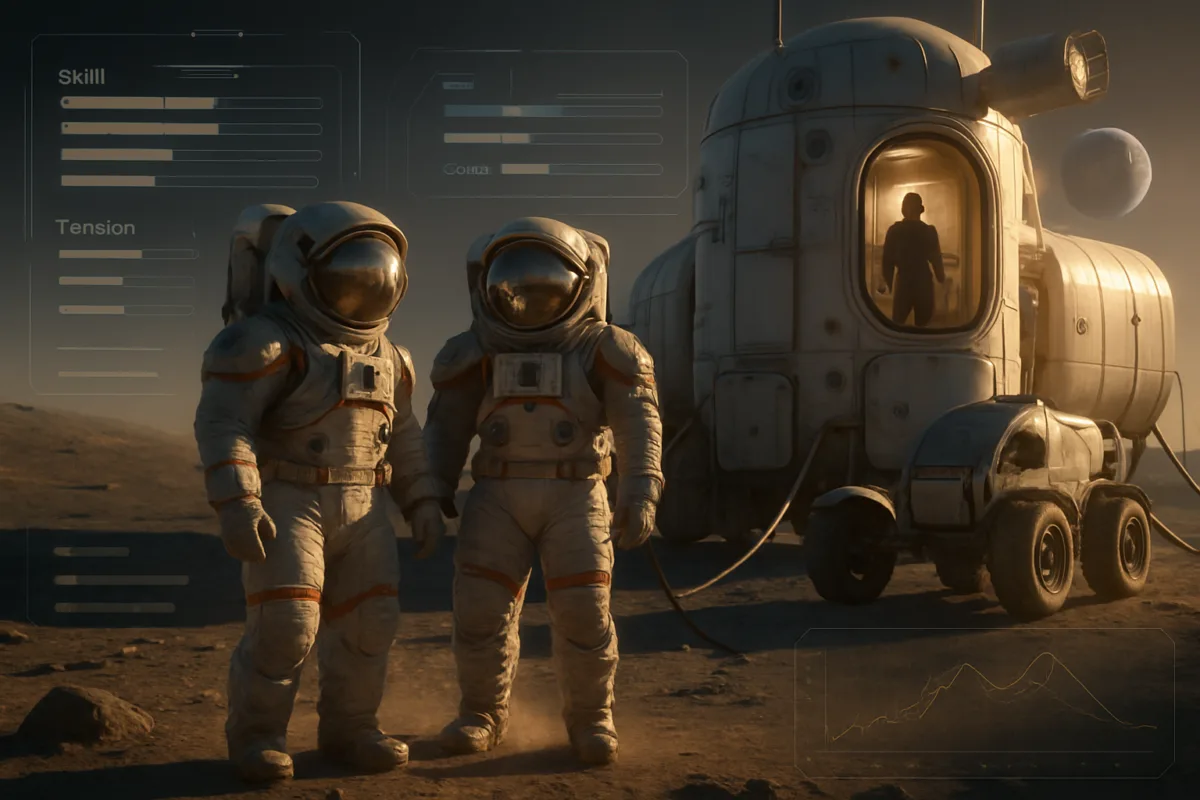
Few arguments are more persuasive for prioritizing people over hardware than the new lunar base model: a virtual Moon settlement that simulates how astronaut skills, stress and teamwork affect mission outcomes. This agent-based simulation shows that even flawless machines and ample supplies cannot guarantee success if human performance degrades under tension. That insight should reshape how Artemis planners allocate resources, design rotations and validate training—because human factors are not ancillary risks, they are mission-critical variables.
Why the lunar base model changes the debate about Moon missions
Technical redundancy, steady power and stocked tanks have long been positioned as the pillars of spaceflight resilience. However, the lunar base model demonstrates that psychological states and team dynamics can undercut those strengths. If missions ignore stress, coping ability and interpersonal conflict, a single failure can cascade into system-wide problems far from Earth.
Moreover, the simulation reframes risk management by quantifying trade-offs that were previously intangible. Instead of treating human behavior as anecdote or intuition, agent-based modeling turns personalities, skills and learning curves into measurable contributors to mission success.
How agent-based lunar simulation reveals hidden vulnerabilities
Agent-based models represent individuals as autonomous actors who follow rules and interact locally, yielding emergent system behaviors. In this lunar simulation, each Agent_Astronaut carries physical health metrics, professional skills and emotional attributes such as tension and coping. These variables combine with learning curves and task difficulty to produce realistic performance outcomes.
Consequently, the model surfaces scenarios where productivity rises while psychological well-being collapses. For instance, some runs show higher task completion but also increasing synthetic workload—meaning more work was done at the expense of crew resilience. This paradox is crucial: raw output cannot be the only measure of operational fitness.
Concrete findings that matter for Artemis
The researchers ran thousands of Monte Carlo iterations across variants: mission length, crew size, rotation cadence and surprise-event frequency. Extending missions from three to six months roughly doubled total completed tasks, while favorable sensitivity tweaks raised task completion by 27 percent and adding astronauts increased productivity by 16 percent.
These numbers are informative but not prescriptive. They imply that longer missions and larger crews can boost work done, yet both choices carry supply, cost and psychosocial trade-offs. Planners must weigh those trade-offs deliberately, not assume technical sufficiency will automatically translate into sustainable human performance.
Why human factors must be integrated into mission design
Arguably, the single biggest contribution of the lunar base model is forcing integration. Power, comms and life support do not exist in isolation from the people who operate them. Stress, sleep loss, team friction and cumulative emergency responses interact with technical failure rates to produce mission trajectories.
Therefore, mission architecture that prioritizes only hardware reliability is incomplete. A more robust approach embeds behavioral health metrics—like synthetic NASA TLX workload scores—into planning, training and operational decision-making. This integrated perspective enables trade-off analyses that are closer to the messy realities crews will face.
From synthetic TLX to real-world validation
The model computes an estimated workload score based on tension, coping and completed tasks, resembling the NASA Task Load Index. That synthetic TLX is a clever workaround for absent real-time human ratings, but it also highlights a next step: ground-truthing.
Consequently, analogous missions and long-duration analog stations should collect behavioral data to calibrate the model. Antarctic expeditions, underwater habitats and NASA’s Human Exploration Research Analog are obvious starting points. Only with iterative validation will the synthetic TLX become a reliable decision-support metric.
Limitations of the lunar base agent-based model
No simulation is neutral; choices about probabilities, personality distributions and environmental hazards shape outcomes. The current model assigns DISC personality types uniformly and uses broad probability ranges where empirical lunar data are sparse. These assumptions undermine predictive precision but do not erase the model’s strategic value.
Furthermore, environmental probabilities—dust damage rates, radiation episodes and equipment failure modes—derive from Apollo logs and terrestrial proxies. Future habitats will differ, so planners must avoid overfitting policies to a single simulated baseline. Instead, treat the model as a stress-test lab for hypotheses rather than a prophecy.
Why these limits strengthen the argument for better data
Because the model’s weaknesses are fixable, they create a roadmap. Better mission records, controlled analog experiments and disciplined psychological monitoring would refine personality priors, hazard distributions and the synthetic workload metric. These improvements would convert the simulation from a benchmark into a trusted operational tool.
Therefore, funding and policy should prioritize data collection during early Artemis sorties and terrestrial analogs so the model evolves alongside the missions it supports.
How mission planners should use the lunar base model now
Planners can and should use this agent-based lunar simulation as a virtual laboratory. It is especially useful for comparative what-if questions: Does rotating crews every two weeks reduce cumulative tension? Will a four-person crew be more resilient than a six-person crew given the same resupply cadence? Which failure rates cause unacceptable cognitive overload?
Moreover, engineers can explore how maintenance burdens trade off with scientific returns. Behavioral scientists can test whether particular team compositions reduce synthetic TLX. Decision-makers can stress-test logistics schedules to see how late resupply or crew losses ripple through operations.
Operational recommendations derived from the model
First, incorporate human factors thresholds into go/no-go criteria, not just hardware margins. If synthetic workload exceeds a set level, postpone nonessential EVAs or increase resupply priority. Second, diversify training to accelerate learning curves for high-risk tasks so experience offsets psychological penalties.
Third, design crew rotations and station-surface transfers to deliberately balance skill mixes and interpersonal compatibility rather than random assignment. Finally, collect behavioral metrics in every mission and analog trial to continually update the model’s priors and validate synthetic TLX estimates.
Policy implications and next steps for Artemis partners
Adopting the lunar base model as a planning standard requires policy-level commitment. Agencies and commercial partners should mandate human-factor simulations as part of mission approval packages and allocate resources to behavioral data collection. This is a modest investment compared with the costs of crew loss, mission failure or years of underperformance.
Furthermore, transparency and data sharing among international partners would accelerate model improvement. Open-source frameworks—like the Python Mesa implementation used in the study—facilitate collaborative refinement and reproducibility, which are essential for complex, multi-agency endeavors.
Consequently, aligning incentives across agencies, industry and academia to prioritize validated human-factors modeling will make Artemis missions more resilient, efficient and ethically responsible.
Ultimately, the lunar base model does not offer simple answers, but it does offer clarity: human skills, stress and teamwork are not peripheral—they are central to mission survivability. By integrating agent-based simulations into planning, validating their synthetic workload metrics, and committing to better behavioral data, mission architects can design lunar operations that respect both engineering constraints and human limits. That approach yields actionable changes today—adjust resupply cycles, optimize crew rotations, broaden training curricula—that will materially improve the odds of sustaining life and science on the Moon.

Dr. Morgan directed the Archives Program from 2014 to 2017, gaining extensive experience in research documentation, information management, and the preservation of scholarly resources. Throughout her career, she has worked closely with academic publications and research materials, developing expertise in evaluating scientific sources and communicating complex topics to broad audiences.
Her primary areas of specialization include scientific publishing, research communication, editorial review, and the translation of technical research into accessible educational content. She has contributed to projects involving space science, astronomy, environmental science, history, archaeology, and emerging scientific discoveries, always emphasizing accuracy, transparency, and the responsible presentation of evidence.
As Editorial Director of Muskurahat.us, Dr. Morgan leads the editorial review process for scientific articles, ensuring that content is based on reputable sources, peer-reviewed research whenever available, and publications from recognized universities, research institutions, and international scientific organizations.
She is committed to promoting scientific literacy through clear, engaging, and well-documented articles that help readers better understand scientific discoveries and their impact on society. Her editorial philosophy is founded on accuracy, intellectual integrity, independent journalism, and continuous learning as scientific knowledge evolves.
Through her work at Muskurahat.us, Dr. Morgan supports the publication of trustworthy scientific content that makes complex research accessible to readers around the world while maintaining rigorous editorial standards.