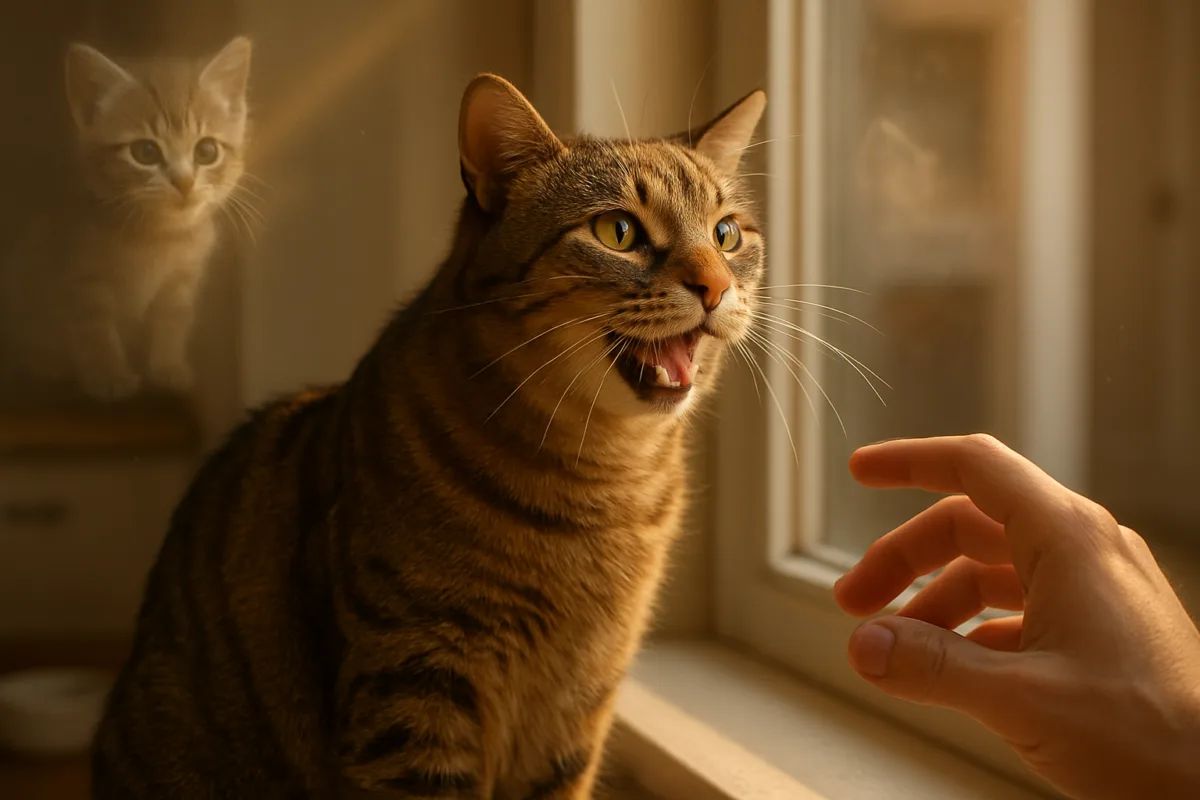
Most cat owners assume a meow is a straightforward translation of feline thought: “Feed me,” “Open the door,” or “Pet me now.” But mounting evidence argues that the familiar adult meow is not a natural, specieswide conversation tool. Instead, it is a human-facing signal—essentially a repurposed kitten call—kept alive and refined because it works on people. If we accept that premise, the implications are profound: we must stop treating meows as a universal feline lexicon and start treating them as context-dependent behavior that we, as caregivers, have helped shape.
What the evidence actually says about meowing
When two adult cats encounter one another, they rarely exchange the plaintive meows most of us associate with domestic life. Cats rely heavily on scent, body language and a broader vocal repertoire—hisses, growls, trills and yowls—to communicate with their conspecifics. The meow, in contrast, appears disproportionately in interactions between adult cats and humans. This is not mere anecdote: systematic reviews and observational studies report the meow’s rarity in cat-to-cat encounters and its prevalence in cat-human ones.
From kitten distress calls to adult social tools
The pathway is clear and plausible. Kittens produce vocal cries to attract maternal care when they are cold, hungry or separated. Controlled studies show that kitten vocalizations vary with isolation, temperature and restraint during the first six weeks of life. For a dependent animal, such sounds are adaptive: they bring attention and assistance. As cats mature, their intercat communication shifts toward olfactory and postural signals, and kitten-like meows fade from cat-to-cat exchanges. Yet many housecats continue to meow at humans well into adulthood.
Bjarne O. Braastad, a respected animal behaviourist, frames this as a broader pattern: animals living with people retain juvenile behaviours that reliably elicit desired human responses. A kitten that meows when picked up and gets food, warmth or an opened door will learn to repeat that call. That reinforcement loop—meow, human responds, meow preserved—explains how a juvenile distress signal evolves into a human-directed communication method.
Domestication, context and the shaped voice of the housecat
Domestic environments have long exerted selective pressures—direct and indirect—on animals. The classic account of cat domestication places early commensal relationships between humans and wildcats near grain stores, where rodents attracted feline predators and humans benefited without intentionally domesticating them. More recent genetic studies complicate the origin narrative, showing migrations and introductions across millennia, but they do not contradict one key idea: spending generations near people changes behaviour.
Comparative studies between feral and house cats show that those living with people produce different acoustic characteristics in their calls and respond differently to social situations. A 2011 experiment exposing feral and house cats to caregivers, strangers and other stressors reported that feral cats were generally more defensive and called at higher rates; both groups meowed, hissed and growled, but the sound signatures diverged. This suggests that experience and selection in human environments shape not only how often cats call, but how those calls sound.
Why the meow survives in human households
The modern meow thrives because it exploits predictable human tendencies. We are primed to respond to juvenile-like vocalizations—think of why human infants and puppy-like features capture our attention. A cat’s meow sits in that psychological sweet spot, evoking caregiving responses. Repeatable outcomes—food, attention, door-opening—cement the behaviour. In short, meowing is less about an intrinsic feline vocabulary and more about an adaptive tool cats use to manage their social environment—namely, us.
We hear the noise, but do we hear the meaning?
If meows are primarily aimed at humans, we should be good at interpreting them, right? Not necessarily. Scientific tests of human ability to decode meows are sobering. In an experiment titled “What’s in a Meow?”, volunteers listened to isolated meow recordings from three contexts—waiting for food, isolation in an unfamiliar place and being brushed. Even when the researchers selected highly representative calls, participants performed poorly. Recognition of a food-related meow reached only about 40.4 percent accuracy, while isolation was identified correctly just 26.7 percent of the time.
Owning a cat helps a little—cat owners scored higher than non-owners on some categories—but the overall picture is clear: we are not fluent in ‘meow-speak.’ That mismatch matters. Owners who believe meows carry fixed, easily decoded meanings risk misinterpreting needs or inadvertently reinforcing undesirable patterns. The more accurate perspective is to see meows as ambiguous signals whose meaning emerges from context, rhythm, location, and the subsequent interaction.
Context trumps cadence
Understanding a meow requires synthesizing multiple cues: where the cat is, what it is looking at, previous events, and whether the sound is repeated. A meow near the food bowl differs in practical meaning from a similar sound at the back door even if the acoustic pattern seems identical on a recording. This explains why owners often understand their own cats reasonably well in daily life even though they fail in blind classification tasks with isolated recordings of unfamiliar cats.
Why this interpretation matters in practical care
Framing the meow as a human-facing, learned behaviour has clear consequences for how we live with cats. First, it undermines the idea that there is a universal feline dictionary to learn; instead, cat owners must learn the idiosyncrasies of their individual animal and the role of context. Second, it highlights the ethical responsibility humans bear: if meows are shaped by our responses, then we influence their welfare—positively or negatively—through the consistency of our behaviour.
Behavioral strategies for responsible ownership
Here are actionable steps grounded in the argument that humans co-create meowing behaviour:
– Pay attention to context. Before responding to every urgent-sounding meow, check where your cat is, what changed recently, and whether basic needs are already met. Often, a glance or a change in routine will reveal the likely cause.
– Avoid unintentionally reinforcing demand vocalizations. If a meow consistently produces the desired result—food, the opened door, immediate intense petting—the cat will escalate and repeat that behaviour. Where possible, create predictable, scheduled responses (e.g., meal times) instead of immediate, ad-hoc reactions that vary unpredictably.
– Use non-vocal cues to teach alternatives. If your cat meows at the door, teach it to sit or go to a mat for calm reinforcement. Rewarding quieter, controlled behaviours helps reduce frantic calling while still meeting the cat’s needs.
– Recognize limitations in interpretation. Even attentive owners misread signals. When in doubt—particularly about potential health issues—err on the side of a veterinary assessment. Vocal changes can indicate distress or illness, and those require professional evaluation.
Broader implications and research needs
Accepting that cats repurposed kitten calls to manage humans invites new research questions and ethical reflections. For researchers, more fine-grained acoustic studies that pair naturalistic recordings with simultaneous analysis of context and human responses can clarify which meow features are meaningful and which are merely incidental. Cross-cultural studies could reveal whether human responses—shaped by different pet-keeping traditions—influence the frequency and form of meowing.
For ethicists and animal welfare advocates, there is a clear charge: animals living with people co-construct their behavioural repertoire with us. Responsibility follows. Designing cat-friendly homes and routines that meet physiological and psychological needs will reduce stress-driven calling and enhance welfare. Policies and educational resources for new cat owners should include evidence-based guidance about how to interpret and shape vocal behaviour without slipping into anthropomorphism.
Finally, the argument reframes a common emotional narrative. Many owners cherish their cats’ meows as intimate, conversational tokens—a view that isn’t wrong, just incomplete. Meowing can signify attachment, predictability, and shared ritual. But it can also be a strategy, conditioned and maintained by predictable human responses. Understanding both aspects—the affectionate and the instrumental—lets us respond with compassion, clarity and care.
Seen in this light, the housecat’s meow is not a simple statement of need but a negotiated behaviour, born in kittenhood and tuned by generations of living with humans. Recognizing that we are part of the communication loop gives us a choice: to be reactive recipients of persistent demands, or to be thoughtful partners who interpret context, adjust routines, and meet needs in ways that improve our cats’ lives while preserving the moments of warmth and connection we all cherish.

Dr. Morgan directed the Archives Program from 2014 to 2017, gaining extensive experience in research documentation, information management, and the preservation of scholarly resources. Throughout her career, she has worked closely with academic publications and research materials, developing expertise in evaluating scientific sources and communicating complex topics to broad audiences.
Her primary areas of specialization include scientific publishing, research communication, editorial review, and the translation of technical research into accessible educational content. She has contributed to projects involving space science, astronomy, environmental science, history, archaeology, and emerging scientific discoveries, always emphasizing accuracy, transparency, and the responsible presentation of evidence.
As Editorial Director of Muskurahat.us, Dr. Morgan leads the editorial review process for scientific articles, ensuring that content is based on reputable sources, peer-reviewed research whenever available, and publications from recognized universities, research institutions, and international scientific organizations.
She is committed to promoting scientific literacy through clear, engaging, and well-documented articles that help readers better understand scientific discoveries and their impact on society. Her editorial philosophy is founded on accuracy, intellectual integrity, independent journalism, and continuous learning as scientific knowledge evolves.
Through her work at Muskurahat.us, Dr. Morgan supports the publication of trustworthy scientific content that makes complex research accessible to readers around the world while maintaining rigorous editorial standards.