When someone types “fund poverty instead of space” into a comment thread, they often intend moral clarity, not math. The phrase NASA budget vs poverty has become shorthand for a supposed zero-sum choice: cancel rockets, cure hunger. That neat framing is emotionally persuasive, but it collapses once you compare real budgets to real global needs.
Why the “Fund Poverty Instead of Space” Argument Sounds Convincing
The popular line traffics in moral intuition: space exploration looks indulgent while people suffer. It exploits an understandable outrage at visible spending on prestige projects when human need persists. As a rhetorical device, it is effective because it reduces a complex global policy problem into an instantly graspable trade-off.
However, rhetorical simplicity is not a substitute for evidence. If public debate is to move beyond slogans, it must confront numbers, scales, and the institutions that allocate resources. Otherwise we sacrifice policy effectiveness to the comfort of indignation.
The Real Math: What Ending Extreme Poverty Would Cost
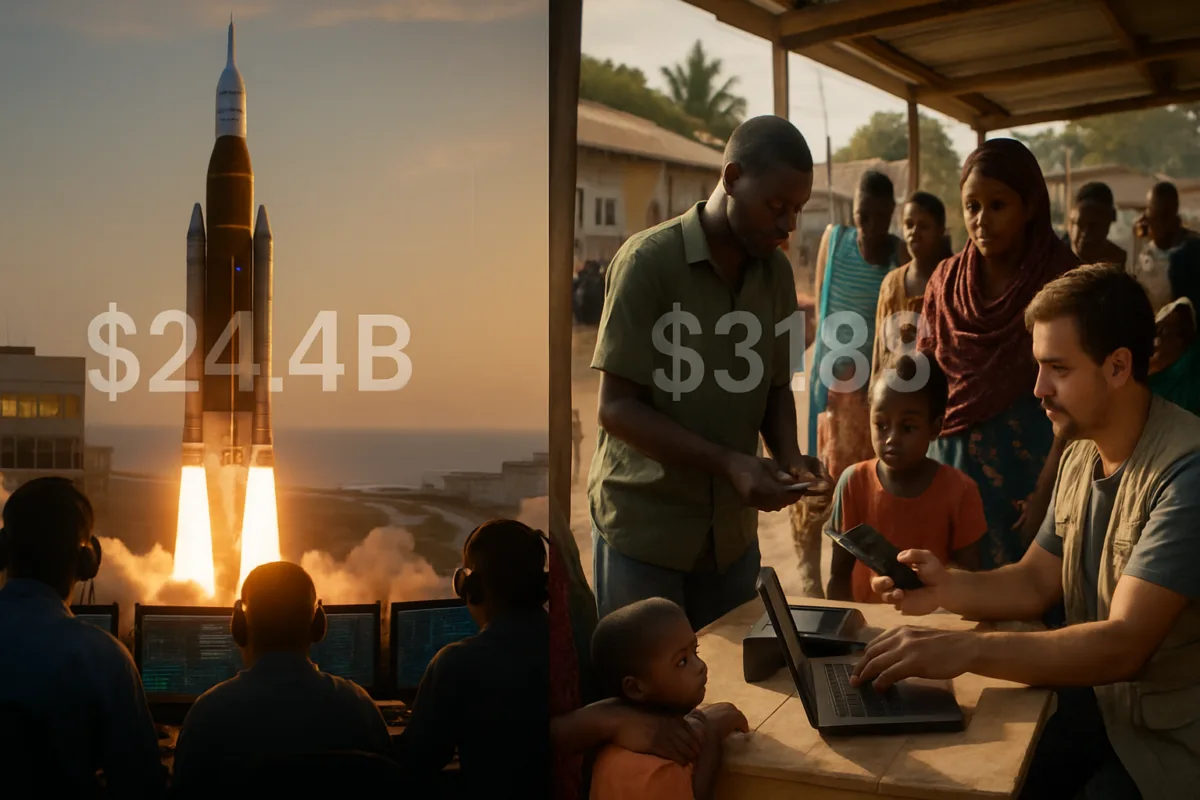
A robust poverty-economics working paper published in December 2025 used household surveys and machine learning to estimate the true cost of eliminating extreme poverty. The researchers calculated that lifting the extreme poor in 23 low-income countries to the historical $2.15-a-day threshold would cost about $170 billion annually if transfers were optimally targeted. Extending that method across 85 countries with about 533 million people below the extreme-poverty line raised the estimate to roughly $318 billion a year when using the World Bank’s newer $3-a-day benchmark.
Put differently, ending extreme poverty globally in that model would require roughly 0.3% of world GDP. That is a meaningful sum, but not an unreachable one when compared to total global output and existing consumption patterns.
NASA Funding vs Poverty Needs: A Scale Problem, Not a Moral One
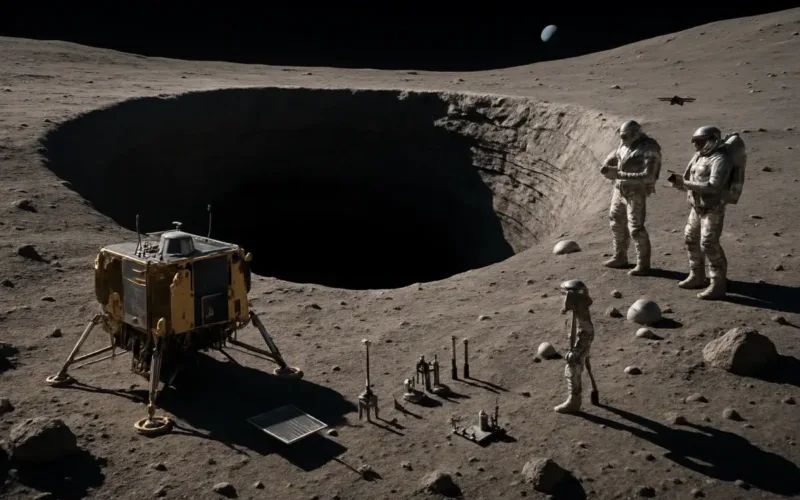
Compare that $318 billion figure to NASA’s fiscal year 2026 budget: $24.4 billion, or about $27.5 billion if you include a separate $10 billion allocation referenced in recent debates. Even at the higher figure, NASA represents less than 9% of the estimated annual cost to eradicate extreme poverty. More precisely, redirecting NASA’s entire budget would address roughly one thirteenth of the global funding shortfall.
Consequently, the arithmetic behind the meme is flawed at its core. The debate treats a national space agency’s budget as though it were commensurate with a global anti-poverty campaign, when in fact the two live in very different budgetary universes.
Why this miscomparison spreads so easily
First, NASA is visible: rocket launches, images from Mars, PR-friendly milestones. Visibility makes for easy targets in moral calculus. Second, people instinctively favor immediate reallocation of a clearly identified line item over the murky politics of increased taxes or international cooperation. Finally, a single agency’s budget is an accessible symbol, whereas global poverty requires multinational coordination and recurring transfers.
Targeting, Logistics, and Political Reality Matter
Even if a global political miracle occurred and a wealthy nation redirected its space allocation to anti-poverty work, money alone would not automatically translate into eradicated poverty. The NBER study’s $170 billion and $318 billion estimates rest on optimal targeting—identifying who needs how much, then delivering those resources effectively. That is technologically feasible but operationally hard.
Leakage, administrative costs, governance capacity, and political constraints inflate the real-world price tag. The naive approach—giving equal transfers to all low-income households—would cost substantially more. Therefore, it’s not only the size of the transfer that matters but also the systems used to distribute it.
What the Numbers Actually Tell Us About Priorities
Here is the central, and more hopeful, implication: ending extreme poverty is not absurdly expensive in global terms. At 0.3% of world GDP, the figure sits below what the world spends on many discretionary goods and services. The issue is collective action and design, not impossibility.
That makes the rhetorical framing that pits NASA against the poor doubly unhelpful. It implies scarcity within a domestic budget line where scarcity is not the binding constraint on global poverty eradication. The real bottlenecks are political will, international coordination, and the technical challenge of delivering targeted transfers at scale.
Comparative context strengthens the argument
For perspective, the study’s authors liken the required share of GDP to the global spending on alcohol or cosmetics—everyday sectors that, collectively, eclipse what’s needed to eliminate extreme poverty. Framing it this way reframes the problem: rather than cancel existing national programs, we should be asking why global allocation systems fail to mobilize a small fraction of overall consumption to meet basic human needs.
Policy Moves That Make Practical Sense
Arguing effectively requires moving from critique to concrete alternatives. First, richer countries and philanthropies can scale targeted cash-transfer pilots and invest in digitized registries to reduce leakage. Second, multilateral lending and grants should prioritize capacity building in delivery systems and data infrastructure, not just headline funding totals.
Third, progressive taxation and coordinated international financing mechanisms—such as global solidarity levies or pooled funds—can mobilize recurring resources more reliably than one-off reassignments of domestic line items. Finally, innovation in financial inclusion, mobile payments, and biometric ID can reduce administrative frictions and lower per-beneficiary costs.
Why space programs still matter alongside anti-poverty efforts
It is worth arguing that space exploration and social spending are not mutually exclusive. Investments in science, technology, and education yield long-term economic and humanitarian dividends. Space programs drive innovation, create high-skill jobs, and produce technologies with broad social applications—from climate monitoring to telecommunications that can help reach marginalized populations.
Thus, the policy choice should not be framed as cancel-or-pay; it should be how to expand and optimize both sets of investments: direct human-centered transfers for immediate relief and strategic research and development for durable prosperity.
Rhetoric Reform: How to Talk About Budgets More Productively
To improve public discourse, advocates must avoid unit-mismatch arguments and instead focus on feasible, framable policy trade-offs. Discussing per-dollar impact, scale, and the logistics of delivery is more persuasive than moralistic one-liners. People respond to concrete plans that show how funds would be raised and spent.
Moreover, transparency about the limitations of each approach encourages coalition-building rather than consumption of viral moral outrage. In practice, that means championing smarter taxes, multilateral coordination, and targeted transfer programs rather than symbolic reallocations that cannot bridge the funding gap.
Actionable Steps for Policymakers and Advocates
Policymakers should commission realistic cost estimates, like the NBER study, and then stress-test them against delivery scenarios. Advocates for poverty eradication should prioritize demonstrable pilot programs that use data-driven targeting to build political credibility. Donors can match funding to capacity-building investments that reduce long-term administrative costs.
Civic actors and journalists should call out misleading dollar comparisons and instead highlight proportional analyses—how much of the global shortfall a given action actually covers. Finally, the public can support scalable instruments such as digital cash transfers and international tax cooperation that produce sustainable revenue streams.
Short-term moves and long-term strategy
Short-term actions include expanding well-designed cash-transfer pilots and increasing funding for delivery infrastructure. Over the long term, the world needs better global public finance mechanisms and a commitment to target resources where they achieve the highest marginal impact.
These are practical, politically feasible measures that respect both the urgency of poverty eradication and the value of continued scientific investment.
The meme that we must “fund poverty instead of space” is rhetorically satisfying but analytically lazy. The correct takeaway from the data is different and more constructive: ending extreme poverty is expensive but affordable by global standards, and it requires coordinated funding, smart targeting, and stronger delivery systems rather than symbolic reallocation of a single agency’s budget. If advocates, policymakers, and citizens focus on mechanisms—mobilizing about 0.3% of global GDP through progressive, cooperative means and investing in efficient distribution—then the math shifts from despair to actionable policy. That is a challenge worth meeting with rigor, not slogans, and it points toward credible steps anyone can support to make real progress for the world’s poorest people.

Dr. Morgan directed the Archives Program from 2014 to 2017, gaining extensive experience in research documentation, information management, and the preservation of scholarly resources. Throughout her career, she has worked closely with academic publications and research materials, developing expertise in evaluating scientific sources and communicating complex topics to broad audiences.
Her primary areas of specialization include scientific publishing, research communication, editorial review, and the translation of technical research into accessible educational content. She has contributed to projects involving space science, astronomy, environmental science, history, archaeology, and emerging scientific discoveries, always emphasizing accuracy, transparency, and the responsible presentation of evidence.
As Editorial Director of Muskurahat.us, Dr. Morgan leads the editorial review process for scientific articles, ensuring that content is based on reputable sources, peer-reviewed research whenever available, and publications from recognized universities, research institutions, and international scientific organizations.
She is committed to promoting scientific literacy through clear, engaging, and well-documented articles that help readers better understand scientific discoveries and their impact on society. Her editorial philosophy is founded on accuracy, intellectual integrity, independent journalism, and continuous learning as scientific knowledge evolves.
Through her work at Muskurahat.us, Dr. Morgan supports the publication of trustworthy scientific content that makes complex research accessible to readers around the world while maintaining rigorous editorial standards.