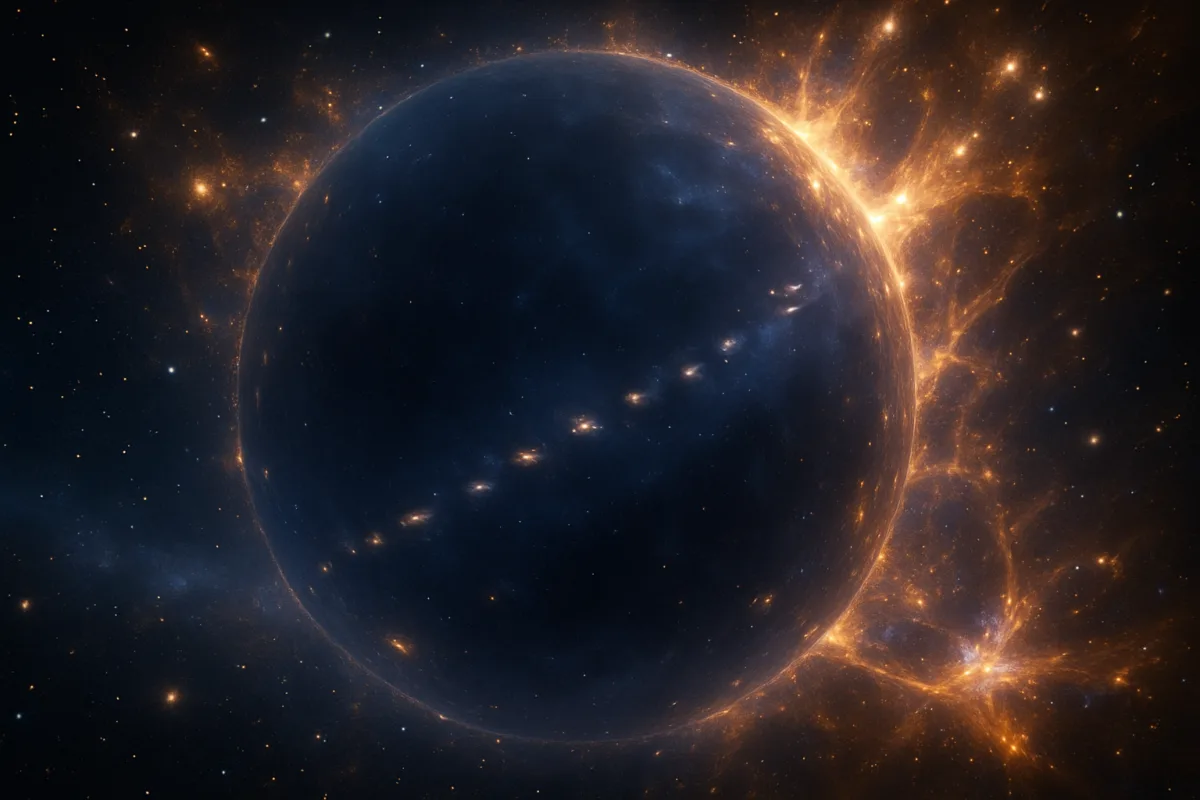
When astronomers first plotted redshifts across a handful of narrow beams of sky in 1981 and saw a conspicuous absence of galaxies, the result read like cosmic negative space: a hole so vast it begged metaphors and hyperbole. That early reaction—part astonishment, part caution—has evolved. Today the Boötes Void is both less mysterious and far more consequential than the initial headlines suggested. My argument is simple but provocative: the Boötes Void should not be treated as a cosmic curiosity or a statistical fluke to be shrugged off; it is instead a powerful, underused laboratory for testing cosmology, probing dark energy and gravity, and correcting how we communicate large-scale structure to the public.
What the data actually showed—and why initial doubts were reasonable
The original 1981 observation was striking because it emerged from a simple bar chart of redshifts: a band around 15,000 km/s that should have contained a concentration of galaxies was nearly empty. The authors—Kirshner, Oemler Jr., Schechter and Shectman—were candid about limitations. They had sampled three narrow patches, and they acknowledged the danger of drawing boundaries after seeing the data. Statistically, that kind of a posteriori selection invites skepticism: an apparently improbable gap can be a product of sampling. By 1987, follow-up work that measured hundreds more galaxies across the interstitial region confirmed a substantial underdensity. The effect shrank in raw volume from the sensational first report, but it persisted: where a naive uniform-density estimate suggested thousands of galaxies, surveys found on the order of a few dozen. Such a discrepancy is not noise to be ignored.
From anomaly to archetype: the evolving interpretation
Subsequent work reframed the Boötes Void from freakishness to an example of a broader phenomenon. Greg Aldering’s colorful remark—that from inside such a void we might not have known other galaxies existed until the 1960s—captured the public imagination and helped make the void famous. Yet Aldering himself later showed the region’s density profile is fairly typical of voids elsewhere; its chief distinction is scale. Modern void catalogues, including Bayesian reconstructions that compare simulations and observations, routinely identify many underdensities. Boötes features in such catalogues as entry 88, with a radius near 39.5 Mpc/h. Voids are not just curiosities; they occupy most of the volume of the cosmos.
Why voids are central to cosmology, not peripheral oddities
The explanatory power of voids comes from their simplicity. Where dense regions are dominated by nonlinear physics—star formation, baryonic feedback, complex galaxy interactions—voids are almost pure gravitational and expansion dynamics. They contain little matter, and therefore their growth is governed primarily by cosmic expansion and the large-scale properties of gravity. If we are to test hypotheses about dark energy or modifications of gravity, voids provide a cleaner stage than galaxy clusters or the interstellar medium. Their evolution encodes how the universe accelerates and how structure responds to that acceleration.
Empirical leverage and observational strategies
Because voids are so sensitive to cosmic acceleration, they offer several observational routes into fundamental physics. One is the Alcock-Paczyński test applied to the shapes of stacked voids: if cosmological parameters are misestimated, the apparent isotropy of voids will be distorted. Another is the integrated Sachs-Wolfe (ISW) effect, where photons crossing evolving gravitational potentials pick up temperature shifts in the cosmic microwave background; voids should leave characteristic imprints. Peculiar velocities of galaxies near void boundaries, gravitational lensing across underdensities, and the statistics of void sizes and clustering all provide complementary constraints. With modern surveys—DESI, Euclid, Rubin Observatory’s LSST, and next-generation radio facilities—these statistics will be measured with precision once considered impossible.
Methodological maturity: from ad hoc bins to Bayesian catalogues
Early doubts about the Boötes Void were legitimate: drawing a boundary after seeing a histogram can bias significance estimates. Today, void finding is more rigorous. Bayesian catalogues that run void-finding algorithms across many simulated reconstructions, retaining only high-significance underdensities, reduce the risk of false discovery. The work led by Rosa Malandrino and colleagues that produced a hundred high-significance voids exemplifies this shift. Boötes survived those tests and remains a robust feature of the local cosmic web. This methodological maturation is precisely why voids deserve center stage: they are observable, testable, and increasingly quantitative.
Against sensationalism: a plea for accurate public framing
There is a tension between the headline-grabbing language of “holes” in the universe and the sober reality that the cosmic web is dominated by emptiness. Sensational metaphors help attract attention, but they also mislead: they imply that the Boötes Void is an anomaly that undermines cosmology, rather than a predicted outcome of hierarchical structure formation and cosmic expansion. Journalists and communicators should emphasize that voids are expected features of a universe seeded with small initial fluctuations and evolved under gravity. The surprising aspect was not the existence of a void, but its scale and the human habit of treating our filamentary neighborhood—the Milky Way’s dense environment—as representative of the cosmos at large. That anthropic bias matters. It shapes both public intuition and the way we prioritize observational strategies.
Scientific priorities and resource allocation
How should the community respond? First, by recognizing voids as cost-effective probes. Precision measurements in void environments often require fewer corrections for complex baryonic physics, which in turn reduces systematic uncertainty. Second, by investing in cross-disciplinary analyses: combining galaxy redshift surveys, weak lensing maps, and CMB datasets to build a holistic picture. Third, by integrating simulations that can model void merging, the “soap-bubble” morphology hinted at by the tube of sixty galaxies inside Boötes, and environmental effects on sparse galaxy formation. These priorities do not diminish the importance of cluster physics or galaxy evolution; they merely diversify our toolkit for confronting dark energy and testing gravity.
Counterarguments and responses
Some may argue that devoting resources to void science risks overfitting anomalies or chasing features that are primarily products of selection effects. That criticism is valid in contexts where statistical rigor is absent. But modern void studies explicitly confront that risk by using ensembles of simulations and Bayesian selection methods. Others might point out that galaxy counts inside any given void are subject to observational incompleteness—dust-obscured dwarfs or low-surface-brightness galaxies could be missed. This, too, is being addressed through multiwavelength campaigns including infrared surveys and deep radio observations. Far from being a speculative enterprise, void cosmology is an observationally mature, methodologically deliberate research program.
The Boötes Void is therefore a case study in scientific posture. The initial discovery—dramatic, partial, and necessarily tentative—triggered curiosity and scrutiny. Follow-up work policed the limits of inference and improved measurement. The region’s eventual classification as a very large but otherwise typical void reframes the narrative: emptiness is not evidence of failure in our cosmological picture but a fertile testing ground for its deepest assumptions. As survey capabilities improve, voids will not fade from relevance; they will become essential.
When we look outward now, the most useful perspective is less about filling in what is missing and more about interpreting what emptiness reveals. The Boötes Void teaches us that the universe’s default condition is underdensity, and that our crowded cosmic address is the real exception. That inversion has practical consequences: it directs attention to cleaner observables, it reframes public expectations, and it offers some of the sharpest tests we have for dark energy and gravity. If we treat voids as mere curiosities, we lose leverage; if we treat them as laboratories, the universe’s emptiest regions may tell us the most about its deepest laws.

Dr. Morgan directed the Archives Program from 2014 to 2017, gaining extensive experience in research documentation, information management, and the preservation of scholarly resources. Throughout her career, she has worked closely with academic publications and research materials, developing expertise in evaluating scientific sources and communicating complex topics to broad audiences.
Her primary areas of specialization include scientific publishing, research communication, editorial review, and the translation of technical research into accessible educational content. She has contributed to projects involving space science, astronomy, environmental science, history, archaeology, and emerging scientific discoveries, always emphasizing accuracy, transparency, and the responsible presentation of evidence.
As Editorial Director of Muskurahat.us, Dr. Morgan leads the editorial review process for scientific articles, ensuring that content is based on reputable sources, peer-reviewed research whenever available, and publications from recognized universities, research institutions, and international scientific organizations.
She is committed to promoting scientific literacy through clear, engaging, and well-documented articles that help readers better understand scientific discoveries and their impact on society. Her editorial philosophy is founded on accuracy, intellectual integrity, independent journalism, and continuous learning as scientific knowledge evolves.
Through her work at Muskurahat.us, Dr. Morgan supports the publication of trustworthy scientific content that makes complex research accessible to readers around the world while maintaining rigorous editorial standards.