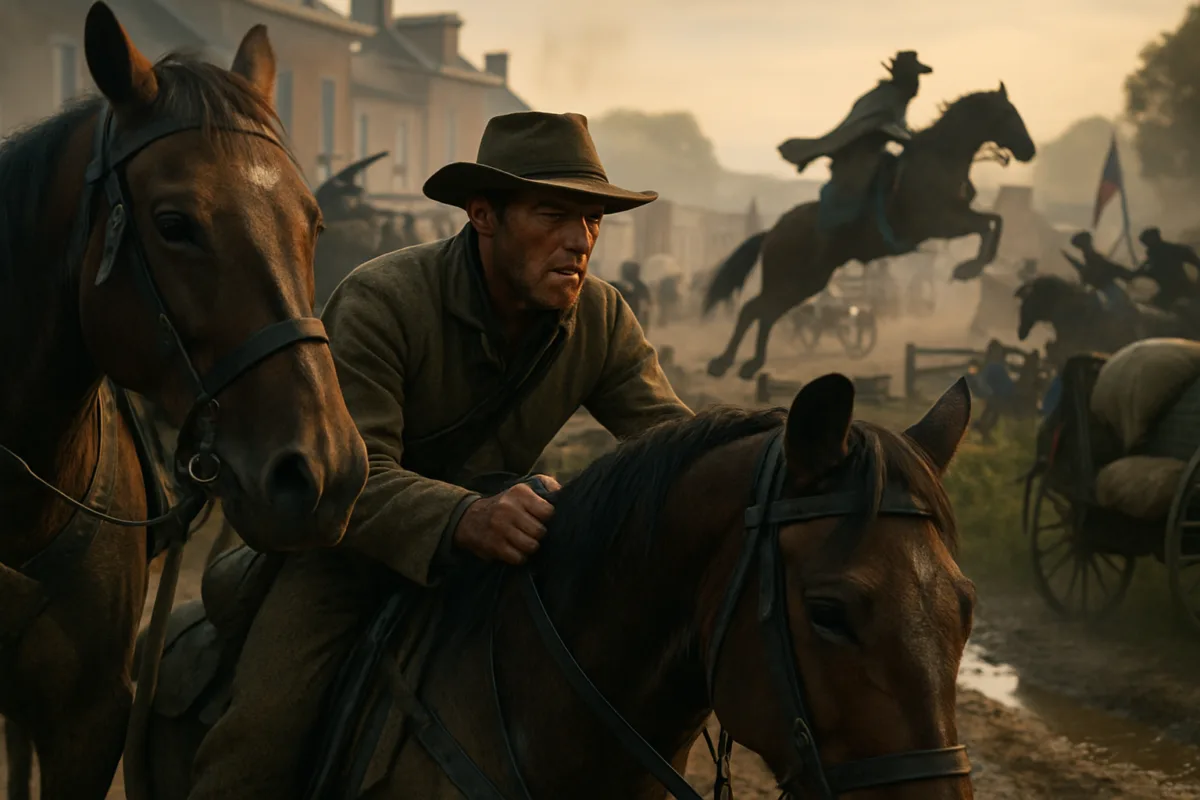
When historians argue about whether the small cavalry clash at Hanover saved the Union at Gettysburg, they are really arguing about agency, causation, and the slippery logic of counterfactual history. The Hanover encounter certainly mattered — it delayed Confederate cavalry commander J.E.B. Stuart at a moment when Robert E. Lee desperately needed eyes and ears — but to credit a single skirmish with deciding the fate of Gettysburg is to oversimplify how campaigns actually unfold. The more convincing case is that Hanover was one significant link in a chain of decisions and misfortunes; the chain began with Stuart’s route choice and was forged in the fog of war.
The tempting but flawed counterfactual
At first glance, the narrative is seductive: Stuart is held up at Hanover, he fails to rejoin Lee in time, Lee marches into Gettysburg partially blind, and the Confederacy suffers a defeat that it never fully recovers from. It is tidy and satisfying. Yet tidy histories rarely withstand scrutiny. Military outcomes are rarely the product of a single event. Campaigns are complex webs of decisions, logistics, terrain, timing, and the enemy’s reactions. Claiming Hanover “saved” the Union elevates a tactical stalemate into strategic determinism and ignores the earlier strategic choices that placed Stuart where he was to begin with.
What actually happened at Hanover
On June 30, 1863, elements of Stuart’s cavalry, including Chambliss’ brigade and the 13th Virginia Cavalry, collided with the Federal rear-guard commanded by Judson Kilpatrick in and around Hanover, Pennsylvania. The fighting was intense for a few hours: cavalry charges through streets and farms, artillery harrying movements, and notably a near-capture of Stuart himself when he narrowly escaped across an irrigation ditch. Casualties were modest by Civil War standards — roughly double on the Union side — but the tactical result mattered as Federal forces denied Stuart possession of the town and forced him to pause.
Hanover as delay, not destiny
Stuart intended to move rapidly north and east, linking with Ewell at York and providing Lee with critical reconnaissance. The Hanover fight cost him time and exhausted men and horses, forcing a grueling forced march that night to regain lost ground. But it is crucial to separate the delay caused by Hanover from the delays that preceded it. Stuart had already taken a longer, more circuitous route around the Union Army — a deliberate decision to move southeast rather than west on June 25 — and had been slowed by captured wagon trains, denied crossings, and skirmishes along the route. Hanover amplified the problem; it did not originate it.
Stuart’s choice: calculated risk or fundamental error?
The heart of the argument should not be whether Hanover happened, but whether Stuart should have been where Hanover made a difference. Lee had asked Stuart to protect Ewell’s right and, if possible, to move in a way that would mask Confederate intentions. Stuart’s response was audacious: a long ride that would circle around the Federal army and, theoretically, deliver surprise and vital intelligence. That audacity had precedent — Stuart had previously ridden around McClellan’s army in 1862, producing intelligence that helped Lee win at the Seven Days Battles. But audacity works only when the balance of risk and reward is properly judged.
Costs of the circuitous route
Stuart’s decision to go east relied on open roads and the assumption that he could outpace or bypass the Army of the Potomac. That assumption failed. He encountered unexpected concentrations of Federal columns on roads he needed, was denied a Potomac crossing that would have shortened his route, and became bogged down while raiding supply points and shepherding a captured wagon train. Each delay multiplied the difficulty of rejoining Lee. By the time Stuart disengaged at Hanover and pressed on, he was racing time already lost.
The wagon train paradox
Critics argue the wagon train of captured supplies slowed Stuart; defenders point out those supplies reduced foraging time for thousands of horses. Both views are true and highlight why assigning final responsibility for Stuart’s absence to a single element is misleading. Operational mobility is not just distance and roads; it is the condition of horses, the exhaustion of troopers, and the logistical tail. The wagon train altered the equation, neither wholly helpful nor wholly harmful.
Fog of war, Clausewitz, and Moltke
Military theory reminds us that no plan survives first contact with the enemy. Clausewitz’s concept of the ‘‘fog of war’’ and Moltke’s famous aphorism about plans not surviving contact both apply to Stuart. Communications were slow, maps imperfect, and the strategic picture fuzzy. Lee himself displayed unusual caution at Gettysburg, a trait often traced to his lack of cavalry intelligence. That caution had operational effects: Lee was less willing to exploit opportunities on the first day because he did not know the true disposition of the Union forces he faced.
Would Stuart’s presence have changed Lee’s decisions?
This is the core counterfactual. If Stuart had arrived on the morning of July 1, Lee might have enjoyed better situational awareness and more tactical options. Stuart could have screened flanks, provided scouting reports, and threatened Union communications—all of which would have complicated Meade’s responses. But even with those advantages, Lee still faced formidable obstacles: interior lines, strong high-ground positions occupied by the Union, and the practical difficulties of coordinating large corps maneuver in unfamiliar terrain. Stuart’s cavalry was a force multiplier for reconnaissance and harassment, not a corps-sized hammer that could by itself deliver a decisive breakthrough.
Hanover’s real contribution to Gettysburg’s narrative
Rather than a single decisive event, Hanover is best understood as an accelerant of pre-existing problems. It magnified the consequences of Stuart’s route choice, added wear to men and animals, and cost a critical day that might otherwise have been used to close with Lee. Stuart’s eventual arrival on the afternoon of July 2 — after crucial decisions and engagements had already occurred — limited his usefulness and left Lee fighting without the cavalry’s eyes for a critical period.
Operational context matters more than the skirmish
Turning Hanover into the pivot of Gettysburg’s outcome simplifies a much messier truth: campaigns are the sum of many small events interacting in unpredictable ways. Stuart’s absence was a serious handicap for the Army of Northern Virginia, but it was a handicap that grew out of earlier operational choices. The initial decision to take an eastern route, compounded by denied crossings, skirmishes, and the burden of captured supplies, created a cascade of delays. Hanover was part of that cascade, not the only pebble on the slope.
Historians and enthusiasts understandably seek a single cause that explains monumental outcomes; it makes narratives easier to teach and to tell. Yet the responsible interpretation acknowledges complexity. Stuart bears responsibility for misjudging the risks of his chosen route, and Hanover served as a consequential but not solitary factor. Lee’s caution at Gettysburg, the Union army’s unexpected movements, and the terrain itself all played roles of equal or greater weight. The most defensible conclusion is that Hanover mattered and made things worse for Lee, but to say it alone “saved” the Union is to mistake one cog in a war machine for the engine itself. That distinction keeps us honest about how history actually happens and reminds us that battlefield destiny is rarely written by a single skirmish.

Dr. Morgan directed the Archives Program from 2014 to 2017, gaining extensive experience in research documentation, information management, and the preservation of scholarly resources. Throughout her career, she has worked closely with academic publications and research materials, developing expertise in evaluating scientific sources and communicating complex topics to broad audiences.
Her primary areas of specialization include scientific publishing, research communication, editorial review, and the translation of technical research into accessible educational content. She has contributed to projects involving space science, astronomy, environmental science, history, archaeology, and emerging scientific discoveries, always emphasizing accuracy, transparency, and the responsible presentation of evidence.
As Editorial Director of Muskurahat.us, Dr. Morgan leads the editorial review process for scientific articles, ensuring that content is based on reputable sources, peer-reviewed research whenever available, and publications from recognized universities, research institutions, and international scientific organizations.
She is committed to promoting scientific literacy through clear, engaging, and well-documented articles that help readers better understand scientific discoveries and their impact on society. Her editorial philosophy is founded on accuracy, intellectual integrity, independent journalism, and continuous learning as scientific knowledge evolves.
Through her work at Muskurahat.us, Dr. Morgan supports the publication of trustworthy scientific content that makes complex research accessible to readers around the world while maintaining rigorous editorial standards.