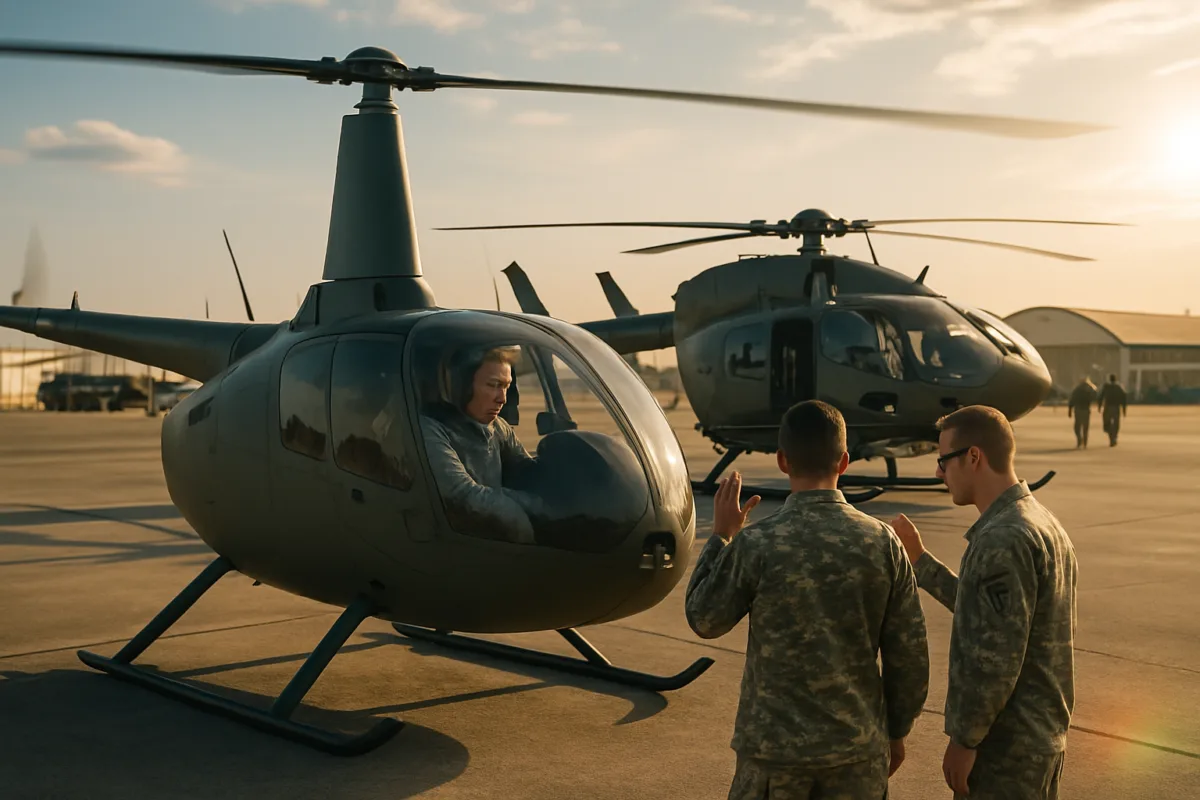
The US Army’s decision to pivot from the twin‑engine UH‑72 Lakota to the simpler, single‑engine Robinson R66 for initial helicopter flight training is not merely a budgetary accommodation — it is a deliberate pedagogical correction that addresses how we teach fundamentals, manage risk, and steward scarce aviation resources. Flight School Next, led by contractor M1 Support Services, embodies the argument that simpler machines produce better basic aviators, and that outsourcing the non‑core burdens of maintenance and logistics can let the Army focus on what matters most: producing safe, competent pilots.
The central thesis: simplicity breeds skill
At the heart of the Army’s decision is a pedagogical premise that should be familiar to anyone who has watched a novice learn a complex skill: remove unnecessary automation during the earliest learning moments, and students must learn the mechanics rather than the shortcuts. The UH‑72 Lakota is a capable, modern twin‑engine platform laden with automation and systems designed to support complex missions. Those features make it an excellent operational aircraft, but they can be a crutch for trainees. The Robinson R66, by contrast, is a stripped‑down turbine helicopter that forces early students to master stick‑and‑rudder flying, hovering, energy management, and basic navigation without leaning on sophisticated flight management systems.
Real pilots learn fundamentals first
Civilian flight training offers the clearest analog. Student rotary‑wing pilots cut their teeth in light trainers like the Robinson R22 before moving on to more capable machines. Fixed‑wing students learn in Cessna 152s or 172s — forgiving, low‑cost platforms that teach the basics. This is not nostalgia for simpler times; it’s a cost‑effective and safety‑driven pedagogy. If civilian flight schools use inexpensive trainers to teach fundamentals, it’s wise for a military service to adopt a similar logic rather than introducing novices to highly automated systems that can mask skill deficiencies.
Costs, crashes, and accountability: the economic and safety calculus
Operational realities push the argument further. Training hours on a twin‑engine UH‑72 burn significantly more fuel, increase maintenance cycles, and accelerate component wear. The Army is rightly scrutinized for both costs and safety: recent high‑profile accidents, including the fatal AH‑64 Apache crash in Texas, underscore a renewed focus on pilot proficiency and error prevention. Reducing per‑hour training costs via a simpler platform allows more hours of practice for the same budget — and more practice against fundamentals correlates with fewer mistakes in advanced aircraft.
Economics without blind thrift
The Flight School Next deal — potentially up to $10 billion over decades — is not merely a procurement price tag. It’s a comprehensive training ecosystem: aircraft, simulators, academic instruction, and maintenance packaged under a contractor‑owned, contractor‑operated (COCO) model. That model shifts day‑to‑day operational responsibilities to M1 Support Services, promising higher availability and predictable lifecycle support. Done right, COCO reduces administrative friction and can be more economical than the Army owning and maintaining a fleet dedicated to a training role.
Anticipating the critiques: single‑engine risks and contractor dependence
No policy choice is free of tradeoffs. Critics will rightly point out two central concerns: first, that single‑engine training may not prepare pilots for multi‑engine emergency management; second, that outsourcing training assets and maintenance creates dependencies and potential vulnerabilities.
Single‑engine training does not equal single‑engine doctrine
The R66 is a single‑engine turbine that meets the Army’s criteria for initial training: turbine exposure, counterclockwise main rotor, and a configuration that compels hands‑on flying. But training on an R66 need not and should not be the entirety of an aviator’s education. The Army retains responsibility for ensuring that pilots meet defined standards before they transition to operational platforms. The pedagogical sequence is critical: rigorous basics on an R66 (or similar) followed by instrument and twin‑engine transition training — conducted in simulators and retained Lakotas or dedicated twin‑engine trainers — will produce aviators who are both fundamentalists and technically competent.
Moreover, modern simulators can faithfully model engine‑out procedures, complex emergency scenarios, and systems failures in multi‑engine aircraft at a fraction of the risk and cost of live flights. Embracing a mixed pipeline — simple live trainers for psychomotor skills and high‑fidelity sims for systems and emergency management — combines the best of both worlds.
COCO is efficient—but it requires vigilant oversight
The COCO model brings efficiency but also necessitates strong contractual oversight. A contractor owning and operating the training fleet means the Army trades some direct control for accountability defined in contracts and performance metrics. That trade can be acceptable if deliverables — sortie rates, safety performance, instructor quality, and aircraft availability — are tightly specified and monitored. The Army must resist complacency: long‑term contracts can ossify practices and create mission risk if incentives are misaligned or if the contractor’s profit motive overrides conservative safety decisions.
Safeguards the Army should insist upon
First, measurable safety and training performance metrics tied to payments. Second, contractual clauses that preserve the Army’s right to audit maintenance and training quality. Third, reserved capability: retain a portion of Army‑owned Lakotas for instrument, formation, and twin‑engine transition training and for use in circumstances where security or classified training is required. Finally, maintain robust simulator programs that replicate multi‑engine emergencies so pilots are not learning those high‑consequence procedures for the first time in a combat platform.
Longer-term impacts: culture, recruitment, and readiness
Training choices shape organizational culture. Sending novices first into a simple, honest aircraft communicates that skill matters — that the service values technically proficient pilots capable of manual flying and sound judgment. That cultural signaling can affect retention and recruitment positively: many prospective aviators are attracted to hands‑on flying, not only to flashy platforms. Conversely, a training regime that overemphasizes automation risks producing pilots who are ill‑prepared for degraded environments where manual skill becomes decisive.
There is also the matter of readiness. If the R66 pipeline allows the Army to graduate more pilots with superior fundamentals per dollar spent, the service alleviates chronic pilot shortages more sustainably than simply buying more advanced trainers that blow through budgets. A healthier pipeline means higher operational readiness across Black Hawks, Apaches, and Chinooks because pilots arrive better prepared to absorb complex mission systems.
What success looks like
To judge whether Flight School Next achieves its promise, the Army must define clear indicators of success: reduced mishap rates tied to basic airmanship errors, lower per‑student training costs without quality degradation, and demonstrable proficiency gains when pilots transition to advanced platforms. Transparency will matter: publishing anonymized metrics and third‑party safety audits will help Congress, the public, and the aviation community evaluate whether the COCO model and the R66 platform are delivering on their pedagogical and fiscal promises.
It will also be essential to preserve agility in the program. Technology and training science evolve. If data show that particular lessons are better taught in different environments or that additional safeguards are needed for single‑engine training, the Army must be able to iterate in contract modifications or supplemental instruction requirements.
Finally, the Army must ensure that training remains holistic: mechanized fundamentals, instrument proficiency, systems knowledge, and combat mission tasking must all be present in the arc from student to frontline aviator. The R66 is a tool — a deliberate tool — not an end in itself.
Switching the initial trainer from UH‑72s to R66s under Flight School Next is a defensible and forward‑looking correction. It recognizes the limits of automation in early skill acquisition, leverages cost efficiencies that can fund more training hours, and aligns military practice with civilian flight training wisdom. But the program will live or die on its implementation: rigorous standards, retained twin‑engine transition training, strong contractual oversight, and transparent performance measurement. If those conditions are met, the Army’s next generation of helicopter pilots will be more competent, safer, and better prepared for the complexity of combat aviation than they would have been otherwise.
Understanding that the move is not a repudiation of the Lakota — which remains valuable as an operational platform — but a recognition that teaching starts with the fundamentals, should make critics more comfortable. The R66 isn’t a downgrade; it’s a pragmatic investment in human skill that appreciates the difference between machines built for missions and machines built to teach. With careful oversight and a commitment to comprehensive transition training, this shift can produce the kind of pilots who survive complex contingencies, reduce mishaps, and ensure the Army’s air arm remains lethal, resilient, and sustainably trained.

Dr. Morgan directed the Archives Program from 2014 to 2017, gaining extensive experience in research documentation, information management, and the preservation of scholarly resources. Throughout her career, she has worked closely with academic publications and research materials, developing expertise in evaluating scientific sources and communicating complex topics to broad audiences.
Her primary areas of specialization include scientific publishing, research communication, editorial review, and the translation of technical research into accessible educational content. She has contributed to projects involving space science, astronomy, environmental science, history, archaeology, and emerging scientific discoveries, always emphasizing accuracy, transparency, and the responsible presentation of evidence.
As Editorial Director of Muskurahat.us, Dr. Morgan leads the editorial review process for scientific articles, ensuring that content is based on reputable sources, peer-reviewed research whenever available, and publications from recognized universities, research institutions, and international scientific organizations.
She is committed to promoting scientific literacy through clear, engaging, and well-documented articles that help readers better understand scientific discoveries and their impact on society. Her editorial philosophy is founded on accuracy, intellectual integrity, independent journalism, and continuous learning as scientific knowledge evolves.
Through her work at Muskurahat.us, Dr. Morgan supports the publication of trustworthy scientific content that makes complex research accessible to readers around the world while maintaining rigorous editorial standards.