Who decides where the edge of space begins, and why should any of us care? The phrase edge of space appears in headlines and brochures, yet it masks a real and growing policy gap: a 20-kilometre band where physics, commerce, and national security collide. That band no longer hosts only experimental flights; it contains paying passengers, commercial marketing claims, and hypersonic trajectories that prompt questions about sovereignty and law.
Why the edge of space matters now for tourism and defense
For decades the lack of a definitive boundary between atmosphere and outer space was an academic quibble. Recently, however, commercial suborbital tourism and hypersonic weapons have turned that quibble into a practical problem. As a result, whether a flight is classified as ‘space’ or ‘high-altitude aviation’ affects advertising, safety regulation, liability, and potentially the interpretation of sovereign airspace.
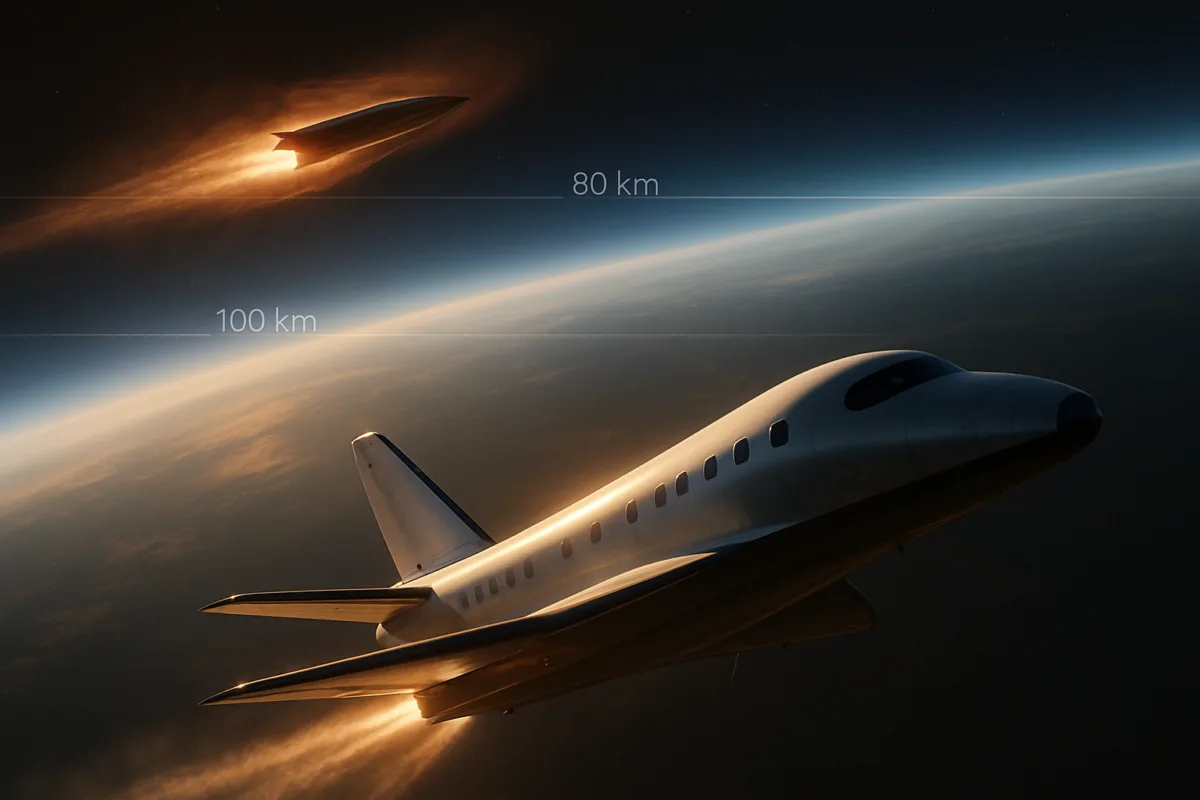
Moreover, different communities use different conventions: the Fédération Aéronautique Internationale endorses the 100-kilometre Kármán line, while U.S. practice has historically recognized 80 kilometres (50 miles). Therefore, an operationally meaningful decision is overdue because business models and military planning depend on it.
Scientific debate: Kármán, satellites, and atmospheric effects
Science does not deliver a single, definitive line. The original Kármán line at 100 kilometres is a records-keeping convention that fit a mid-20th-century view of aeronautics versus astronautics. Yet those physical arguments are contingent: different metrics—lift versus orbit survivability versus meteor ablation—point to different numbers.
For example, Jonathan McDowell used satellite orbital survival and perigee behavior to argue that 80 kilometres is a more practical boundary, since orbits dipping below roughly 80 kilometres rarely survive. Conversely, lift-based analyses can point higher, near 110 kilometres. In short, physics informs the choice but does not mandate one.
The legal void: treaties without a demarcation
International law compounds the confusion. The 1944 Chicago Convention affirms state sovereignty over airspace, while the 1967 Outer Space Treaty declares outer space beyond national appropriation. Neither treaty, however, defines where airspace ends and outer space begins. Consequently, no clear legal line exists that states have agreed upon to resolve sovereignty disputes linked to high-altitude vehicles.
As a result, a hypersonic test or a suborbital overflight could be characterized differently depending on which convention a state prefers—and that inconsistency carries diplomatic and security risks.
Commercial stakes: astronaut wings, marketing, and consumer expectations
Space tourism firms have a commercial incentive to claim that their customers reached space. Blue Origin emphasized flights above the Kármán line; Virgin Galactic flew passengers to about 86 kilometres and marketed those flights as ‘spaceflights’ under U.S. definitions. That 20-kilometre gap thus changes ticket copy, advertising veracity, and customer expectations.
Furthermore, regulatory recognition matters. The FAA’s historical use of 50 miles for astronaut wings and the FAI’s retention of 100 kilometres create parallel credentialing systems. For consumers and pilots, these mixed signals are confusing and undermine consistent safety and liability frameworks.
Military implications: hypersonic paths and sovereignty questions
Hypersonic boost-glide vehicles routinely traverse altitudes that cross into the disputed band. Some designs may briefly reach 120 kilometres before descending to tens of kilometres for the remainder of their trajectory. For neighboring states, a vehicle flying at 90 kilometres raises questions: did it traverse sovereign airspace or was it passing through outer space?
Without an agreed boundary, the interpretation falls back to political judgment. That is dangerous because ambiguity invites miscalculation; an agreed convention would at least reduce a vector for unnecessary escalation, even though it would not alone resolve legal permissibility of weapon use.
Argument for adopting 80 kilometres as a pragmatic standard
The case for adopting 80 kilometres as a working international convention is persuasive on operational grounds. It aligns with satellite orbital behavior and the practical point at which meteors begin to ablate, which are observable and reproducible phenomena. For regulatory regimes, an 80-kilometre line would better map to how vehicles actually behave.
Additionally, shifting to an 80-kilometre convention would harmonize the U.S. historical practice with a science-informed metric, reduce marketing disputes about whether a flight reached space, and clarify some aspects of activity oversight that matter to both operators and passengers.
Counterarguments and why they matter
That said, defenders of the 100-kilometre Kármán line emphasize continuity and the symbolic value of a century-old convention. Changing a long-standing standard risks producing transitional confusion among record-keeping bodies and international organizations. Moreover, some physical calculations—particularly those focused on aerodynamic lift—point toward a somewhat higher boundary.
Nevertheless, these counterarguments are about conventions, not immutable physics, and policy should prioritize operational clarity and international buy-in over historical inertia.
Transitional issues to anticipate
For example, switching conventions would require updating record books, marketing rules, insurance policies, and possibly national credentialing for astronaut wings. Coordination will be needed among aviation regulators, space agencies, and international bodies to ensure a smooth transition and to prevent regulatory arbitrage.
Therefore, a managed, multi-year harmonization plan is essential if any new boundary is to be widely accepted and practically useful.
How to build an effective international process
First, the debate needs a neutral technical review that synthesizes satellite data, atmospheric science, and operational flight logs. Second, an inclusive multilateral body—perhaps a UN-facilitated panel with experts, industry, and military observers—should translate that technical review into a recommended convention. Third, signatory states should commit to phased implementation to allow regulatory and commercial systems to adapt.
Moreover, transparency and public engagement are critical. Tourism customers and civil society need to see how the numbers were chosen and what the implications will be for safety, liability, and privacy.
Policy recommendation: adopt 80 kilometres as the working convention
Given the balance of operational evidence and the growing stakes, policymakers should converge on 80 kilometres as a pragmatic working definition for the boundary of space. This does not require rewriting the Outer Space Treaty or the Chicago Convention; rather, it asks international bodies and national regulators to accept a harmonized convention for record-keeping, commercial labeling, and much of civil oversight.
At the same time, the recommendation should include carve-outs and clarifications for military and sovereign concerns, preserving state discretion where national security is implicated and allowing room for case-by-case diplomatic resolution.
Next steps for industry, regulators, and militaries
Industry must stop treating the boundary as a marketing free-for-all: firms should adopt clear, standardized language that explains which convention they report and what it means for safety and liability. Regulators should harmonize definitions across aviation and space authorities to reduce confusion for consumers and insurers.
Finally, militaries should engage openly in multilateral discussions so that sovereignty and security considerations are incorporated into any agreed convention. Without their buy-in, any standard risks being politically hollow.
The debate over where space begins is not an abstract semantic fight; it is a policy choice with concrete consequences for commerce, safety, and security. Pragmatically adopting an 80-kilometre working convention—backed by transparent science, phased implementation, and explicit military safeguards—would reduce ambiguity and create a stable operating environment for new industries and technologies. Policymakers, industry leaders, and defense planners can begin this work now by commissioning an authoritative technical review, committing to a harmonization timeline, and agreeing on standardized public disclosures that explain what ‘space’ means in practice.

Dr. Morgan directed the Archives Program from 2014 to 2017, gaining extensive experience in research documentation, information management, and the preservation of scholarly resources. Throughout her career, she has worked closely with academic publications and research materials, developing expertise in evaluating scientific sources and communicating complex topics to broad audiences.
Her primary areas of specialization include scientific publishing, research communication, editorial review, and the translation of technical research into accessible educational content. She has contributed to projects involving space science, astronomy, environmental science, history, archaeology, and emerging scientific discoveries, always emphasizing accuracy, transparency, and the responsible presentation of evidence.
As Editorial Director of Muskurahat.us, Dr. Morgan leads the editorial review process for scientific articles, ensuring that content is based on reputable sources, peer-reviewed research whenever available, and publications from recognized universities, research institutions, and international scientific organizations.
She is committed to promoting scientific literacy through clear, engaging, and well-documented articles that help readers better understand scientific discoveries and their impact on society. Her editorial philosophy is founded on accuracy, intellectual integrity, independent journalism, and continuous learning as scientific knowledge evolves.
Through her work at Muskurahat.us, Dr. Morgan supports the publication of trustworthy scientific content that makes complex research accessible to readers around the world while maintaining rigorous editorial standards.