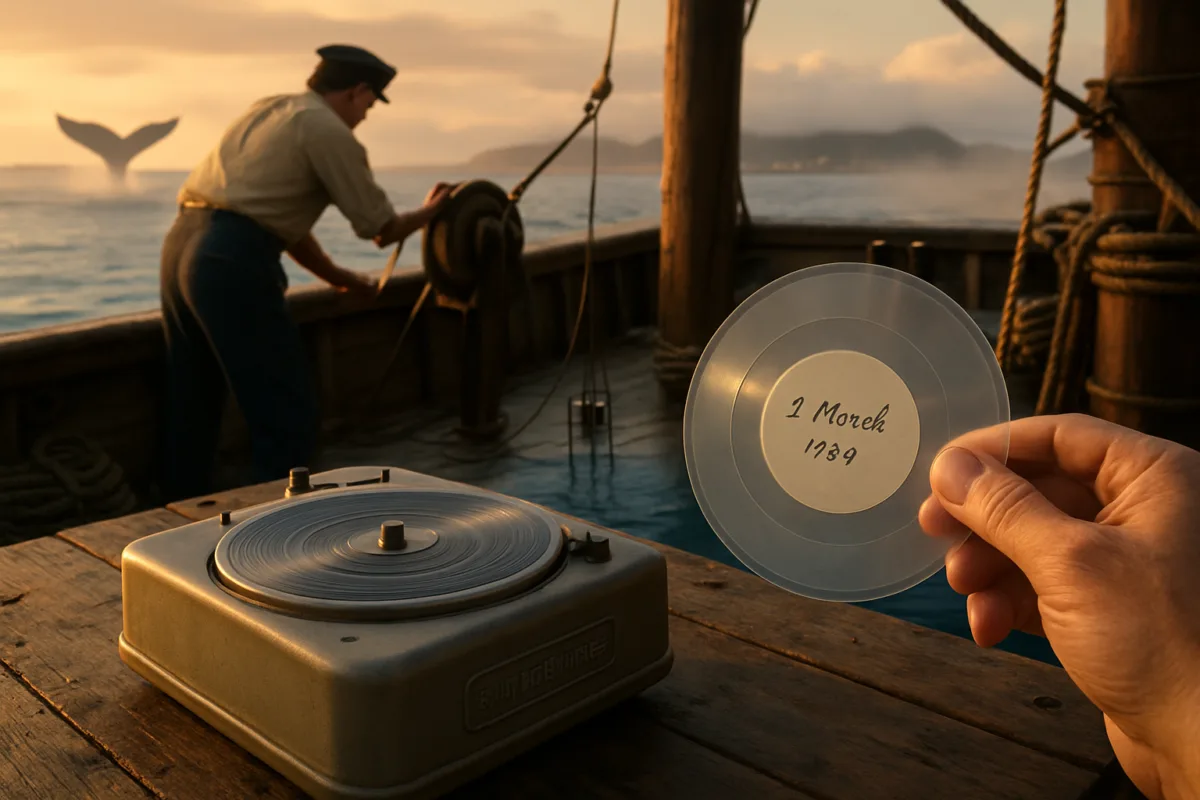
The oldest whale recording emerging from a 1949 audograph disc off Bermuda is more than a quaint museum curiosity; it is evidence that archiving the unexplained can reshape scientific narratives decades later. From the moment a low, looping sound was etched onto plastic, someone made a choice to keep data—an act that today we should treat as a clear obligation. This single preserved humpback whale song challenges how we value ephemeral field data and demands that we invest in preserving our sonic past.
Why the 1949 recording changes how we think about early whale recordings
First, the context matters: the primary keyword “oldest whale recording” is not merely a headline magnet. It signals a shift in how researchers reconstruct natural history when physical archives survive. The audograph disc from March 7, 1949 predates the widely credited 1960s discoveries about humpback song, meaning the acoustic behavior existed long before the scientific framework to interpret it.
Furthermore, accepting this disc as potentially the oldest preserved recording forces us to confront gaps. The record is thin for the 1940s, and that silence is meaningful. If archival luck had gone another way—magnetic tapes degrading, discs discarded—that sonic snapshot might never have been available to modern bioacousticians.
Preservation versus publicity: why careful phrasing matters
It is tempting to simplify the story with a sweeping superlative, but the phrase “may be the earliest preserved recording of a whale” is deliberately cautious and correct. Science thrives on precision, and overstated headlines corrode that precision. In other words, nuance is not pedantry here; it’s epistemic responsibility.
Moreover, hedging acknowledges the limits of our knowledge. Older recordings could exist unheard in other institutional drawers or private collections. WHOI’s careful language models good practice: celebrate discovery, but maintain the rigorous caveats that prevent misinformation from spreading.
What the 1949 disc tells us about the ocean soundscape
Beyond the individual whale, the recording is a time capsule of the late-1940s ocean soundscape. Sea noise from shipping, sonar testing, and other human activities has grown dramatically since then. Thus, an archival acoustic baseline lets us quantify change over decades rather than guessing how much human noise has altered marine life behavior.
For example, marine bioacousticians can compare spectral properties of the 1949 humpback sequence with contemporary recordings to detect shifts in pitch, duration, or complexity. These changes may reflect adaptation to increased background noise or cultural evolution among whale populations.
Why archival luck is not a strategy: the case for sustained digitization
The fortunate survival of a plastic disc should not be our only conservation plan. Plastic and magnetic media have different longevity profiles, and many mid-century recordings are vulnerable to decay. This is why targeted funding—like the modest $10,000 that enabled digitization in this case—has outsized scientific returns.
Consequently, institutions and funders must treat digitization as infrastructure, not as an optional archive hobby. Investing in systematic preservation will unlock data that answer long-term questions about marine ecology, climate impacts, and even historical human behavior at sea.
Actionable funding priorities for researchers and institutions
First, prioritize triage: identify media at highest risk and digitize those assets. Second, adopt open metadata standards so recordings are discoverable across institutional boundaries. Third, partner with community-driven grants to scale efforts; small awards can catalyze much larger outcomes when applied strategically.
These steps are practical and affordable relative to the scientific value they yield. The 1949 disc proves that a little archival money can produce big discoveries when combined with the right expertise.
Data stewardship as a duty across time
Collecting and preserving data when its meaning is unclear is not optional for responsible science. The 1949 researchers did not label the sound as whale song; they simply kept the recording because it was anomalous and thus potentially useful. That instinct is precisely what modern research culture needs to protect.
In other words, the ethical case for stewardship is inseparable from the epistemic case. Data that seem irrelevant today may become pivotal tomorrow, and preserving them respects both scientific integrity and intergenerational knowledge transfer.
How cautious interpretation benefits both science and the public
Careful phrasing around “earliest” versus “may be earliest” protects scientific credibility and prevents sensationalism. Sensational headlines attract clicks but often mislead readers and undermine trust in research institutions. Conversely, transparent claims with clear limitations invite deeper engagement and informed debate.
Thus, scientists and journalists share responsibility. The public deserves compelling stories, but not at the expense of accuracy. Maintaining that balance will ultimately strengthen support for archival projects and the long-term work of conservation science.
What historians and conservationists can learn from a single disc
Historians gain a rare primary source that complements written logs from mid-century research vessels. Conservationists gain a measurable baseline that can inform mitigation strategies for ocean noise. Together, these perspectives show how interdisciplinary thinking converts archival data into actionable insight.
For instance, policymakers could use historical soundscapes to set evidence-based noise regulations for shipping lanes. Likewise, researchers can test hypotheses about cultural drift in humpback songs across decades, tracking whether songs evolve in response to anthropogenic pressures.
Practical steps for readers who care about preserving scientific archives
Donate to reputable archives and digitization projects, advocate for local museum and library funding, or volunteer time if you have media-digitization skills. Encourage transparency from scientific institutions about what archives they hold and what they plan to digitize next.
Even non-specialists can lobby representatives for grants that support scientific infrastructure, especially projects that preserve irreplaceable data. Collective action matters because archival gaps are often a product of long-term underfunding rather than a lack of public interest.
The 1949 audograph disc teaches a decisive lesson: small choices about what to keep and how to protect it ripple across decades. By arguing for deliberate, well-funded preservation strategies and sober public communication, we ensure that future researchers have the raw materials to rewrite scientific narratives when warranted. Preserving unexplained data, supporting digitization, and demanding careful reporting are concrete actions that readers can take today to make sure the next seventy-seven-year discovery is not lost to the archives.

Dr. Morgan directed the Archives Program from 2014 to 2017, gaining extensive experience in research documentation, information management, and the preservation of scholarly resources. Throughout her career, she has worked closely with academic publications and research materials, developing expertise in evaluating scientific sources and communicating complex topics to broad audiences.
Her primary areas of specialization include scientific publishing, research communication, editorial review, and the translation of technical research into accessible educational content. She has contributed to projects involving space science, astronomy, environmental science, history, archaeology, and emerging scientific discoveries, always emphasizing accuracy, transparency, and the responsible presentation of evidence.
As Editorial Director of Muskurahat.us, Dr. Morgan leads the editorial review process for scientific articles, ensuring that content is based on reputable sources, peer-reviewed research whenever available, and publications from recognized universities, research institutions, and international scientific organizations.
She is committed to promoting scientific literacy through clear, engaging, and well-documented articles that help readers better understand scientific discoveries and their impact on society. Her editorial philosophy is founded on accuracy, intellectual integrity, independent journalism, and continuous learning as scientific knowledge evolves.
Through her work at Muskurahat.us, Dr. Morgan supports the publication of trustworthy scientific content that makes complex research accessible to readers around the world while maintaining rigorous editorial standards.