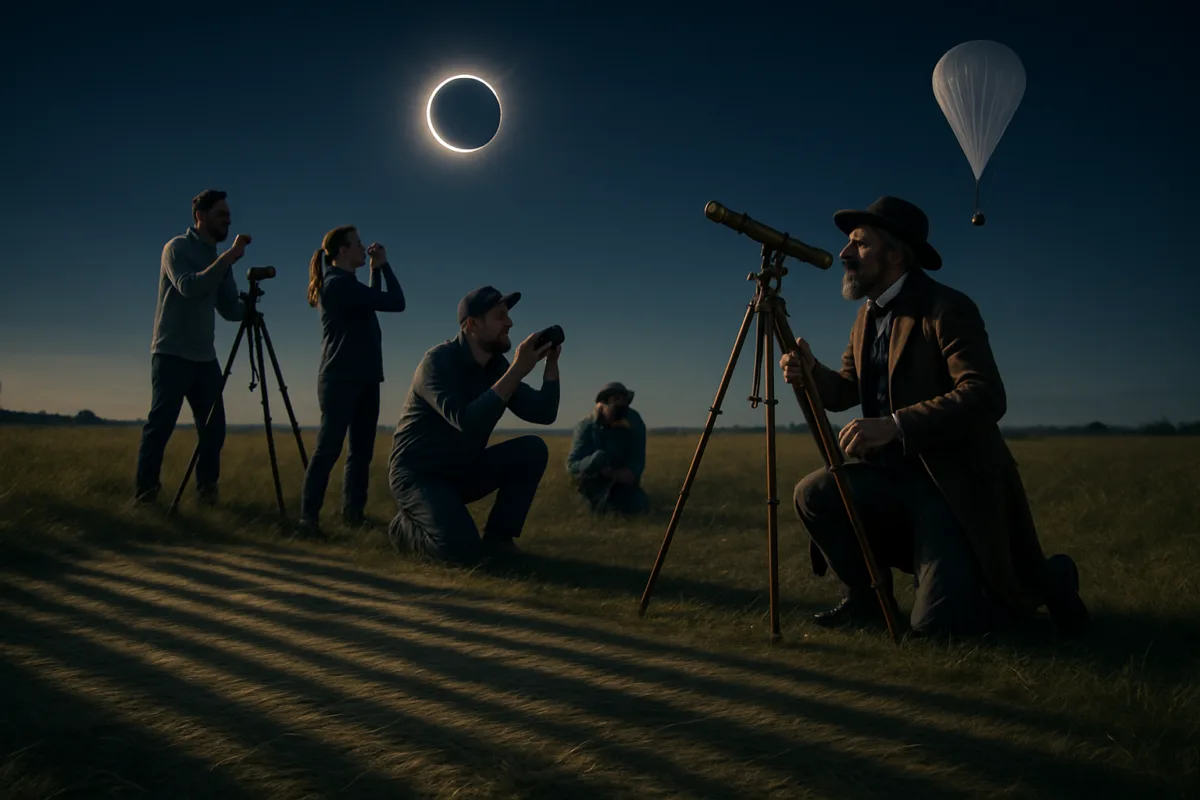
Few eclipse phenomena are as poetic and puzzling as shadow bands: thin, wavering ribbons of light and dark that race across the ground just before totality. Observers since at least the 19th century have reported these ripples, yet despite a widely cited turbulence explanation, the phenomenon resists precise prediction. That gap between accepted theory and stubborn anomaly matters for both atmospheric optics and how we teach scientific certainty.
The curious history of shadow bands and early eclipse observations
Historical accounts are the obvious place to begin when evaluating any long-standing scientific puzzle. The July 8, 1842 total solar eclipse produced some of the most often-cited early descriptions: astronomers noted undulating light along the Sun’s thinning crescent in the final minutes before totality, an effect later compiled into popular accounts.
But careful historians caution against romantic embellishment. Some retellings add colourful — and unverifiable — details, while earlier reports possibly describing the same effect date back even further. The point is not to deny the phenomenon’s long pedigree, but to underline that anecdote and selective memory are poor substitutes for controlled measurement.
Atmospheric scintillation: the standard shadow bands explanation
The textbook answer is straightforward: shadow bands are a form of atmospheric scintillation. As the Sun compresses into a thin crescent, it becomes an effectively narrow light source. Turbulent refractive index variations in the atmosphere then distort that narrow beam, producing alternating light and dark bands on the ground.
This model is attractive because it explains several qualitative features: the bands appear only in the minutes bracketing totality, they drift and change rapidly, and their prominence varies with local atmospheric conditions. For many observers and writers, that suffices to declare the mystery solved.
Why the standard model is incomplete
Yet appealing explanations do not equal predictive power. The turbulence-based account struggles with measurable details: typical band spacing, consistent apparent motion, and why similar atmospheric conditions sometimes produce very different band patterns. If a model cannot forecast spacing or velocity, it cannot be said to fully explain the phenomenon.
Moreover, different observational campaigns have produced contradictory inferences about where the effect originates in the atmosphere. These inconsistencies matter because they reveal gaps in the model, not merely quirks of reporting.
Balloon flights and conflicting measurements
To move beyond theory, researchers have taken the question into the sky. A team dubbed the “Shadow Bandits” flew high-altitude balloon payloads during recent total eclipses to test whether the bands form above the planetary boundary layer or lower down in near-surface turbulence.
Their 2017 flight returned data consistent with formation above the boundary layer, suggesting higher-altitude structures play a role. But the 2024 flights, using improved instruments across two U.S. sites, failed to reproduce that result, instead finding no signal above the boundary layer. That contradiction does not mean the question is trivial — it means the data are insufficient and experimental design needs tightening.
A geometric-optical alternative and the need for rigorous testing
Adding to the debate, a 2026 preprint argues that turbulence models cannot quantitatively produce observed spacing and motion and offers a geometric-optical analogy akin to Young’s double-slit experiment. That paper has not yet been peer-reviewed, but its existence is important because it reframes the debate: is the effect purely scintillation, or is there a coherent-optics component that textbooks have overlooked?
Either way, the two lines of research — balloon-borne atmospheric probes and geometric-optics modeling — are not mutually reinforcing. They highlight divergent mechanisms and, crucially, reveal the inadequacy of treating the phenomenon as closed simply because a plausible mechanism exists.
Why this unresolved question matters to science and education
At stake is more than a curiosity about eclipses. Shadow bands are a real-world test of atmospheric optics, turbulence theory, and observational rigor. If we accept a hand-wavy explanation in textbooks, students learn that plausible narratives can substitute for predictive science. Conversely, framing shadow bands as an open problem teaches scientific humility and the iterative nature of inquiry.
Furthermore, resolving the mechanics of shadow bands could improve understanding of atmospheric refractive processes relevant to ground-to-space optical links, adaptive optics, and remote sensing. The implications extend beyond aesthetics to applied optics and instrumentation.
What robust research on shadow bands should look like
Given the conflicting results to date, a systematic, multi-pronged research program is the logical next step. First, standardized observational protocols are essential: synchronized high-speed photometry across multiple wavelengths, precisely calibrated cameras, and coordinated timing at geographically distributed sites along the path of totality.
Second, repeatability matters. Launching multiple balloon payloads with redundant sensors during the same eclipse — and doing so across different eclipses — can separate site-specific anomalies from robust atmospheric features. Third, data must be archived openly to enable independent reanalysis and modeling efforts.
Integrating models and machine learning
Besides instrumentation, the analytical approach needs modernization. High-frame-rate video and photometric arrays can feed machine-learning models trained to classify band patterns, measure spacing, and estimate motion vectors. Those quantitative measurements would then serve as objective targets for both turbulence simulations and geometric-optical models.
By demanding that theories reproduce numerical descriptors — spacing distributions, velocity fields, spectral dependence — scientists force models to stand or fall on empirical accuracy rather than verbal plausibility.
Practical steps: how professional and amateur communities can contribute
Practically speaking, a coordinated campaign need not be expensive. Amateur astronomers already contribute high-quality eclipse footage; a community-driven standard for data collection (frame rate, exposure, spectral filters, GPS-synced timing) could turn scattered anecdotes into a scientific dataset.
Meanwhile, funding agencies should support a modest number of well-designed balloon flights, with clear experimental controls and multi-site coverage. Collaboration between atmospheric physicists, optical engineers, and citizen scientists will maximize coverage and reduce the chance that a single anomalous flight will skew interpretation.
Addressing common counterarguments
Some will say that devoting resources to shadow bands is a luxury when larger atmospheric questions exist. But targeted experiments are relatively low-cost and high-yield: the instrumentation is modest, and eclipses provide predictable windows for concentrated observation. Moreover, refining how we measure and model small-scale atmospheric optics has outsized benefits for other fields.
Others argue that the phenomenon is already ‘explained enough’ for practical purposes. That complacency ignores the scientific value of precision. Understanding why similar atmospheric conditions produce divergent band behavior is not trivia; it’s a test of our models’ completeness.
Transitioning from curiosity to predictive capability
To transform shadow bands from an interesting anecdote into a predictive science, researchers must demand repeatable, quantitative results. This requires explicit hypotheses (e.g., band spacing scales with refractive index structure function parameters at X altitude) and experiments designed to reject those hypotheses if wrong.
Only by making the models falsifiable and then performing the experiments can we move beyond plausible narratives to confident prediction. That shift is the hallmark of mature science, not of finished curiosity.
Shadow bands are more than a poetic footnote to an eclipse; they are an unresolved experimental problem that illuminates how science handles anomalies. The way forward is clear: coordinated, high-speed, multi-site observations; balloon campaigns with rigorous controls; open data and cross-disciplinary analysis; and the inclusion of citizen scientists as structured contributors. Those steps will either reinforce the scintillation framework with quantitative precision or reveal a new optical mechanism — either outcome advances knowledge.
If you plan to observe an upcoming eclipse, consider contributing to a standardized data collection effort: use a GPS-synced camera, record at high frame rates, document local atmospheric conditions, and share raw files to a public repository. That kind of participation turns wonder into evidence and helps solve a question that has rippled across the ground for nearly two centuries.

Dr. Morgan directed the Archives Program from 2014 to 2017, gaining extensive experience in research documentation, information management, and the preservation of scholarly resources. Throughout her career, she has worked closely with academic publications and research materials, developing expertise in evaluating scientific sources and communicating complex topics to broad audiences.
Her primary areas of specialization include scientific publishing, research communication, editorial review, and the translation of technical research into accessible educational content. She has contributed to projects involving space science, astronomy, environmental science, history, archaeology, and emerging scientific discoveries, always emphasizing accuracy, transparency, and the responsible presentation of evidence.
As Editorial Director of Muskurahat.us, Dr. Morgan leads the editorial review process for scientific articles, ensuring that content is based on reputable sources, peer-reviewed research whenever available, and publications from recognized universities, research institutions, and international scientific organizations.
She is committed to promoting scientific literacy through clear, engaging, and well-documented articles that help readers better understand scientific discoveries and their impact on society. Her editorial philosophy is founded on accuracy, intellectual integrity, independent journalism, and continuous learning as scientific knowledge evolves.
Through her work at Muskurahat.us, Dr. Morgan supports the publication of trustworthy scientific content that makes complex research accessible to readers around the world while maintaining rigorous editorial standards.