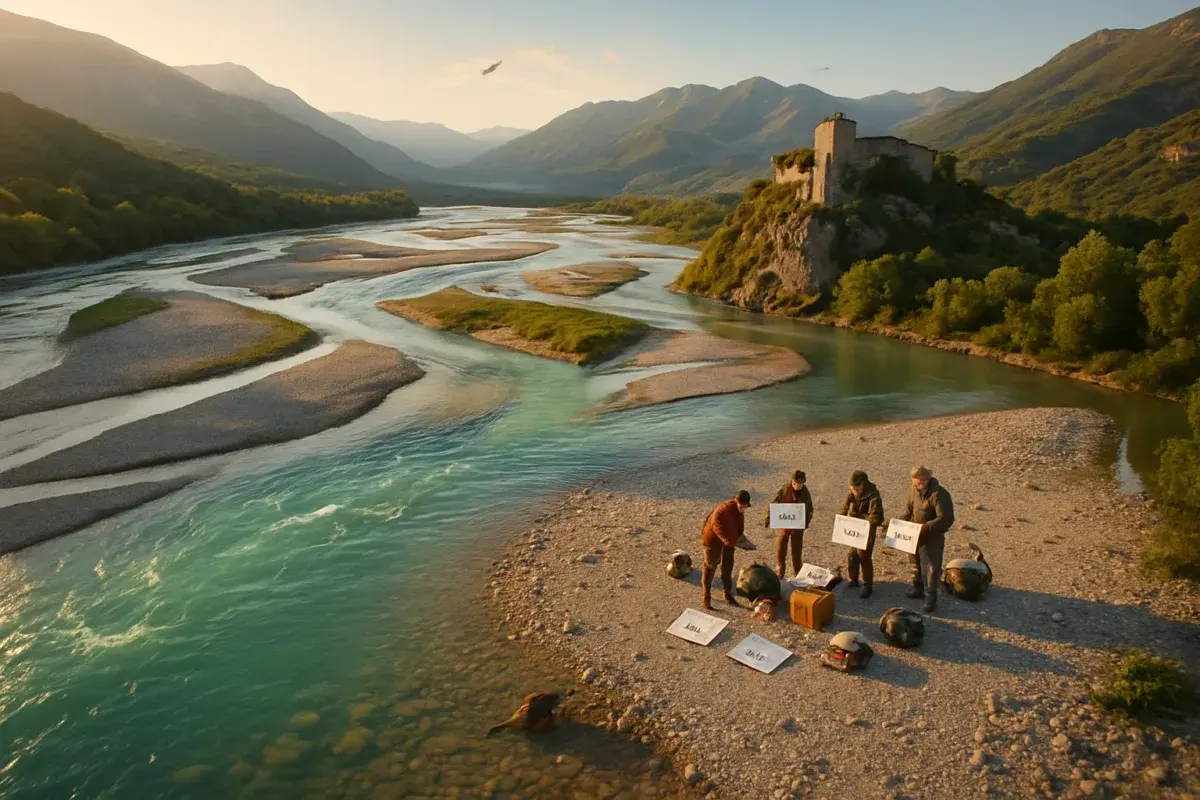
Europe prides itself on progress and engineering prowess, yet progress has a blind side: the systematic reengineering of rivers. The Vjosa — Aoös in its Greek upper reaches — stands out not because it is merely scenic, but because it still behaves like a river did before industrial civilisation. That single fact should force a reassessment of how we value natural systems. The Vjosa’s legal protection as a Wild River National Park in Albania was not an indulgent luxury for romantics; it was an essential corrective to centuries of short-term decision making that favoured immediate energy and development gains over the irreplaceable services of intact ecosystems.
Why the Vjosa matters ecologically and economically
The argument in favour of protecting the Vjosa is straightforward: intact river systems deliver a bundle of ecological functions that are expensive or impossible to replicate once destroyed. The Vjosa still flows freely from the Pindus mountains to the Adriatic, forming narrow gorges, braided midsections and a near-natural delta. These dynamic processes create habitat diversity — islands appear and disappear, floodplains are regularly renewed, and sediment is redistributed across the basin. Those are not aesthetic luxuries; they’re central life-support functions.
Scientific inventories show more than 1,100 animal species in the Vjosa and its tributaries, including endangered and endemic species such as the Balkan lynx and several threatened fish and plant species. These biological values ripple into economic ones: groundwater recharge, flood mitigation, fertile agricultural plains, fish stocks and eco-tourism. A functioning river is a natural infrastructure asset that pays dividends across sectors and generations. To suggest its value can be reduced to a one-off calculation of kilowatt-hours from hydropower is to misunderstand both ecology and economics.
The limits of hydropower as a development paradigm
Hydropower is often framed as a clean, renewable fix to energy needs, but that framing obscures significant trade-offs. Dams trap sediment, fragment habitats, alter flood regimes and block migratory pathways. Yes, they produce electricity, but they also erase entire ecological processes and force costly, imperfect engineering remedies. European examples of restoration show that once a river has been dammed, restoring its functions is slow, expensive and frequently incomplete.
Moreover, the economic calculus that justifies dams often ignores indirect costs — lost fisheries, diminished tourism, altered groundwater regimes and the social impacts on communities along floodplains. The Vjosa case exemplifies how a narrow focus on energy generation can overlook broader, long-term value. The Albanian government initially saw hydropower as the obvious path to meet rising demand; what defenders of the river argued successfully was that the country could capture greater, more enduring value by preserving the river’s natural functioning instead.
An ecological argument that is also pragmatic
There is nothing puritanical about defending the Vjosa. The argument is opportunistic in the best sense: protecting an intact system is the most cost-effective way to deliver multiple public goods. Engineers can approximate some ecological functions with infrastructure, but never perfectly and almost never without enormous recurring costs. From flood control to groundwater recharge to fisheries health, the Vjosa’s free flow supplies services that would be prohibitively expensive to replicate. In short, the precautionary and pragmatic move is preservation, not substitution.
How the Vjosa victory was won — and why the strategy matters
The Vjosa’s protection was not a lucky accident or a top-down decree born of sudden environmental conscience. It was the outcome of sustained, strategic advocacy, rigorous science, legal action and creative international alliances. Two Albanian scientists, working through EcoAlbania, spent a decade assembling the evidence, mobilising local communities and challenging proposed hydropower projects in court. Their success in having projects annulled on environmental grounds marks a turning point in how development is legally assessed in Albania.
This strategy — combine solid ecology with legal rigor and public mobilisation — should be considered a blueprint for conservation efforts elsewhere. It dispels the myth that environmental protection is merely sentimental. Instead, it reframes conservation as a problem-solving exercise that applies scientific, legal and social tools to secure public goods for the long term. International partners like the IUCN and private funders such as Patagonia amplified the local campaign, showing how transnational coalitions can convert local evidence into global leverage.
Transboundary conservation and the broader political message
The Vjosa is not only an Albanian river; upstream it is the Aoös in Greece. The success of the Wild River National Park raises an obvious political challenge: if the river is to remain ecologically intact, protection must be transboundary. A truly effective conservation regime would extend into Greece, linking mountain headwaters to the Adriatic delta under a shared management framework. That’s not just idealism. Rivers do not respect national borders; ecosystems require regional governance that places ecological integrity above fragmented development decisions.
Political opponents of the park have argued that Albania sacrificed potential energy for conservation. Yet the broader message is that Europe has a responsibility to safeguard what remains of its wild rivers. The Vjosa’s protection sends a normative signal: ecological integrity and the long-term public interest should not be casually subordinated to short-term private gains. If Europe still believes in environmental leadership, it must look beyond tokenism and protect functional systems where they persist.
The persistence of threats and the political economy of water
Legal designation is powerful, but it is not a panacea. The Himara Aqueduct proposal—intended to divert water from a Vjosa tributary for coastal tourism—illustrates the recurring pressure of development interests. Gravel extraction, speculative oil proposals and tourism-driven diversions continue to threaten the river’s integrity. These pressures reveal the underlying political economy: water and river corridors are attractive targets for developers, and unless governance and enforcement are robust, legal designations can be hollowed out by carve-outs and exceptions.
This reality reframes the argument for protection as ongoing stewardship. If a national park is only words on paper, the ecological functions that make the Vjosa valuable will erode. The legal baseline the park created is meaningful precisely because it provides a platform for continuous civic monitoring, judicial review and international scrutiny. The true test of success will be whether Albanian institutions and international partners can sustain that vigilance.
Lessons for European river policy
The Vjosa should be a catalyst, not an outlier. Europe’s rivers have been extensively modified; the Vjosa is an anomaly because it retains processes that in most places have been engineered away. That anomaly makes the Vjosa a template for future policy: place higher value on intact hydrological processes, apply rigorous environmental assessment before approving infrastructure, and recognise the comparative advantages of natural assets in climate resilience.
Policy makers must also embrace the economics of permanence. Short-term gains from hydropower or tourism development are often politically attractive because their benefits are immediate and concentrated, while ecological and social costs are diffuse and long-term. Rebalancing the incentives requires transparent accounting of ecosystem services, stronger legal safeguards, and mechanisms that channel benefits from intact rivers to local communities so that conservation is not perceived as an external imposition but as a viable, local development pathway.
There is also a moral dimension. The Vjosa story is about more than an Albanian river; it is about how societies choose between extracting natural wealth now and investing in systems that sustain life over generations. The victory in court, the international coalition, and the park’s designation show that democracy can work in favour of ecological continuity. Yet the subsequent pressures around water diversions and development projects highlight an uncomfortable truth: environmental wins demand constant political engagement. If Europe is serious about green transitions, it must pair technological innovation with a renewed commitment to conserving the living systems that make those transitions possible. Protecting the Vjosa illustrates how an integrated approach — combining science, law, community voice and international support — can flip a seemingly inevitable development trajectory. That lesson matters well beyond one river valley; it points to a pragmatic, ethical roadmap for conserving the remaining wild systems on a continent that has otherwise reshaped its waterscapes beyond recognition.

Dr. Morgan directed the Archives Program from 2014 to 2017, gaining extensive experience in research documentation, information management, and the preservation of scholarly resources. Throughout her career, she has worked closely with academic publications and research materials, developing expertise in evaluating scientific sources and communicating complex topics to broad audiences.
Her primary areas of specialization include scientific publishing, research communication, editorial review, and the translation of technical research into accessible educational content. She has contributed to projects involving space science, astronomy, environmental science, history, archaeology, and emerging scientific discoveries, always emphasizing accuracy, transparency, and the responsible presentation of evidence.
As Editorial Director of Muskurahat.us, Dr. Morgan leads the editorial review process for scientific articles, ensuring that content is based on reputable sources, peer-reviewed research whenever available, and publications from recognized universities, research institutions, and international scientific organizations.
She is committed to promoting scientific literacy through clear, engaging, and well-documented articles that help readers better understand scientific discoveries and their impact on society. Her editorial philosophy is founded on accuracy, intellectual integrity, independent journalism, and continuous learning as scientific knowledge evolves.
Through her work at Muskurahat.us, Dr. Morgan supports the publication of trustworthy scientific content that makes complex research accessible to readers around the world while maintaining rigorous editorial standards.