Within days of its ribbon-cutting, the new NASA wind tunnel at Langley has become shorthand for both technological renewal and institutional caution. The Flight Dynamics Research Facility is the first new wind tunnel NASA has opened in over forty years, and that matters: it rebuilds physical testing capability the agency sorely needed even as computational fluid dynamics grows more powerful.
Why the new NASA wind tunnel matters for modern aerodynamics
The arrival of the Flight Dynamics Research Facility challenges the idea that simulation alone can replace physical testbeds. Despite rapid gains in modeling, certain aerodynamic problems remain stubbornly resistant to purely computational approaches.
High-angle-of-attack behavior, complex turbulent flows, and aeroacoustic phenomena still demand empirical measurement. For those reasons, a modern wind tunnel is not nostalgia — it is an engineering necessity.
What the Flight Dynamics Research Facility brings to the table
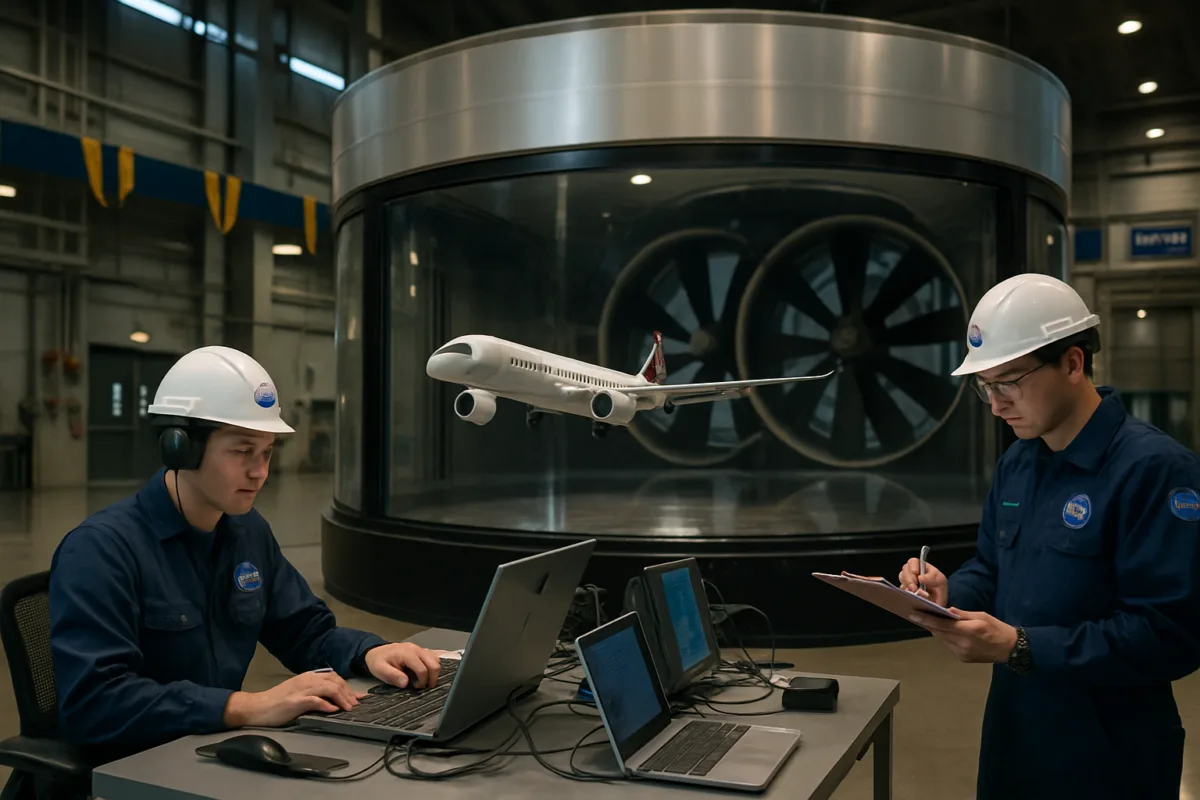
The facility occupies a 25,000 square foot building with a 20-foot diameter test chamber, larger and faster than the legacy tunnels it replaces. It can generate airspeeds up to 117 miles per hour, roughly double the maximum of the old chambers, powered by four 750-horsepower motors that drive 14-foot diameter eight-bladed carbon-fiber fans.
Importantly, the chamber supports both free-flight testing, where scale models fly unconstrained, and conventional mounted testing. That dual capability is rare and matters because different experiments require different setups — what works for a mounted probe won’t necessarily capture free-flight separation or unsteady aerodynamics.
How this facility replaces capability rather than expanding it
It’s crucial to remember that Langley’s tunnel count has contracted for years rather than expanded. Between 2011 and now, several older tunnels and support buildings were demolished under a Facilities Reduction Program, leaving fewer physical test assets overall.
The Flight Dynamics Research Facility consolidates the roles of the 20 Foot Vertical Spin Tunnel and the 12 Foot Low Speed Tunnel into a single, faster facility. That consolidation is efficient in one respect, but it does not restore the breadth of physical infrastructure Langley once maintained.
Why we should welcome a physical lab despite advances in CFD
Proponents of computational fluid dynamics correctly point out that simulations have reduced the time and cost of early-stage aerodynamics work. Yet the argument that CFD will entirely supplant wind tunnels is not defensible on technical grounds.
Experts have repeatedly highlighted CFD’s limits for unsteady, turbulent, or otherwise “messy” problems. Until those gaps are meaningfully closed, physical testing remains the gold standard for validating models and revealing surprises that simulations miss.
Programs set to use the new chamber — and why that breadth matters
NASA has suggested a wide range of programs will use the chamber, from the X-66 Transonic Truss-Braced Wing demonstrator to tests supporting the Orion Launch Abort System, SLS aerodynamics, and the DAVINCI Venus probe. That diversity underlines Langley’s role as shared infrastructure for both aeronautics and spaceflight.
Shared facilities are efficient, but they also create scheduling and prioritization challenges. Different programs will compete for the same test hours; how NASA manages those conflicts will shape whether the tunnel becomes a bottleneck or a force multiplier.
Accounting for the delay and opaque costs
The project was finished roughly 15 months later than NASA initially announced in 2022, and public reporting lists construction costs between $53 million and $57 million. NASA’s own release omitted a definitive cost figure and did not explain the cause of the delay.
That lack of transparency invites reasonable skepticism. When a public agency invests tens of millions in infrastructure, taxpayers and stakeholders deserve clear updates on timeline changes and budgetary variance, not only ceremonial platitudes.
Operational transparency: staffing, run schedules, and allocation
NASA’s announcement said little about operating costs, staffing levels, or how test time will be allocated across competing programs. Those omissions are important rather than incidental.
For example, if the new facility requires substantially more staffing than the two tunnels it replaced, total operating costs could rise, offsetting some benefits of consolidation. Conversely, if it is understaffed, test backlogs will grow and projects will suffer schedule slips.
What successful use of the tunnel would look like
Success will be measurable in concrete ways: timely publication of first test results, demonstrable improvements in aerodynamic data quality for projects like the X-66, and efficient scheduling that balances aeronautics and exploration needs. Those outputs will show whether the higher airspeed and larger chamber translate into better engineering outcomes.
Moreover, transparent reporting on initial certification runs and early campaigns would build public trust and serve as a model for managing shared national test infrastructure.
Counterarguments and why they don’t outweigh the need for physical testing
Detractors might argue that investing in more compute capacity and better CFD tools offers greater long-term leverage than building new physical structures. That position has merit in the abstract and should inform NASA’s broader portfolio.
However, it’s a false dichotomy to treat computing and wind tunnels as mutually exclusive. The most responsible approach combines advanced simulation with targeted physical testing to validate models and probe regimes that remain poorly understood computationally.
Policy implications and recommendations for NASA stakeholders
Federal stakeholders should insist on three things: first, a public operating plan that details staffing and projected run rates; second, a clear allocation framework for scheduling across aeronautics and exploration; and third, timely publication of initial test data so the facility’s value can be evaluated objectively.
By demanding these deliverables, Congress, partners, and the aerospace community can ensure the Flight Dynamics Research Facility delivers verifiable returns on a significant public investment.
Transitional note: what to watch in the coming months
For now, the most informative milestone will be the first published test results from whatever program runs them. Those data will show whether the facility’s faster speeds and larger chamber yield new insights that older tunnels simply couldn’t provide.
In parallel, watch for NASA’s certification timeline and any public release that explains how the 15-month schedule slip occurred. Those disclosures will either quiet concerns or reinforce the need for better program oversight.
Practical takeaways for engineers and program managers
If you’re an engineer or program manager planning to use the facility, start preparing now. Align your test plans with the chamber’s capabilities — free-flight and mounted testing support different kinds of measurements — and build flexibility into your schedules to accommodate initial certification runs.
Also, insist on data-sharing agreements and publication timelines that ensure your work contributes to broader knowledge, not just a single program’s proprietary dataset.
A final consideration for taxpayers and the broader public
Investing in physical infrastructure like the Flight Dynamics Research Facility is defensible when it fills clear technical gaps and supports multiple national priorities. The new tunnel meets that bar, but it also demands accountability.
Transparent reporting on costs, staffing, and test outcomes will transform a ceremonial ribbon-cutting into enduring public value. Until we see those outputs, it’s reasonable to be cautiously optimistic and vocally demanding.
The Flight Dynamics Research Facility is a necessary step forward for NASA and for American aerospace capability, but its success will hinge on transparency and disciplined management. Stakeholders should track the first published test results, press for clear operating plans, and ensure that the facility’s promise — faster, larger, and more capable aerodynamic testing — translates into verifiable technical advances and efficient support across both aeronautics and space exploration.

Dr. Morgan directed the Archives Program from 2014 to 2017, gaining extensive experience in research documentation, information management, and the preservation of scholarly resources. Throughout her career, she has worked closely with academic publications and research materials, developing expertise in evaluating scientific sources and communicating complex topics to broad audiences.
Her primary areas of specialization include scientific publishing, research communication, editorial review, and the translation of technical research into accessible educational content. She has contributed to projects involving space science, astronomy, environmental science, history, archaeology, and emerging scientific discoveries, always emphasizing accuracy, transparency, and the responsible presentation of evidence.
As Editorial Director of Muskurahat.us, Dr. Morgan leads the editorial review process for scientific articles, ensuring that content is based on reputable sources, peer-reviewed research whenever available, and publications from recognized universities, research institutions, and international scientific organizations.
She is committed to promoting scientific literacy through clear, engaging, and well-documented articles that help readers better understand scientific discoveries and their impact on society. Her editorial philosophy is founded on accuracy, intellectual integrity, independent journalism, and continuous learning as scientific knowledge evolves.
Through her work at Muskurahat.us, Dr. Morgan supports the publication of trustworthy scientific content that makes complex research accessible to readers around the world while maintaining rigorous editorial standards.