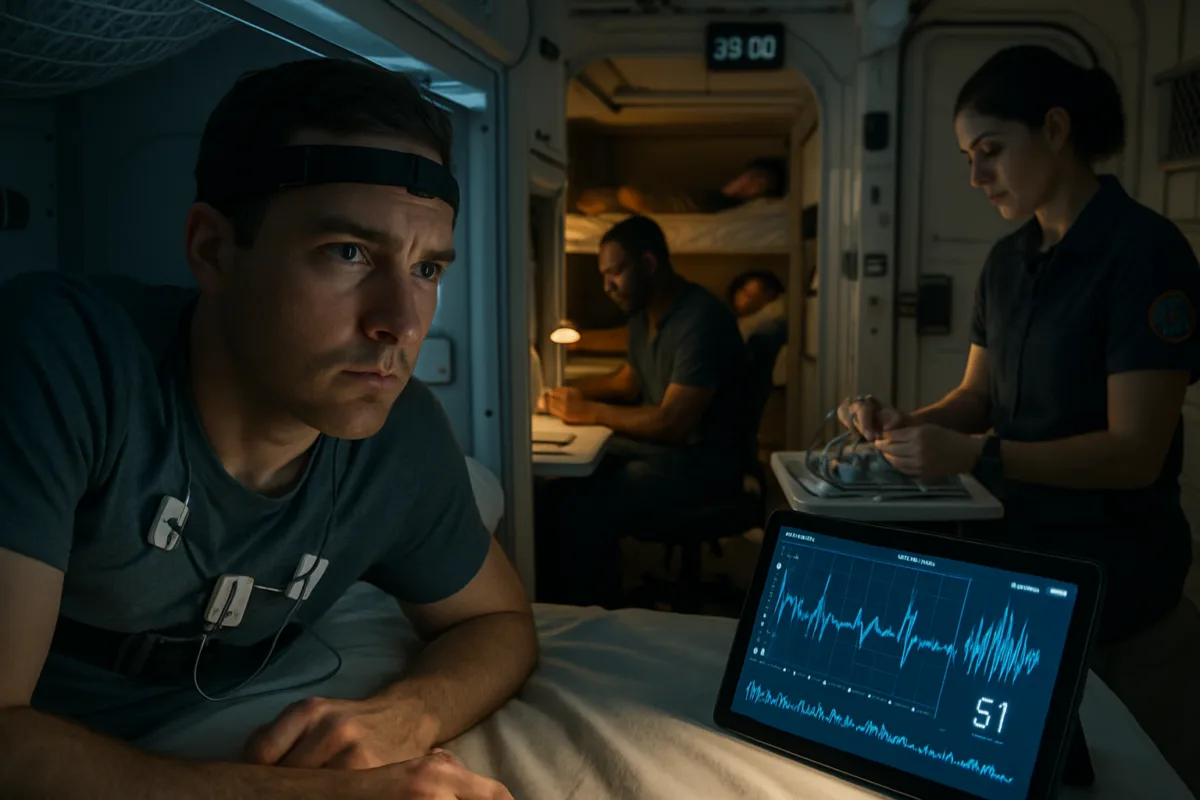
Sleep deprivation in space is not an abstract hazard — it can change heart rhythms, impair judgment, and amplify risks when crews are far from help. Recent data from the SIRIUS-19 isolation experiment show a single sleepless night produced measurable autonomic strain in healthy, trained crew members. That finding should force mission designers to rethink how they schedule overnight tasks and monitor physiological resilience on long voyages.
Why sleep deprivation in space matters for crew safety
The first reason to treat disrupted sleep as a top operational risk is straightforward: the autonomic nervous system responds quickly to sustained wakefulness. Increased heart rate and shifts in heart rate variability (HRV) are not merely biometric curiosities; they reflect heightened sympathetic activation that can degrade decision-making under pressure. When a crew member’s cardiovascular state is primed for stress, the margin for error narrows during complex tasks.
Moreover, long missions to the Moon or Mars will impose delays in communication with Earth and limited options for real-time support. Consequently, even minor cognitive slips triggered by fatigue can have outsized consequences. Therefore, protecting restorative sleep continuity must be non-negotiable in mission planning.
What the SIRIUS-19 analog reveals about sleep disruption and HRV
SIRIUS-19 monitored six volunteers in a sealed habitat for 120 days, tracking sleep, pulse rate and HRV across several nights. Crucially, one night of complete sleep deprivation produced the most pronounced autonomic response: average pulse rose and the LF/HF HRV ratio shifted toward greater sympathetic dominance. These physiological changes matched increased subjective sleepiness reported by most crew members the next morning.
At the same time, brief planned awakenings — representing alarm-driven or operational interruptions — lowered sleep efficiency but did not produce the same immediate autonomic spike. This contrast is important. It suggests that while short disturbances degrade sleep quality, a full night awake is the event that creates the clearest and most measurable strain on the body’s stress-recovery balance.
Interpreting HRV in an operational context
Heart rate variability is a nuanced metric. A higher LF/HF ratio can signal increased sympathetic drive or reduced parasympathetic recovery, but it is sensitive to breathing, posture and activity. Nevertheless, when higher pulse and elevated LF/HF appear together after a sleepless night, the combined pattern is hard to ignore. It indicates a physiologic state less suited to calm, precise performance.
Consequently, mission health officers should not treat HRV as a single definitive readout, but rather as an actionable indicator within a broader monitoring strategy. When HRV trends upward in concert with elevated resting heart rate and subjective sleepiness, a conservative operational response is warranted.
Argument: occasional awakenings are manageable, but full nights awake must be limited
SIRIUS-19 supports a practical distinction: crews can tolerate occasional, short sleep interruptions under controlled conditions, but intentionally scheduling full nights of wakefulness creates disproportionate physiological risk. The rationale rests on both the measurable autonomic strain and the potential cognitive costs of sustained wakefulness.
From an operational standpoint, this argues for a risk-weighted approach to overnight work. If a critical cargo unload or emergency drill is unavoidable, planners should build mandated recovery windows and use objective physiological monitoring to verify that affected crewmembers have returned to baseline. Otherwise, normalizing overnight operations risks cumulative harm that could undercut mission resilience.
Why training and selection are not substitutes for system design
Some may counter that highly trained crews will tolerate sleep loss better. Indeed, SIRIUS-19 participants were experienced, physically fit, and had prior isolation exposure. Their resilience likely masked subtler effects that would appear in a broader crew population. Therefore, selection and training are necessary but not sufficient safeguards.
Instead, systems-level solutions — habitat design, lighting schedules, noise control, and operational tempo — must reduce the frequency and depth of sleep disruption. In other words, you cannot outsource fatigue management entirely to human endurance and willpower.
Practical measures to protect sleep and reduce autonomic strain
First, operational policies should minimize planned full overnight shifts. When such shifts are unavoidable, crews need enforced recovery periods with protected sleep windows and reduced workload. This prevents immediate strain from compounding into chronic impairment over the mission’s long timescale.
Second, habitat design must prioritize restorative sleep continuity. That includes sound-dampening materials, private sleep modules, and circadian-friendly lighting that supports melatonin rhythms. These environmental mitigations reduce the chance that an alarm or routine task will cascade into a night of sustained wakefulness.
Monitoring and rapid intervention: portable sleep recorders and HRV tracking
SIRIUS-19 demonstrated that portable, medical-grade sleep monitors can collect reliable data in a confined operational setting. Instruments like SOMNOtouch RESP enabled self-administered EEG and cardiovascular recordings without a full laboratory setup. This approach should translate well to missions where space and crew time are scarce.
In practice, integrating continuous HRV and sleep-duration monitoring into mission health workflows allows for early detection of problematic trends. If HRV and resting heart rate climb while sleep totals fall, medics can impose graded countermeasures — from schedule rearrangement to targeted naps and recovery protocols — before performance seriously degrades.
Addressing limitations and planning for real spaceflight realities
While the SIRIUS-19 findings are informative, they come with caveats that should temper overreach. The study’s small size, single-night disturbance design, and gravity-bound setting mean results are suggestive rather than definitive. Real astronauts will face microgravity, varied light exposure and continuous background noise that may change the sleep-autonomic relationship.
Nonetheless, prudence argues for acting on the clearest signal we do have: full nights awake produce measurable autonomic activation even in experienced crews. Waiting for perfect, large-scale spaceflight data before implementing sleep-protective policies would be a high-risk decision.
Policy implications for Moon and Mars missions
Agencies planning longer missions should codify limits on overnight operations, require recovery periods after sleep deprivation events, and mandate physiological monitoring protocols tied to predefined thresholds. These thresholds can trigger automated schedule changes or medical consultations, keeping human judgment intact while reducing reliance on subjective self-assessment alone.
In addition, mission rehearsals in analog habitats should include repeated fragmentation tests to model accumulation effects. Doing so will reveal how multiple interrupted nights change HRV trends and cognitive outcomes over time, providing a stronger empirical foundation for operational rules.
Why treating sleep like a mission-critical resource is an ethical necessity
Beyond operational efficiency, there is an ethical dimension: crews deserve systems that minimize preventable harm. If a single sleepless night can elevate cardiovascular stress and increase sleepiness, mission designers have a duty to reduce those risks where feasible. That duty extends to creating environments and schedules that respect human biological needs.
Furthermore, transparent protocols for monitoring and recovery create trust. When crew members know that their wellbeing is being actively managed — not merely logged — they are more likely to report fatigue honestly and follow prescribed recovery plans.
Ultimately, the SIRIUS-19 analog offers a clear, actionable insight: short, occasional awakenings lower sleep efficiency but do not produce the same immediate autonomic strain as a full night awake. Therefore, mission planners must prioritize preventing prolonged wakefulness through habitat design, schedule constraints, and physiological monitoring. By doing so, teams can preserve cognitive performance and protect crews during the most vulnerable periods of a mission, while retaining operational flexibility when emergencies demand it.

Dr. Morgan directed the Archives Program from 2014 to 2017, gaining extensive experience in research documentation, information management, and the preservation of scholarly resources. Throughout her career, she has worked closely with academic publications and research materials, developing expertise in evaluating scientific sources and communicating complex topics to broad audiences.
Her primary areas of specialization include scientific publishing, research communication, editorial review, and the translation of technical research into accessible educational content. She has contributed to projects involving space science, astronomy, environmental science, history, archaeology, and emerging scientific discoveries, always emphasizing accuracy, transparency, and the responsible presentation of evidence.
As Editorial Director of Muskurahat.us, Dr. Morgan leads the editorial review process for scientific articles, ensuring that content is based on reputable sources, peer-reviewed research whenever available, and publications from recognized universities, research institutions, and international scientific organizations.
She is committed to promoting scientific literacy through clear, engaging, and well-documented articles that help readers better understand scientific discoveries and their impact on society. Her editorial philosophy is founded on accuracy, intellectual integrity, independent journalism, and continuous learning as scientific knowledge evolves.
Through her work at Muskurahat.us, Dr. Morgan supports the publication of trustworthy scientific content that makes complex research accessible to readers around the world while maintaining rigorous editorial standards.