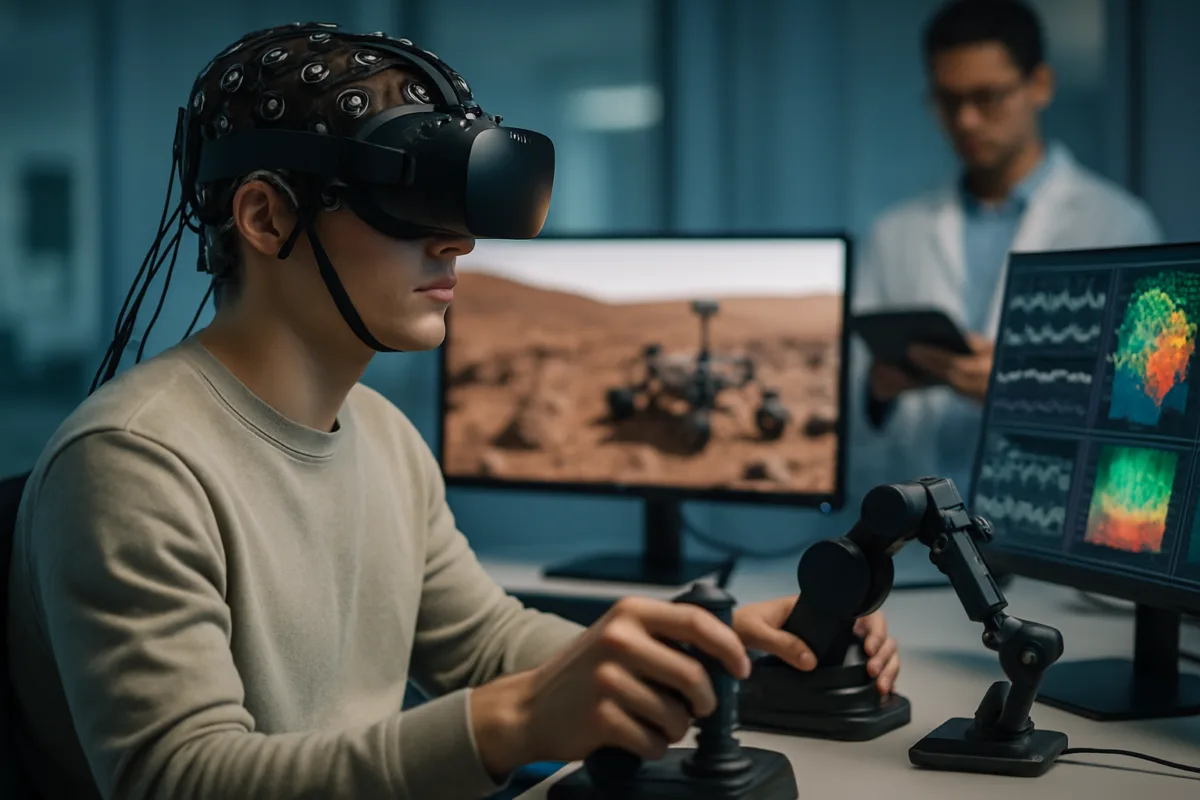
Virtual reality Mars rover tasks activate the brain more widely than isolated cognitive drills, and that difference matters for how we prepare crews for long-duration missions. A recent study using EEG and fNIRS found robust increases in cortical engagement when participants completed realistic rover simulations compared with simpler partner tasks. The early finding challenges the assumption that small lab tests alone can capture the neural demands of complex operational work.
Why realistic VR Mars rover tasks matter for deep-space crews
The argument is straightforward: if training does not mimic operational complexity, it may fail to recruit the networks astronauts actually need. Realistic simulation blends decision-making, spatial control, fine motor actions and sustained attention into one task, mirroring the multi-component demands of rover driving and equipment repair. Therefore, immersive exercises could produce different—and potentially more useful—brain activation patterns than classic cognitive tests.
Study overview: what EEG and fNIRS revealed about simulated rover activity
In the 2026 experiment, twenty healthy adults who reached a performance threshold completed both a simulated rover expedition in VR and a set of simpler, matched cognitive exercises. Researchers recorded electrical activity with EEG and tracked cortical blood oxygenation with fNIRS. Across both modalities the operational VR condition produced significantly larger responses, with strong statistical results that make random chance an unlikely explanation.
Broader cortical recruitment, not just isolated spikes
Importantly, increased activation appeared across multiple brain regions and frequency bands rather than as a focal anomaly. EEG bands associated with attention and working memory (theta, alpha, low beta) were engaged, while fNIRS showed elevated oxygenation in prefrontal regions tied to planning and decision-making. This pattern suggests the simulation demanded integrated processing rather than merely amplifying a single cognitive component.
Interpreting stronger brain activation: engagement, workload, or overload?
One can reasonably defend two competing interpretations. On the one hand, higher activation can signal useful engagement: the brain is coordinating multiple systems to learn or apply complex skills. On the other hand, elevated signals can also reflect fatigue, stress, or cognitive overload—factors that degrade performance if sustained.
Evidence favors operative engagement, with caveats
Several aspects of the study support the engagement view: the tasks were mission-relevant, participants trained to proficiency before testing, and the activation was broad and consistent across measures. However, the presence of reported headaches and fatigue when wearing combined sensors and VR headsets underscores the need for caution. Consequently, activation alone cannot be equated with beneficial learning without longitudinal evidence.
Why this matters for astronaut training and cognitive countermeasures
Long-duration missions will place crews in environments where timely help from Earth is limited. Crewmembers may need to operate rovers, repair hardware, and perform scientific observations with high stakes and delayed support. If VR elicits a richer pattern of brain involvement, integrating mission-like simulations into training could better maintain or rehearse those composite skills en route.
From episodic drills to integrated rehearsal
Traditional cognitive batteries split abilities into neat, testable components, which is efficient for measurement but may miss how abilities combine under operational stress. Therefore, a shift toward integrated rehearsal—where navigation, manipulation and decision-making occur together—could better prepare astronauts for real conditions. Moreover, VR allows safe repetition and programmable difficulty scaling, making it a practical option for long voyages.
Design principles for effective VR-based training programs
To translate enhanced activation into durable skill, training designers must address frequency, difficulty, and outcome measurement. First, training cadence should balance stimulation and recovery to avoid chronic overload. Second, tasks should be adaptive: increasing complexity only as proficiency and physiological tolerance allow.
Measure what matters: retention and connectivity
Researchers should pair neural metrics with behavioral outcomes such as accuracy, response time, and delayed retention tests. In addition, tracking functional connectivity—how brain regions coordinate—could clarify whether VR encourages useful integration rather than inefficient effort. Consequently, a multimodal assessment strategy will determine whether stronger activation predicts long-term benefit.
Limitations of the current evidence and why further research is essential
The study’s small, selected sample and terrestrial conditions limit direct extrapolation to astronauts in microgravity and confined habitats. Participants were young, healthy adults who achieved predefined rover proficiency, which introduced selection bias. Therefore, replication with larger, more diverse cohorts and with prolonged, repeated sessions is necessary before operational adoption.
Testing in space and across mission phases
To close the gap between lab and flight, experiments should follow astronauts before, during and after missions, ideally incorporating VR exercises at multiple time points. This approach would reveal whether in-flight training counters microgravity-induced neural changes or mitigates subjective space fog. Only then can agencies quantify the utility and risks of VR-based countermeasures.
Operational recommendations for research teams and agencies
Agencies should fund longitudinal trials that combine EEG/fNIRS monitoring with rigorous behavioral endpoints. Additionally, standardizing sensor comfort and motion sickness mitigation will reduce confounds introduced by the measurement setup. Importantly, teams must predefine cognitive and motor outcomes so that neural signals can be explicitly linked to performance gains.
Practical steps for implementation
Start with mixed-proficiency cohorts to understand how VR benefits novices versus experienced operators. Then test adaptive training regimens that modulate workload based on physiological markers and error rates. Finally, share data openly to accelerate multi-center validation and to refine best practices for in-flight deployment.
Broader implications beyond spaceflight
The core insight—that mission-like simulation recruits broader brain networks—applies to any domain where complex sensorimotor and cognitive integration matters. Medical simulators, remote robotics, military operations and industrial maintenance could all benefit from realistic VR protocols that mimic real-world decision chains. Consequently, investment in translational research could pay dividends across several high-stakes fields.
Overall, the evidence argues for elevating operational realism in cognitive training while remaining scientifically rigorous about what neural activation represents. If future longitudinal studies confirm that enhanced activation predicts durable skill retention and better operational performance, VR could become a cornerstone of long-duration mission readiness. Until then, agencies and researchers should pursue carefully controlled trials that connect brain signals to measurable, mission-relevant outcomes and design training schedules that maximize learning while minimizing fatigue. By doing so, teams can move from neural observation to actionable programs that protect performance on the long road to Mars and beyond.

Dr. Morgan directed the Archives Program from 2014 to 2017, gaining extensive experience in research documentation, information management, and the preservation of scholarly resources. Throughout her career, she has worked closely with academic publications and research materials, developing expertise in evaluating scientific sources and communicating complex topics to broad audiences.
Her primary areas of specialization include scientific publishing, research communication, editorial review, and the translation of technical research into accessible educational content. She has contributed to projects involving space science, astronomy, environmental science, history, archaeology, and emerging scientific discoveries, always emphasizing accuracy, transparency, and the responsible presentation of evidence.
As Editorial Director of Muskurahat.us, Dr. Morgan leads the editorial review process for scientific articles, ensuring that content is based on reputable sources, peer-reviewed research whenever available, and publications from recognized universities, research institutions, and international scientific organizations.
She is committed to promoting scientific literacy through clear, engaging, and well-documented articles that help readers better understand scientific discoveries and their impact on society. Her editorial philosophy is founded on accuracy, intellectual integrity, independent journalism, and continuous learning as scientific knowledge evolves.
Through her work at Muskurahat.us, Dr. Morgan supports the publication of trustworthy scientific content that makes complex research accessible to readers around the world while maintaining rigorous editorial standards.