As headlines swirl and social feeds pulse with alarm, a new phrase has entered the public lexicon: Iran Targets Kuwait Retaliation Us. That clumsy search query captures a real shift in perceptions — and in military risk — that many wire reports have not fully unpacked. Beyond the immediate facts of missile launches, interdicted shipments or diplomatic condemnations, the evolving story is about geography, logistics and the fragility of low-profile partners whose proximity to both Tehran and U.S. forces makes them uniquely vulnerable.
What’s happening right now — and why it matters beyond the headline
Recent exchanges in the Gulf include a mix of kinetic strikes, maritime incidents and public threats. What is new is not merely the volume of activity but the targeting calculus: actors tied to Iran are focusing attention on states like Kuwait that are geographically close to Iran yet politically aligned with U.S. security interests. That creates a tension where actions that previously would have been framed as attacks on U.S. assets are now reframed in public and diplomatic discourse as attacks on small Gulf partners.
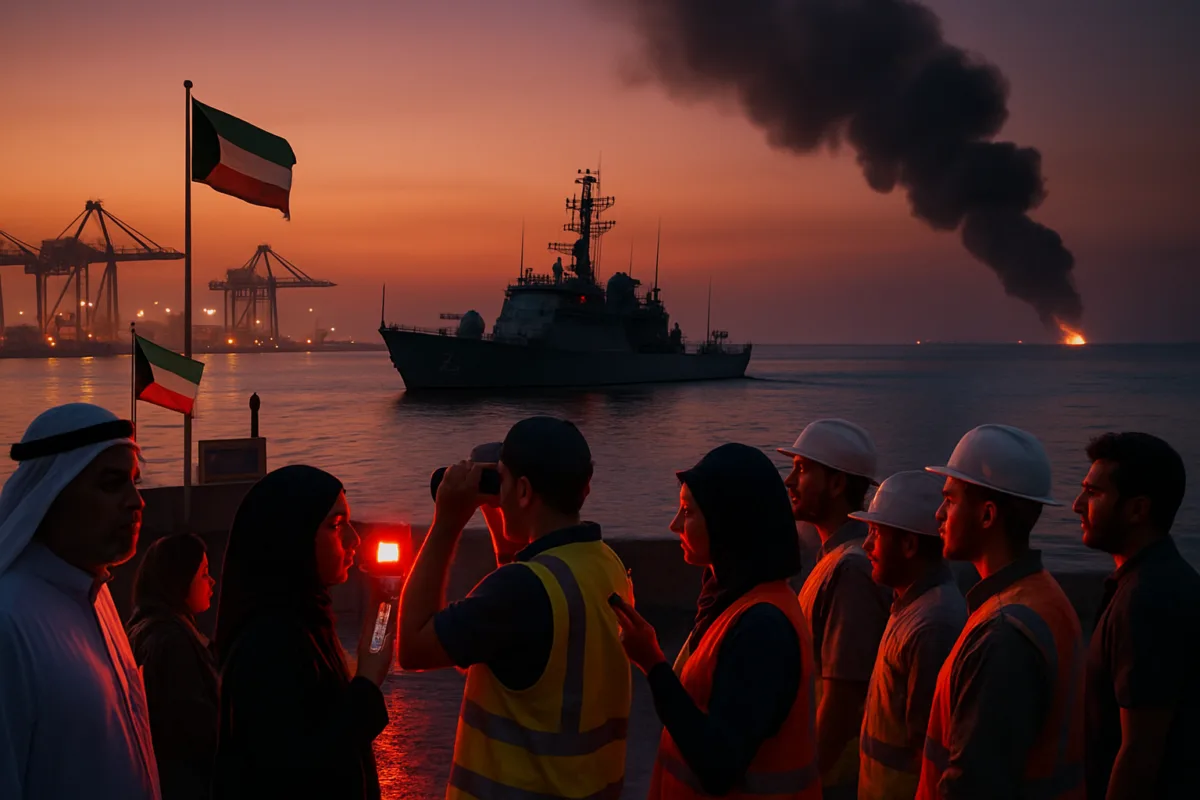
The media has dutifully tracked missile flight paths and diplomatic condemnations, but fewer outlets have explored the asymmetric logic behind targeting Kuwait specifically. Kuwait hosts critical logistics hubs, has airspace used for U.S. operations, and lies along littoral sea lanes that channel both commerce and military movements. Strikes or harassment in these zones have outsized strategic and economic ripple effects that are not immediately visible in short news cycles.
How local geography reshapes strategic calculations
Kuwait’s coastline is a narrow wedge into the Persian Gulf. That geography makes it an efficient corridor for resupply, personnel rotations and regional coordination. In conflict modeling terms, that efficiency is a double-edged sword: it shortens the time and space needed for friendly forces to mobilize, but it also reduces warning times for civilian populations and infrastructure when hostilities heat up. In practice that means a small number of well-placed strikes can disrupt shipping, close ports, and complicate allied military logistics far more effectively than strikes in less constrained waters.
Local impact: what Kuwaitis and residents are already facing
Local consequences are tangible even when the headlines stay abstract. Kuwait’s population, composed of citizens and a large expatriate community, relies on a narrow set of maritime and overland supply routes for food, medical supplies and fuel. Disruptions quickly translate into port slowdowns, delayed container shipments, and rationing decisions that disproportionately affect lower-income and migrant communities.
Emergency preparedness in Kuwait has improved since the 1990s, but civil defense capacity has limits. Shelter spaces, early-warning networks and medical surge capacity are finite; a prolonged period of heightened risk would force public services to prioritize. Schools, airspace, and commercial hubs could experience rolling closures that ripple into daily life. For residents who depend on daily wages or cross-border commerce, these localized shocks are the lived reality of a geopolitical crisis.
Numbers that give scale to the risk
Quantifying this vulnerability helps explain why a seemingly small tactical decision can have outsized effects. Consider how quickly a port closure or insurance premium spike raises costs: even a few days of disrupted shipments can add millions of dollars to logistics costs for a country the size of Kuwait, whose economy remains heavily integrated with the global oil market and regional trade networks. On the human side, an evacuation advisory or temporary border closure affects hundreds of thousands of commuters and expatriate workers within a matter of hours.
Why the United States is central — but also constrained
The U.S. remains the security partner of choice for Gulf states, including Kuwait. American forces provide training, logistics, and a military safety umbrella that deters large-scale conventional invasion. But deterrence today is a layered, resource-intensive task: missile defense batteries, naval patrols, intelligence-sharing, and diplomatic pressure all have to be sustained simultaneously.
Two practical limits shape U.S. options. First, missile defense systems and forward-deployed assets are finite. They can be repositioned quickly, but sustained coverage is expensive and can be politically sensitive at home. Second, the legal and political calculus of retaliatory strikes is more complicated when an attack affects or risks harming a third-party state. Retaliation against Iranian proxies after they strike in or near Kuwait risks escalating conflicts in ways that draw in Kuwait’s sovereignty as an operational constraint.
The information problem: perception versus intent
Another underreported element is the informational asymmetry created by proxy warfare. When non-state groups act in ways consistent with state objectives but retain deniability, the factual record becomes messy. Kuwaiti officials, U.S. commanders, and regional intelligence services may disagree publicly over attribution. That ambiguity complicates strategic choices: punishing Tehran directly risks wider war; inaction risks encouraging further harassment; and punitive measures directed at local proxies can entangle Kuwaitis in retaliatory cycles they did not choose.
Military posture and defensive adaptations
Military planning in response to these threats has emphasized dispersion, redundancy and civil-military coordination. For Kuwait and allied planners, that means diversifying ports of call, pre-positioning critical supplies inland, and investing in passive defenses like hardened shelters and redundant communication links. For coalition partners, it means flexible naval tasking, focused intelligence efforts, and rapid diplomatic backchannels to avoid inadvertent escalation.
Technological adaptations matter too. Drone and missile threats have encouraged investments in layered defenses: short-range interceptors for point defense, naval escorts for vulnerable shipping, and electronic warfare measures to deny guidance signals. Those systems are effective at blunt-force defense but are expensive and require trained maintenance and logistics — which returns the problem to the practical constraints of budgets and time.
Historical echoes that illuminate current choices
There are useful historical analogues. The 1980s Tanker War and later maritime confrontations in the Gulf show how persistent low-intensity conflict can drain resources and elevate insurance and shipping costs long before a conventional war begins. The pattern is consistent: small tactical attacks accumulate strategic consequences. Recognizing this pattern—rather than waiting for a single dramatic incident—allows policymakers to take preventive measures that minimize civilian harm and economic disruption.
What mainstream coverage often misses
Wire reporting has been strong on attribution and counting missiles, but less attentive to the asymmetric economics and the local governance choices that will determine how the crisis unfolds day-to-day. For instance, how Kuwait allocates its emergency shelters, manages port prioritization, or communicates evacuation orders will shape civilian resilience more than most military moves. Likewise, private-sector responses — insurers raising premiums, shipping firms rerouting through longer paths, regional airlines reducing flights — create feedback loops that amplify the initial kinetic incidents.
Another blind spot is the psychological dimension. Public anxiety in Kuwait and across the Gulf is rising, and social media accelerates rumor and confusion. Official travel advisories, community hotlines, and reliable local journalism become as critical as interception systems in maintaining social order.
A practical checklist for readers in the region or with family there
– Monitor official Kuwaiti and U.S. travel advisories as the primary source of actionable guidance.
– Keep emergency contacts and a basic three-day supply of essentials if you live in the Gulf.
– Verify news through established outlets and local consulates rather than social shares.
– For businesses, model cost impacts for short-term shipping delays and prepare contingency suppliers.
– For investors, watch insurance spreads and logistics indices as early indicators of extended disruption.
If you’ve seen social chatter or search spikes for phrases like ‘Iran Targets Kuwait Retaliation Us’, that reflects both fear and a realignment of strategic targeting. Policymakers and citizens alike should treat the situation as a phase where preventive, locally grounded measures can make the difference between limited harassment and prolonged economic and humanitarian strain. The most consequential actions will be mundane: ensuring resilient supply chains, clear public messaging, and narrowly calibrated defensive postures that protect civilians while avoiding unnecessary escalation.

Dr. Morgan directed the Archives Program from 2014 to 2017, gaining extensive experience in research documentation, information management, and the preservation of scholarly resources. Throughout her career, she has worked closely with academic publications and research materials, developing expertise in evaluating scientific sources and communicating complex topics to broad audiences.
Her primary areas of specialization include scientific publishing, research communication, editorial review, and the translation of technical research into accessible educational content. She has contributed to projects involving space science, astronomy, environmental science, history, archaeology, and emerging scientific discoveries, always emphasizing accuracy, transparency, and the responsible presentation of evidence.
As Editorial Director of Muskurahat.us, Dr. Morgan leads the editorial review process for scientific articles, ensuring that content is based on reputable sources, peer-reviewed research whenever available, and publications from recognized universities, research institutions, and international scientific organizations.
She is committed to promoting scientific literacy through clear, engaging, and well-documented articles that help readers better understand scientific discoveries and their impact on society. Her editorial philosophy is founded on accuracy, intellectual integrity, independent journalism, and continuous learning as scientific knowledge evolves.
Through her work at Muskurahat.us, Dr. Morgan supports the publication of trustworthy scientific content that makes complex research accessible to readers around the world while maintaining rigorous editorial standards.