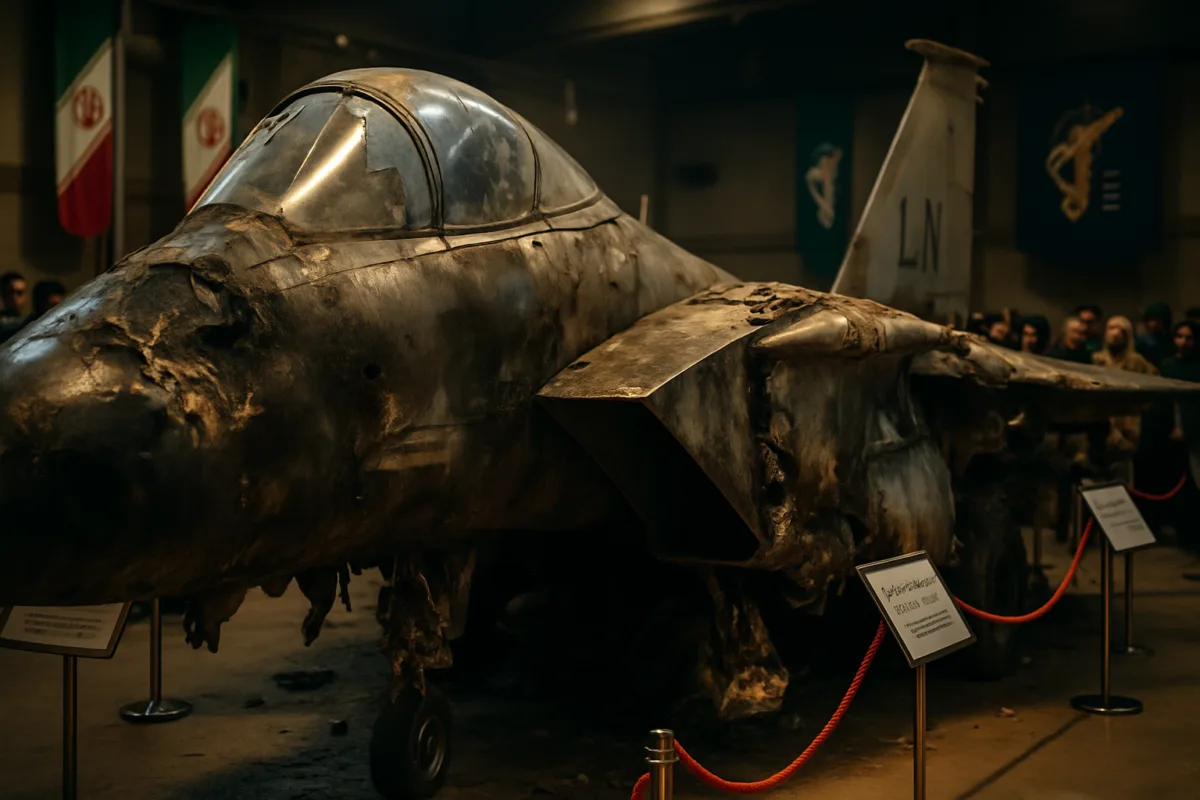
The public exhibition of a downed F-15E Strike Eagle in Iran is more than a spectacle for domestic consumption; it is a calculated statement with tactical, strategic, and symbolic consequences. When a state parades captured military hardware, it is broadcasting a narrative designed to shape perceptions of competence, resolve, and technological reach. But beneath the theater lies a tangle of practical implications that should concern policymakers, military planners, and the public alike. This is not merely about one aircraft; it is about how modern air warfare, intelligence tradecraft, and international politics intersect in a conflict where optics often matter as much as ordnance.
What a War Trophy Signals — and What It Does Not
On the surface, displaying the wreckage of an F-15E strike aircraft serves obvious propaganda aims. For Tehran, the piece of metal labeled as the downed ‘Dude 44’ does three things at once: it asserts a tangible victory, bolsters domestic morale, and seeks to undermine the perception of U.S. air superiority in a volatile theater. A photographed canopy or an identifiable tail code becomes a visual proof point that can be circulated across social media, state news outlets, and international channels.
Propaganda Gains Versus Operational Reality
But the propaganda value should not be conflated with a larger shift in military balance. A single downed aircraft, however spectacular, does not equal air supremacy. The reality of air warfare is statistical: logistics, sortie generation rates, aerial refueling, sensors, and crew training accumulate advantage over time. By highlighting a single event, Iran seeks to convert an isolated tactical success into a strategic narrative. That narrative can influence perceptions and embolden allied actors, but it cannot by itself reproduce the industrial base, carrier strike groups, or sustained sortie capacity that underpin long-term airpower.
Symbolism That Amplifies Risk
Still, symbols matter. Publicly displaying an F-15E serves to intimidate domestic and regional audiences, sway neutral observers, and pressure political elites in adversary capitals by shaping public opinion. The U.S. is sensitive to such optics because public sentiment affects policy, funding, and political risk tolerance. Thus, what might be a localized intelligence or maintenance failure can ripple outward, altering strategic calculus in Washington, allied capitals, and domestic politics across the Middle East.
Intelligence and Technical Consequences of Captured Hardware
One of the most consequential, and often under-discussed, aspects of captured military hardware is the intelligence opportunity it represents. Even when wreckage is badly damaged, adversaries can glean insights about materials, sensor layouts, electromagnetic signatures, and maintenance habits. They can examine paint, wiring, and componentry for vulnerabilities that may be exploited in future engagements, whether through improved electronic warfare, tailored countermeasures, or the development of more effective detection methods.
How Much Can Be Reversed?
Practical limits do exist. Modern aircraft incorporate composite materials, classified avionics, and software systems baked into sealed modules, often destroyed or rendered unreadable in violent crashes. A crashed airframe does not provide the equivalent of source code. Nevertheless, forensic analysis of components, RF emissions, and battle damage patterns can yield enough data to inform tactics against similar platforms. Even small revelations — ranges, emitter frequencies, or blind spots revealed by spent ordnance — can be tactically exploitable.
Supply Chain and Operational Security Vulnerabilities
Beyond pure engineering intelligence, captured gear can expose operational practices: how crews stow classified items, how maintenance teams mark system components, or how certain defensive suites are configured. These procedural insights can quickly translate into targeted countermeasures. That is why militaries treat downed aircraft with urgency: to deny adversaries the chance to examine sensitive technologies and to protect personnel who may have been captured or left behind.
Implications for Air Warfare Tactics and Doctrine
The display of the F-15E wreckage should force a reevaluation of how advanced air forces operate in high-threat environments. Air doctrine that relies on technological advantages must also account for asymmetric adaptations. If adversaries can integrate older, cost-effective systems with modern intelligence, surveillance, and reconnaissance networks, they can create layered defenses that complicate even highly capable strike packages.
Rethinking Risk Calculus
Commanders must weigh the benefits of bold, high-value strikes against the political and material cost of losses. Losses degrade not only materiel but narrative dominance. A single plane lost over hostile territory yields a continuous image for adversaries to weaponize in the information domain. That alone changes how mission planners should think about risk: more emphasis on stand-off weapons, unmanned systems for certain high-risk tasks, and layered electronic warfare to reduce the chance of shoot-downs.
Extending the Reach of Defensive Posture
Moreover, the incident underscores the need for investments in force protection measures beyond the aircraft themselves. Improved suppression of enemy air defenses (SEAD), better real-time intelligence fusion, resilient communication links, and faster recovery protocols can reduce the vulnerability window in which an aircraft can be hunted and displayed as a trophy. Training that simulates the political fallout of a downing should be part of mission rehearsal, because the strategic effects extend far beyond the tactical encounter.
Political and Diplomatic Ramifications
The public exhibition of U.S. equipment is designed to provoke a political response. Tehran gains leverage by shaping domestic narratives and signaling defiance internationally. The gift for Iran is rhetorical: it demonstrates that U.S. materiel can be contested inside Iran, which could embolden proxy actors and complicate alliance politics in the region.
Escalation Risks and Deterrence Credibility
For Washington and partners, the challenge is to respond in ways that protect credibility without feeding escalation spirals. Overreaction risks widening the conflict and providing Iran further propaganda material; underreaction risks signaling weakness. Crafting calibrated responses that blend cyber operations, targeted pressure on military supply chains, and diplomatic action to shore up regional alliances is a delicate balancing act. Ultimately, maintaining deterrence requires both visible resolve and operational prudence.
Information Operations as a Defensive Tool
Countering the narrative should be strategic and factual: transparency about what was lost and why it does not signal systemic failure, coupled with messaging that underscores continued operational capability. This does not mean hiding setbacks, which can erode trust, but contextualizing them within a broader, resilient posture. Combatting propaganda with truth — and with visible, deliberate action that mitigates future losses — will blunt the adversary’s psychological edge.
Practical Steps the United States and Allies Should Take
Tactically, the immediate imperative is to tighten operational security and reduce exposure. This means accelerating the hardening of communications, investing in more expendable unmanned assets for reconnaissance in high-threat zones, and prioritizing electronic warfare to mask signatures. Strategically, it means doubling down on logistics resilience so that finite inventories do not become a deterministic weakness over months of conflict.
Policy and Procurement Adjustments
On a policy level, sustained conflicts expose the vulnerabilities of procurement systems that assume uninterrupted supply chains and stable funding. Diversifying sources for critical components, improving stockpile transparency with allies, and modernizing rapid replenishment mechanisms can prevent a single loss from cascading into a campaign-level disadvantage. In an era where display images can shift public opinion, procurement is also deterrence policy.
Learning Without Overreacting
Finally, military and civilian leaders must resist the twin temptations of denial and overreaction. Denying facts erodes credibility; overreaction hands the opponent another headline and a potential propaganda windfall. The measured path is to acknowledge lessons, adapt tactics, protect technology, and communicate competence — not smugness — to domestic and international audiences.
Iran’s exhibition of the F-15E wreckage is therefore a complex signal: a localized operational setback elevated into a strategic narrative by skillful information warfare. Recognizing the difference between the spectacle and the underlying military realities is not an exercise in minimizing loss; it is a necessary condition for effective response. The United States and its partners must treat captured hardware as both a tactical vulnerability and an informational battlefield, calibrating military adjustments and messaging strategies accordingly so that a single downed platform does not become a lasting defeat of credibility or capability.

Dr. Morgan directed the Archives Program from 2014 to 2017, gaining extensive experience in research documentation, information management, and the preservation of scholarly resources. Throughout her career, she has worked closely with academic publications and research materials, developing expertise in evaluating scientific sources and communicating complex topics to broad audiences.
Her primary areas of specialization include scientific publishing, research communication, editorial review, and the translation of technical research into accessible educational content. She has contributed to projects involving space science, astronomy, environmental science, history, archaeology, and emerging scientific discoveries, always emphasizing accuracy, transparency, and the responsible presentation of evidence.
As Editorial Director of Muskurahat.us, Dr. Morgan leads the editorial review process for scientific articles, ensuring that content is based on reputable sources, peer-reviewed research whenever available, and publications from recognized universities, research institutions, and international scientific organizations.
She is committed to promoting scientific literacy through clear, engaging, and well-documented articles that help readers better understand scientific discoveries and their impact on society. Her editorial philosophy is founded on accuracy, intellectual integrity, independent journalism, and continuous learning as scientific knowledge evolves.
Through her work at Muskurahat.us, Dr. Morgan supports the publication of trustworthy scientific content that makes complex research accessible to readers around the world while maintaining rigorous editorial standards.