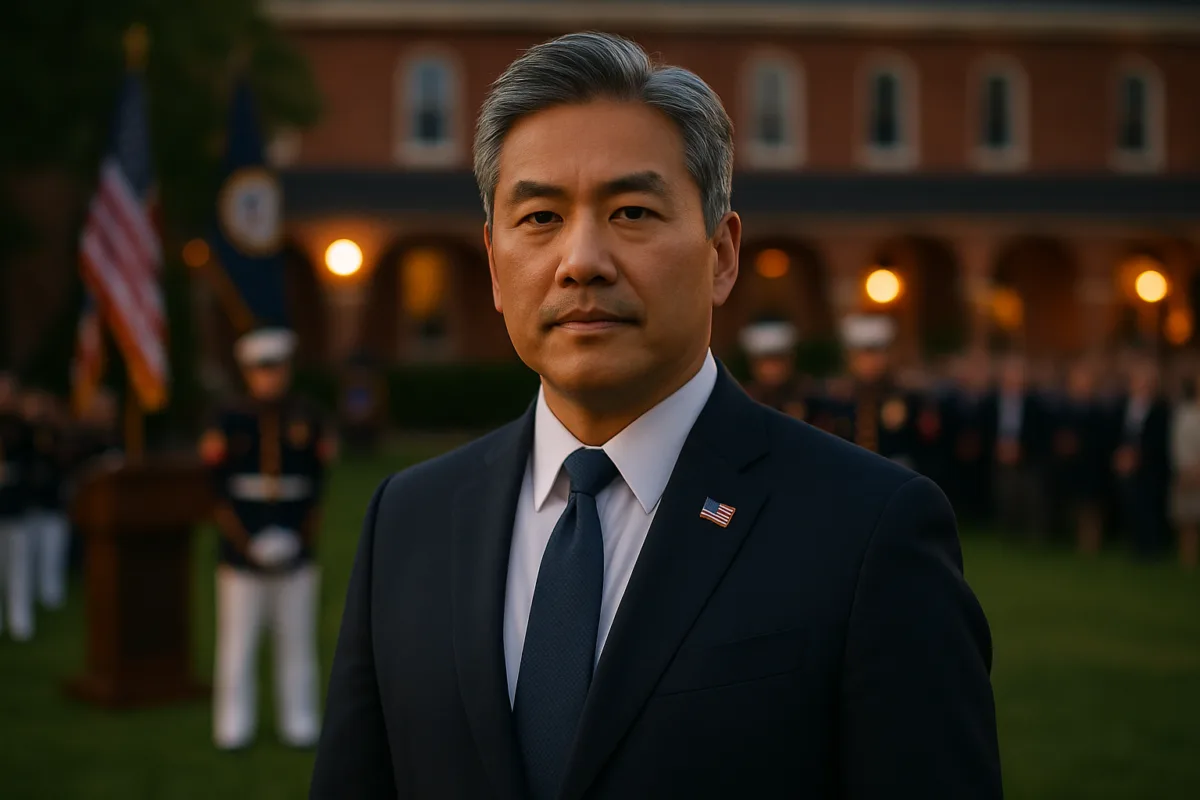
Hung Cao’s nomination to be the permanent Secretary of the Navy demands scrutiny because it is not merely a staffing change — it is a directional statement about naval priorities, political control, and the role of immigrants in America’s military leadership. Within weeks of President Trump’s announcement, debates have already shifted from biography to the hard questions of shipbuilding, carrier deployments, and organizational culture in the US Navy.
Why Hung Cao’s Nomination Matters for Naval Leadership
The choice of a Secretary of the Navy matters because civilian leadership sets policy, funding priorities, and the tone of civil-military relations. Cao’s elevation from acting to permanent secretary would give him institutional authority to influence procurement, readiness, and strategic posture.
Moreover, a Secretary who has lived the immigrant experience and served as an enlisted sailor brings both symbolism and distinct perspectives. That said, symbolism alone does not guarantee effective governance; we must examine policy signals and administrative competence.
Translating Biography into Institutional Change
Cao’s personal narrative — arriving as a refugee, rising through naval ranks, and later running for elected office — is compelling. Yet the pressing questions for naval administration concern shipbuilding timelines, maintenance backlogs, and the operational strains reflected in extended carrier deployments.
Therefore, the real test of Cao’s leadership will be whether his tenure accelerates realistic reforms and resolves chronic readiness issues rather than serving primarily as a rhetorical victory.
Immigrant Background and the US Navy’s Civilian Leadership
If confirmed, Cao would mark a historic first as the top civilian official born in Asia to lead the Navy, building on a lineage of immigrant Secretaries of the Navy such as Edward Hidalgo and Carlos Del Toro. This milestone should prompt an argument about meritocracy and representation in national security.
However, representation must be weighed against policy competence and alignment with strategic objectives. Being an immigrant or refugee does not automatically translate into effective naval administration, just as non-immigrant leaders are not inherently superior.
Why Representation Alone Is Not Enough
Representation enriches perspectives and can strengthen military legitimacy in diverse societies. Yet, the Navy’s challenges are technical and fiscal: shipyard throughput, life-cycle sustainment, and force posture against near-peer competitors.
Consequently, it is valid to celebrate symbolic firsts while insisting that a Secretary demonstrate a detailed understanding of naval logistics, acquisition pipelines, and operational constraints.
Policy Questions: Shipbuilding, Deployments, and Naval Readiness
Among the most urgent issues Cao would face are extended deployments of nuclear-powered carriers, maintenance strains, and a shipbuilding program behind schedule and over budget. The widely reported case of the USS Abraham Lincoln’s prolonged at-sea period underscores these problems.
Therefore, any Secretary of the Navy must prioritize a realistic shipbuilding cadence, better maintenance cycles, and policies that safeguard sailors’ well-being without sacrificing deterrence or forward presence.
Prioritizing Shipyards and Sailor Welfare
First, bolstering shipyard capacity requires both funding and process reform. Second, operational tempo must be balanced with predictable port visits and crew rest to preserve readiness. Third, acquisition reform should emphasize modularity and endurance in future vessels.
Consequently, Cao’s leadership should be judged by his ability to coordinate with Congress, the Department of Defense, and private industry to deliver measurable improvements in these areas.
Political Dynamics: Trump’s Influence and the Senate Confirmation
President Trump’s rapid endorsement of Cao frames the nomination politically and places pressure on the Senate to act. Republican support from figures like Senator Rick Scott signals a partisan coalition, while confirmation hearings will inevitably center on policy as well as temperament.
Furthermore, Cao’s confirmation faces a dual test: earning bipartisan confidence on substantive naval issues and demonstrating nonpartisan stewardship of uniformed service members.
The Risk of Politicizing Military Administration
When nominations become proxies for larger political battles, the Navy risks suffering from short-termism. Decisions tailored to political narratives can undermine long-term investments in platforms and human capital.
Therefore, senators should evaluate Cao on clear technical plans and an ability to insulate uniformed leadership from undue political pressure while still executing civilian oversight responsibly.
What Cao’s Stance on DEI Signals for Military Culture
Cao has been publicly critical of diversity, equity, and inclusion programs in the military. This position raises questions about morale, recruitment, and retention in a diverse force facing intense global competition.
On one hand, questioning DEI spending and priorities can refocus resources on core warfighting capabilities. On the other hand, dismissing efforts that address discrimination and unequal opportunity may harm cohesion and the Navy’s ability to attract top talent.
Balancing Cohesion and Competitiveness
A pragmatic approach would assess DEI initiatives through measurable outcomes: recruitment quality, retention rates, and unit effectiveness. If programs demonstrably improve readiness, they deserve continuation; if not, they should be restructured, not reflexively abolished.
Cao’s rhetoric needs to be tethered to data-driven policy that enhances both fairness and operational effectiveness.
Implications for Naval Warfare and Strategic Posture
Beyond administration, the Secretary influences warfighting concepts and the Navy’s posture vis-à-vis China, Russia, and other maritime competitors. Cao’s priorities will shape investment in distributed lethality, unmanned systems, and carrier strike groups.
Hence, his tenure could accelerate a shift toward lighter, more distributed platforms or double down on traditional carrier-centric power projection, depending on his strategic preferences.
Strategic Choices with Budgetary Consequences
Any pivot in force design will require reallocation of a constrained defense budget. The Secretary must advocate convincingly to Congress for funding while managing trade-offs across ships, aircraft, and munitions.
Therefore, Cao’s nomination should be evaluated for his capacity to articulate a credible strategic vision that matches fiscal reality and operational needs.
What to Watch During Confirmation and Early Tenure
In the confirmation hearings, expect pointed questions about the USS Abraham Lincoln’s deployment, shipyard backlogs, and how Cao intends to address sailor quality of life. Senators will also probe his views on DEI and how they translate into policy.
Early in his tenure, practical indicators to monitor include announcements on shipbuilding investments, maintenance schedules, and any structural reforms to the Navy Department’s acquisition authorities.
Actionable Benchmarks for Accountability
Specific benchmarks should include measurable reductions in carrier deployment durations, increased dry-dock throughput, and concrete personnel initiatives that reduce burnout. These are the metrics that will reveal whether Cao’s leadership moves beyond rhetoric.
Accordingly, stakeholders — from lawmakers to veteran groups — should demand transparent reporting tied to these outcomes.
Ultimately, Hung Cao’s nomination is more than a symbolic milestone: it is a test of whether a compelling personal story can translate into disciplined, effective stewardship of the Navy. For advocates of strong naval power, the imperative is clear — scrutinize the nominee’s plans for shipbuilding, readiness, and sailor welfare, and insist on data-driven reforms that strengthen deterrence. By focusing on measurable policy outcomes and bipartisan accountability, the Navy can benefit from fresh leadership while safeguarding the force’s long-term operational readiness and strategic edge.

Dr. Morgan directed the Archives Program from 2014 to 2017, gaining extensive experience in research documentation, information management, and the preservation of scholarly resources. Throughout her career, she has worked closely with academic publications and research materials, developing expertise in evaluating scientific sources and communicating complex topics to broad audiences.
Her primary areas of specialization include scientific publishing, research communication, editorial review, and the translation of technical research into accessible educational content. She has contributed to projects involving space science, astronomy, environmental science, history, archaeology, and emerging scientific discoveries, always emphasizing accuracy, transparency, and the responsible presentation of evidence.
As Editorial Director of Muskurahat.us, Dr. Morgan leads the editorial review process for scientific articles, ensuring that content is based on reputable sources, peer-reviewed research whenever available, and publications from recognized universities, research institutions, and international scientific organizations.
She is committed to promoting scientific literacy through clear, engaging, and well-documented articles that help readers better understand scientific discoveries and their impact on society. Her editorial philosophy is founded on accuracy, intellectual integrity, independent journalism, and continuous learning as scientific knowledge evolves.
Through her work at Muskurahat.us, Dr. Morgan supports the publication of trustworthy scientific content that makes complex research accessible to readers around the world while maintaining rigorous editorial standards.