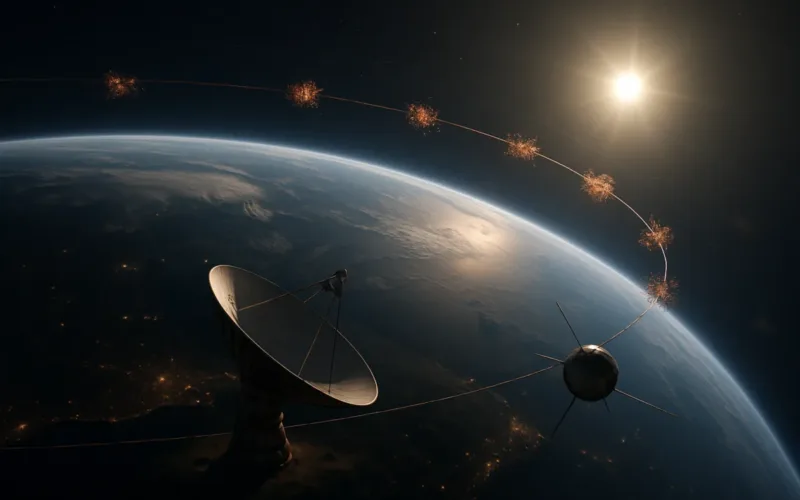
The discovery that Hubble archive anomalies could be extracted from decades of images in just two and a half days forces a hard question: should we keep building ever-larger telescopes, or should we first harvest the scientific gold already sitting in our archives? The Hubble archive anomalies flagged by AnomalyMatch—more than 800 objects never documented in the literature—show that transformative discoveries may not require new nights on the sky but smarter ways to read what we already have.
Why mining the Hubble archive matters for modern astronomy
At first glance this sounds like a modest result: a pattern-spotting program found rare galaxies and lenses in old data. Yet the scale is what makes it remarkable. Nearly 100 million image cutouts were processed in two and a half days, yielding more than 1,300 genuine oddities after human review.
Moreover, the findings are not obscure statistical noise. The flagged objects include hundreds of merging galaxies, dozens of gravitational lens candidates, ring galaxies, and jellyfish galaxies with trailing gas tails. These are scientifically valuable, rare phenomena that had been photographed but not catalogued.
How AnomalyMatch changed the game in archival data mining
To be clear, AnomalyMatch is not a synthetic astronomer with intuition. It is a pattern-matching system that learns from a few examples, ranks what looks unusual in a vast unlabelled set, and iteratively asks humans to judge the most uncertain cases. The human-in-the-loop aspect is crucial; it keeps the machine focused and the output verifiable.
Consequently, the approach operates as a high-speed filter rather than an autonomous authority. That distinction matters because it preserves scientific rigor while unlocking scale. What used to require years of manual inspection can now be done in days, freeing researchers to analyze and follow up on genuinely novel objects.
Archival value versus building new instruments
It is tempting to view scientific progress as a ladder: build a bigger instrument, get better data, repeat. However, the Hubble archive anomalies episode forces a rebuttal. The telescope was not new; the images were taken years ago. What changed was computational ability and algorithmic design.
Therefore, funding and strategic priorities deserve rebalancing. Investing in AI tools, computational infrastructure, and thorough curation of archival datasets offers high leverage. As the Vera C. Rubin Observatory, Euclid, and the Nancy Grace Roman Space Telescope produce petabytes of data, human attention alone will be insufficient to extract their full value.
Why anomaly detection is not the same as mystery hunting
People often conflate anomalies with inexplicable phenomena. In practice, anomaly detection finds statistical outliers—objects that differ from the bulk of the dataset. Most flagged items have known astrophysical explanations, but they are rare and scientifically interesting.
Consequently, the real achievement is turning rarity into discoverability. Instead of waiting for a patient human to happen upon a peculiar cutout, a pattern-spotter forces that rarity to the surface. That shift makes systematic searches practical, reproducible, and scalable.
Transitional note on interpretability
Moreover, interpretability remains essential. AnomalyMatch’s human reviewers validated more than 1,300 oddities, showing that machine suggestions still require expert interpretation. As a result, AI augments rather than replaces domain knowledge.
Implications for survey-era astronomy and data policy
Looking ahead, the flood of imaging data from next-generation surveys will dwarf the Hubble archive. The Rubin Observatory alone will generate tens of petabytes across its survey lifetime, demanding automated triage at scale. Tools like AnomalyMatch indicate that the bottleneck will be computational and organizational, not observational.
Therefore, astronomy institutions must treat archives as active research resources. That means standardizing metadata, ensuring long-term access, funding dedicated compute for archival mining, and encouraging reproducible pipelines that other teams can run and improve.
Counterarguments and the limits of AI in science
There are legitimate counterpoints. First, algorithmic bias can skew what is considered anomalous. Training sets that underrepresent certain phenomena may cause the system to miss or misrank valuable targets. This risk requires diverse training examples and periodic auditing.
Second, false positives can waste researcher time. AnomalyMatch mitigated this by prioritizing human review, but scaling human oversight remains costly. Therefore, efficient workflows and prioritization heuristics must accompany anomaly detection tools.
Practical steps for researchers, institutions, and funders
For researchers: start integrating archival searches into project designs. When proposing follow-up observations, include archival mining as a low-cost path to target discovery. This yields better use of telescope time and sharper science cases.
For institutions: fund computational resources dedicated to archive analysis. Make curated subsets and benchmark challenges available so teams can develop and stress-test anomaly detectors. Transparency will improve tool robustness.
For funders: allocate a portion of survey and mission budgets to post-observation data science. The marginal cost of compute and software is tiny compared to building new telescopes, yet the return on investment can be immediate and high.
How citizen science and collaboration can scale verification
Citizen science has a strong track record in astronomy. Platforms like Zooniverse democratize classification and can provide a parallel verification stream for machine-flagged candidates. Combining automated triage with crowd-sourced review multiplies human attention without prohibitive expense.
Consequently, projects should design interfaces that let volunteers vet AI shortlists. Clear training materials and feedback loops will improve both volunteer performance and machine learning models over time.
Preparing for the era of petabyte astronomy
Ultimately, the most defensible strategy is mixed: invest in instruments to gather better data while simultaneously building the computational and human infrastructure to exploit what we already have. The Hubble archive anomalies episode offers a blueprint: rapid algorithmic triage, human validation, open archives, and reproducible pipelines.
Furthermore, training the next generation of astronomers must include data science, software engineering, and ethics. These skills ensure teams can develop fair, interpretable tools and responsibly handle vast datasets.
Final actionable steps for readers in the field
If you are a researcher, run a pilot archival search on a dataset you already use; measure the yield and time saved. If you lead a survey project, allocate compute credits and design open benchmarks for anomaly detection. If you fund science, require a data exploitation plan that includes archival mining and community access.
Taken together, these steps make the case clear: the future of astronomical discovery will be built as much from clever re-use of existing data as from new instruments. The Hubble archive anomalies are a provocation and an opportunity—act on them now to harvest discoveries before the next wave of data renders us all overwhelmed.

Dr. Morgan directed the Archives Program from 2014 to 2017, gaining extensive experience in research documentation, information management, and the preservation of scholarly resources. Throughout her career, she has worked closely with academic publications and research materials, developing expertise in evaluating scientific sources and communicating complex topics to broad audiences.
Her primary areas of specialization include scientific publishing, research communication, editorial review, and the translation of technical research into accessible educational content. She has contributed to projects involving space science, astronomy, environmental science, history, archaeology, and emerging scientific discoveries, always emphasizing accuracy, transparency, and the responsible presentation of evidence.
As Editorial Director of Muskurahat.us, Dr. Morgan leads the editorial review process for scientific articles, ensuring that content is based on reputable sources, peer-reviewed research whenever available, and publications from recognized universities, research institutions, and international scientific organizations.
She is committed to promoting scientific literacy through clear, engaging, and well-documented articles that help readers better understand scientific discoveries and their impact on society. Her editorial philosophy is founded on accuracy, intellectual integrity, independent journalism, and continuous learning as scientific knowledge evolves.
Through her work at Muskurahat.us, Dr. Morgan supports the publication of trustworthy scientific content that makes complex research accessible to readers around the world while maintaining rigorous editorial standards.