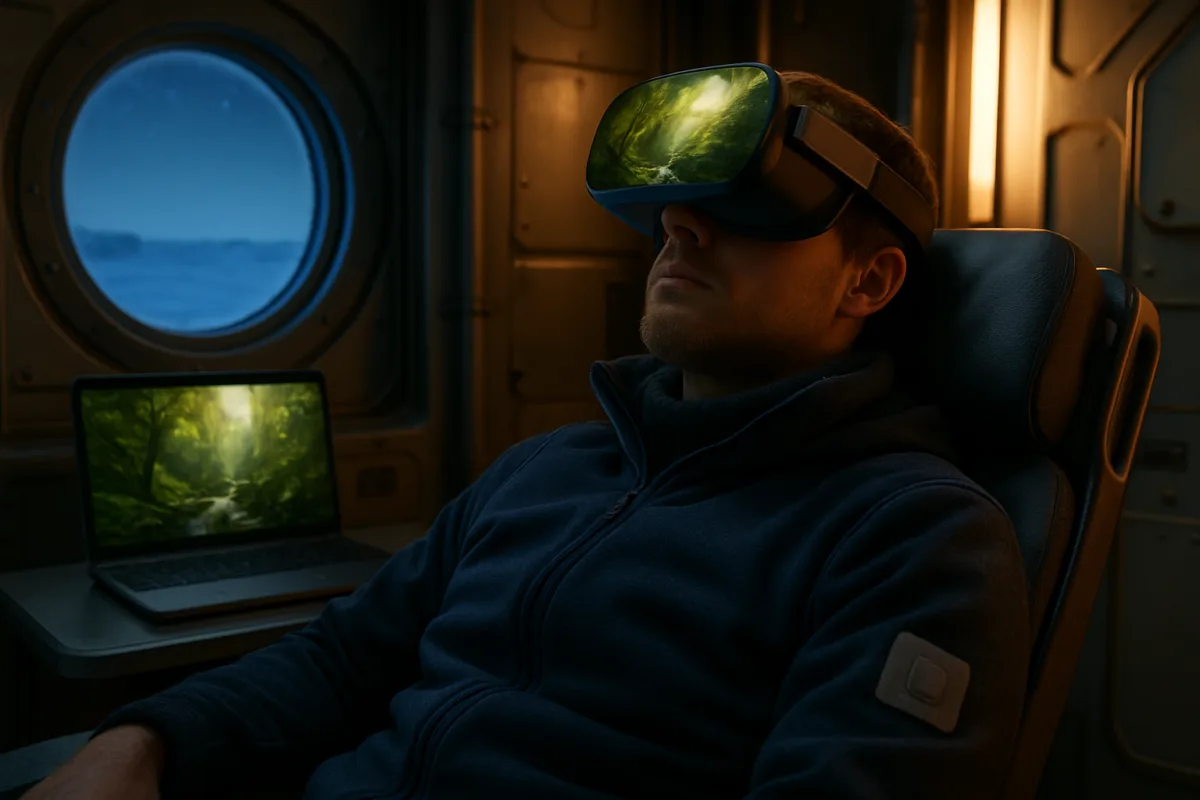
Virtual reality for space crews is not a futuristic luxury—evidence from an Amundsen-Scott South Pole study shows it can be a practical, near-term countermeasure against monotony and mental fatigue. The study’s finding that immersive nature scenes delivered through headsets outperformed laptop viewing should force mission planners to rethink how behavioral health tools are specified and resourced. If we accept that psychological resilience matters as much as oxygen and water, then the technical and design choices around VR deserve far more scrutiny.
Why the South Pole study is relevant to future astronauts
The Amundsen-Scott winter-over environment replicates many psychological pressures of long missions: isolation, confinement, environmental monotony, and a limited social pool. Consequently, outcomes from this analogue study have direct implications for lunar habitats and Mars transit vehicles where crew members will face similar cognitive and emotional stressors.
Moreover, the paper was not merely exploratory. Researchers tested 16 different conditions—comparing headset versus laptop, nature versus city scenes, 4- versus 10-minute sessions, and presence or absence of temperature cues—so the results function like an actionable design brief rather than a tentative proof of concept.
What the evidence actually favors: VR nature scenes and longer sessions
Across the board, participants ranked immersive nature scenes presented via headset higher on perceived value, immersion, and restoration. Laptop-based viewing and urban environments typically landed in the middle or lower tiers, while 10-minute exposures generally outperformed 4-minute trials.
These preferences are not trivial. They indicate that delivery method, content category, and session length interact meaningfully with short-term mood and subjective sense of recovery. Thus choosing VR hardware or content randomly is unlikely to deliver consistent benefits for a crew under prolonged stress.
Attention Restoration Theory and the pull of natural environments
The study’s results align with Attention Restoration Theory, which posits that natural scenes facilitate recovery from directed attention fatigue by offering effortless, soft fascination. In an environment dominated by white plains and machinery, a believable forest, stream, or beach provides contrast enough to permit cognitive replenishment.
Still, while averages favored nature, mood effects were mixed because baseline mood disturbance was low for many participants. That nuance matters: restoration is not guaranteed simply by showing nature; the quality and match to personal need determine the effect.
Design features that decide whether VR helps or hinders
Not all enhancements made experiences better. The study highlights three features that reliably altered outcomes: session duration, multisensory coherence, and image or audio quality. These are operational variables mission architects can control, and they should be treated as core specifications rather than optional refinements.
Consequently, space agencies should consider minimum standards around these features to ensure that investments in immersive tech translate into behavioral benefits.
Session length: longer is often better
Participants frequently reported that four minutes was simply too short—sessions often ended just as they started to acclimate or explore. Ten minutes allowed more meaningful engagement and was more likely to produce feelings of relaxation or escape.
Furthermore, several crew members said they sometimes wanted even longer sessions depending on the scene. Therefore, session length should be adjustable rather than fixed, letting users extend exposure as needed for maximal restoration.
Multisensory cues must be coherent and contextually timed
Temperature cues via wearables showed mixed results. Some participants found thermal feedback promising, yet others felt mismatched sensations detracted from immersion. A weak or mistimed cue can break presence rather than enhance it.
Hence, additional sensory channels—haptics, smell, localized airflow—should only be implemented if they can be precisely synchronized to the visual and auditory content and calibrated for individual sensitivity.
Image and audio fidelity are not cosmetic; they determine believability
A striking operational takeaway was participants’ sensitivity to visual and audio quality. Many reported that low resolution, unstable motion, or pixelation pulled them out of the scene and reduced restorative value. When the brain detects artifacts, it reminds the user of the simulation’s artificiality.
Therefore, delivery hardware and content production must prioritize high-resolution capture and stable rendering. If mission planners skimp on bandwidth, storage, or headset specs, the entire intervention risks becoming counterproductive.
Personalization: the non-negotiable variable
Even though nature scenes ranked highest on average, personal preference consistently moderated effects. Some crew members preferred urban or familiar indoor settings, reporting that such scenes felt socially rich or comfortably normal compared to endless white landscapes.
That variability implies a simple policy error to avoid: do not design a one-size-fits-all library. Instead, prepare diverse content categories—calm natural vistas, familiar civic or domestic spaces, and higher-arousal environments—to match different restoration needs and personal tastes.
Variety across arousal levels and familiarity
Practical libraries should include low-arousal scenes (quiet forests, beaches), medium-arousal social settings (cafes, city markets), and high-arousal exploratory experiences (mountain trails, bustling plazas). Crew members will value the ability to select a scene that fits their current state—whether they seek calm, connection, or stimulation.
Additionally, including culturally familiar places or personalized memories can make experiences feel relevant and restorative rather than exotic or alienating.
User autonomy and scheduling control
Autonomy emerged as a design principle: participants wanted control over when sessions started and which scenes were available. The ability to self-administer a quick reset or a longer restful session empowers adaptive coping during unpredictable stressors.
Therefore, mission protocols should avoid overly rigid scheduling for VR use. Instead, provide guidelines and recommended usage windows while preserving individual choice.
Concrete recommendations for mission planners and engineers
Based on the South Pole evidence, a practical VR program for lunar or Mars missions should incorporate minimum hardware specs, a curated content strategy, and a feedback-driven evaluation loop. These components ensure the system is both effective and adaptable.
Minimum hardware and technical standards
Specify headsets capable of high-resolution stereoscopic rendering, stable motion tracking, and low-latency audio. Prioritize displays that approach 4K-equivalent per eye when feasible, and ensure headsets are comfortable for repeated, extended wear.
Also, provision bandwidth and storage for high-quality content and incorporate on-board processing to reduce dependence on mission downlink when possible.
Content strategy and curation
Develop a diversified content library that includes nature, urban, and familiar indoor scenes, produced at high photographic fidelity with attention to motion stability. Include adjustable session lengths and metadata tags for arousal level, familiarity, and recommended use cases.
Regularly update the library based on crew feedback and include a simple user interface that allows rapid selection, preview, and extension of sessions.
Evaluation, personalization, and continual improvement
Implement in-mission evaluation tools: brief pre/post session questionnaires, optional qualitative feedback, and usage analytics. Use that data to tailor content offerings and technical adjustments for each crew member.
Over time, this feedback loop will reveal which scenes genuinely restore versus those that merely entertain, enabling evidence-based curation that respects individual differences.
For agencies tempted to treat immersive tech as an optional morale booster, the South Pole study is a corrective: VR has potential, but only when built to human needs, not developer convenience. Investment decisions should therefore prioritize fidelity, personalization, and flexible delivery over flashy but shallow content.
Given mission constraints on mass, power, and bandwidth, planners must weigh trade-offs; nevertheless, the behavioral return on a thoughtfully specified VR system is likely high. Simple steps—ensuring headsets meet minimum visual standards, designing a diverse content library, allowing user control over session length, and embedding a feedback loop—can turn VR from novelty to operational tool.
Ultimately, the research argues for a philosophy of design: treat virtual sensory stimulation as an adaptive, user-driven countermeasure rather than a one-off experiment. If mission teams adopt that posture, crews will arrive at a Moon base or transit vehicle with access to believable, personally meaningful escapes that truly help them focus, recover, and perform when it matters most.

Dr. Morgan directed the Archives Program from 2014 to 2017, gaining extensive experience in research documentation, information management, and the preservation of scholarly resources. Throughout her career, she has worked closely with academic publications and research materials, developing expertise in evaluating scientific sources and communicating complex topics to broad audiences.
Her primary areas of specialization include scientific publishing, research communication, editorial review, and the translation of technical research into accessible educational content. She has contributed to projects involving space science, astronomy, environmental science, history, archaeology, and emerging scientific discoveries, always emphasizing accuracy, transparency, and the responsible presentation of evidence.
As Editorial Director of Muskurahat.us, Dr. Morgan leads the editorial review process for scientific articles, ensuring that content is based on reputable sources, peer-reviewed research whenever available, and publications from recognized universities, research institutions, and international scientific organizations.
She is committed to promoting scientific literacy through clear, engaging, and well-documented articles that help readers better understand scientific discoveries and their impact on society. Her editorial philosophy is founded on accuracy, intellectual integrity, independent journalism, and continuous learning as scientific knowledge evolves.
Through her work at Muskurahat.us, Dr. Morgan supports the publication of trustworthy scientific content that makes complex research accessible to readers around the world while maintaining rigorous editorial standards.