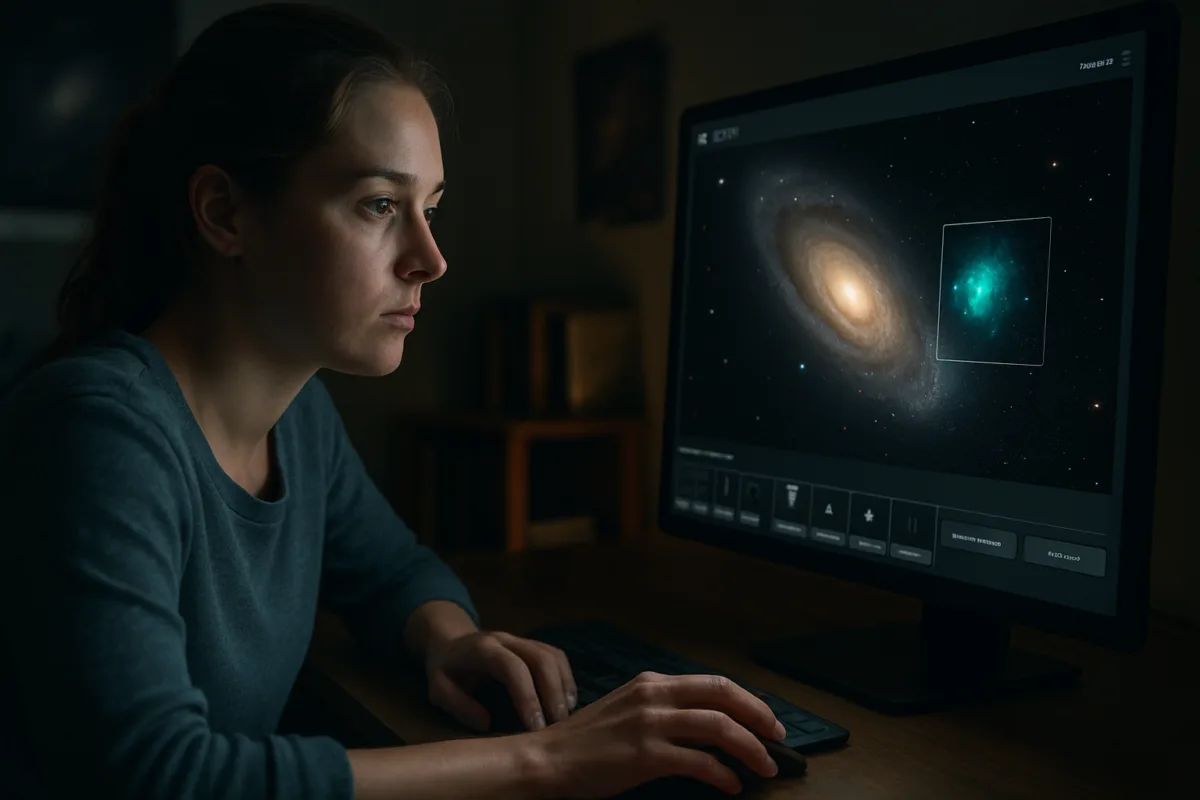
When a Dutch primary schoolteacher clicked through galaxy images on a volunteer website and flagged an odd blue-green smudge, she unwittingly discovered Hanny’s Voorwerp, a phenomenon that forces scientists to rethink both quasar lifecycles and how we search the sky. That singular observation—made by Hanny van Arkel on Galaxy Zoo in 2007—wasn’t an accidental novelty; it is a decisive argument for the continued centrality of citizen science in big-data astronomy. The reasons are scientific, practical, and institutional, and they deserve urgent attention.
How Hanny’s Voorwerp was found and why the discovery matters
In the summer of 2007 volunteers using the Galaxy Zoo interface examined images from the Sloan Digital Sky Survey, sorting spirals from ellipticals and flagging anomalies. Hanny van Arkel noted a small, bright blue-green cloud near the spiral galaxy IC 2497 that did not fit any classification option and drew it to the attention of professional astronomers. What followed—X-ray follow-up, Hubble imaging, and spectroscopy—revealed a cloud of highly ionized gas illuminated by what had once been a quasar.
Crucially, the quasar at the center of IC 2497 had already switched off by the time astronomers pointed sensitive instruments at the galaxy, meaning the cloud was a light echo from a luminous but now-quiet active galactic nucleus. The phenomenon demonstrated that quasars can shut down on timescales of order 100,000 years, far shorter than many prior models assumed. This single human-flagged anomaly therefore reshaped astrophysical thinking about black hole feeding cycles and galactic feedback.
Citizen science versus automation: why human eyes still win at anomalies
Automated algorithms excel at pattern recognition when the patterns are well defined, but they struggle with outliers and rare phenomena that lack training exemplars. Galaxy Zoo was launched because, in 2007, automated morphological classification could not reliably replace human visual inspection for millions of galaxy images. Hanny’s Voorwerp was exactly the kind of unpredictable outlier that algorithms miss.
Moreover, machine learning systems are only as good as their training data and their designers’ assumptions. When you ask a machine to classify into a fixed set of categories, you implicitly close the door on novel discoveries. Conversely, thousands of volunteers looking at hundreds of thousands of images create a diversity of attention and curiosity that functions as an open-ended anomaly detector. Thus, citizen science complements computational pipelines by catching the unexpected and forcing a recalibration of theoretical models.
The scientific implications of a quasar shutting off quickly
The spectroscopy of the green cloud—dominated by doubly ionized oxygen—required a hard ultraviolet radiation field consistent with quasar-level luminosity. Yet contemporaneous X-ray observations found no active nucleus in IC 2497. The most plausible interpretation is that the central engine turned off within the last 100,000 years while the light from its active phase continued to travel outward to illuminate distant gas.
Such rapid quasar shutoff challenges long-standing assumptions about the duty cycle of supermassive black holes. If quasars flicker on and off on surprisingly short timescales, then models of galaxy evolution, black hole growth, and AGN feedback require substantial revision. Short duty cycles alter predictions for energy deposition into galactic gas, star formation regulation, and the timing of cosmic feedback processes.
Further evidence and the broader class of “Voorwerpjes”
Follow-up Hubble observations revealed that Hanny’s bright patch is part of a much larger hydrogen streamer, with pockets of star formation at the interface facing IC 2497. Bill Keel and collaborators then searched archival Hubble images, using more Galaxy Zoo volunteers, and identified multiple similar structures—dubbed “voorwerpjes”—around galaxies that once hosted quasars. That expanded sample transformed Hanny’s object from a one-off curiosity into a definable category with statistical weight.
Therefore, the discovery was not merely serendipitous. It inaugurated a new observational approach: using unexpected human observations to drive targeted follow-up and archival mining, which in turn builds a richer empirical basis for theorists. The empirical payoff validates the citizen science model.
Why institutions must invest in human+AI hybrid research models
It is tempting for research institutions to prioritize full automation as datasets balloon to petabyte scales. However, the Hanny’s Voorwerp case shows that purely automated strategies risk systematically missing phenomena that fall outside design assumptions. A hybrid model that combines algorithmic pre-filtering with volunteer or expert human inspection is more scientifically robust.
Funding agencies and observatories should, therefore, treat volunteer-powered platforms as essential research infrastructure, not optional outreach. Doing so means allocating resources for data curation, volunteer training, and the maintenance of interfaces that enable serendipity. Measurement pipelines should explicitly reserve human-in-the-loop stages for anomaly detection and for vetting high-value, low-frequency signals.
Operational recommendations for research programs
First, integrate citizen platforms into survey planning from the start so human inspection is not an afterthought. Second, enable archival-mining projects that explicitly recruit volunteers for targeted searches inspired by initial discoveries. Third, incentivize reproducibility by making images, labels, and volunteer annotations easily downloadable and citable.
These measures would transform ad-hoc volunteer contributions into reproducible science assets and reduce the friction between a volunteer’s curiosity and professional follow-up. Institutions that adopt this approach will not only accelerate discovery but also democratize access to frontline research.
Public engagement is not optional: education and discovery are linked
Hanny van Arkel was a 25-year-old primary schoolteacher when she made her discovery; her role underscores how public engagement expands the effective workforce of science. Citizen science projects create touchpoints for education, inspire future scientists, and provide low-cost, high-value contributions to research. These benefits extend beyond data processing to cultural and pedagogical domains.
Furthermore, naming the object “Hanny’s Voorwerp” highlighted a cultural shift: discoveries can now emerge from a distributed public, and science benefits when credit and visibility accompany contribution. Naming is symbolic but it also signals that institutions value non-professional involvement—an important incentive for broader participation.
How readers, educators, and policymakers can act now
For readers who want to support meaningful science, the simplest action is to participate: sign up for Galaxy Zoo or another Zooniverse project and actively flag anything unusual. Participation requires only curiosity, not a degree, and the time investment can directly contribute to publishable discoveries. Volunteering also provides a direct learning pathway into astrophysics and data literacy.
Educators should integrate citizen projects into curricula to teach scientific thinking and data skills. Policymakers and funders should earmark small but sustained funds to maintain volunteer platforms, support volunteer training materials, and underwrite follow-up observations triggered by public discoveries. These investments yield outsized scientific returns for relatively modest sums.
Practical steps for researchers
Researchers should design surveys with explicit human-in-the-loop checkpoints for anomaly detection and establish protocols for rapid follow-up when volunteers flag unusual objects. They should also create easy pipelines to extract volunteer annotations for subsequent machine learning training, converting human insight into more capable hybrid systems. This recursive cycle—human discovery, professional follow-up, archival search, algorithm retraining—creates a resilient discovery engine.
Ultimately, Hanny’s Voorwerp is a model for discovery in the age of data abundance. It shows that anomalies are scientifically precious and that human attention remains indispensable for spotting the kinds of exceptions that force paradigm shifts.
Hanny’s Voorwerp demonstrates that discovery is a social and technical process: an attentive volunteer, accessible data, and responsive institutions together produced a result with real theoretical consequences. If we want more breakthroughs like this, the sensible course is to invest in platforms that harness public curiosity, to design research workflows that respect serendipity, and to treat volunteers as partners rather than as cheap labor. Take one practical step today—visit Galaxy Zoo or another Zooniverse project, try classifying a few images, and practice the kind of careful attention that once led to rewriting a chapter of quasar history. That small action could become the starting point for the next transformative discovery.

Dr. Morgan directed the Archives Program from 2014 to 2017, gaining extensive experience in research documentation, information management, and the preservation of scholarly resources. Throughout her career, she has worked closely with academic publications and research materials, developing expertise in evaluating scientific sources and communicating complex topics to broad audiences.
Her primary areas of specialization include scientific publishing, research communication, editorial review, and the translation of technical research into accessible educational content. She has contributed to projects involving space science, astronomy, environmental science, history, archaeology, and emerging scientific discoveries, always emphasizing accuracy, transparency, and the responsible presentation of evidence.
As Editorial Director of Muskurahat.us, Dr. Morgan leads the editorial review process for scientific articles, ensuring that content is based on reputable sources, peer-reviewed research whenever available, and publications from recognized universities, research institutions, and international scientific organizations.
She is committed to promoting scientific literacy through clear, engaging, and well-documented articles that help readers better understand scientific discoveries and their impact on society. Her editorial philosophy is founded on accuracy, intellectual integrity, independent journalism, and continuous learning as scientific knowledge evolves.
Through her work at Muskurahat.us, Dr. Morgan supports the publication of trustworthy scientific content that makes complex research accessible to readers around the world while maintaining rigorous editorial standards.