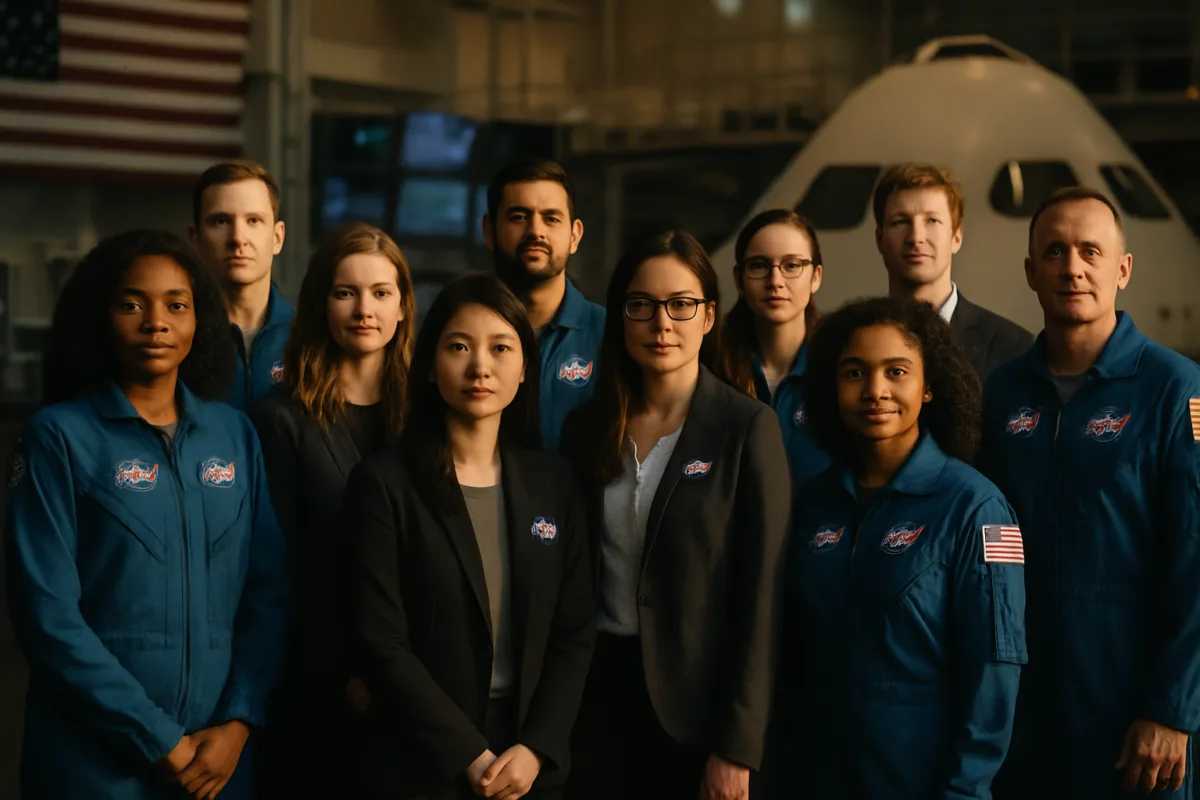
When NASA reported that the 2025 astronaut candidate class was chosen from more than 8,000 applicants, the headline read like a verdict on ambition. The phrase NASA astronaut applications, which dropped from a record 18,300 in the 2016 recruitment cycle to just over 8,000 in 2024, has been seized as evidence that fewer people aspire to reach space. That interpretation is simplistic and misleading; a closer look shows structural changes, new career paths, and a one-off surge in 2016 are better explanations for the decline.
Why the raw applicant count overstates a decline in interest
At first glance, the decrease from 18,300 to about 8,000 looks dramatic. However, the 2016-2017 surge was an outlier in a longer historical arc. Before 2016, NASA typically received far fewer applicants—6,300 in 2012, for example—and 8,000 used to be the record for decades before that. That context matters, because interpreting the recent numbers without it encourages a false narrative of national apathy.
Furthermore, application totals are shaped by eligibility thresholds and administrative choices. In 2020 NASA raised the minimum education requirement from a bachelor’s degree to a master’s degree, narrowing the candidate pool. So the applicant count partly reflects policy decisions, not a sudden evaporating of public fascination with spaceflight.
How the private space industry is reshaping the applicant pool
Another decisive factor is the maturation of the commercial space sector. U.S. space-sector employment grew substantially over the decade through 2024, drawing engineers, pilots, physicians, and scientists into private companies. Those are precisely the professionals who would once have applied to NASA’s astronaut selection process.
Consequently, career pathways that once funneled talent toward NASA now offer alternatives. Companies like SpaceX, Blue Origin, and smaller launch and spacecraft firms provide compelling missions, attractive compensation, and earlier hands-on experience. As a result, the pool of potential applicants isn’t necessarily smaller—it’s simply dispersed across more employers and mission profiles.
Related careers weaken the signal from application totals
Moreover, the widening menu of technical careers reduces the relative appeal of a single, low-probability route to space. Becoming a NASA astronaut remains extremely competitive—roughly 10 slots from a pool of over 8,000 in the 2024 cycle—but many routes to meaningful space work no longer require the intermediary step of joining NASA’s corps.
For example, engineers can now design orbital systems, mission operations staff can run commercial launches, and private astronauts can fly on for-pay missions. The dream of space has acquired multiple addresses.
Gender milestone and what it tells us about selection, not supply
The 2025 class being the first with more women than men is genuinely significant, but it reveals more about selection criteria than applicant supply. Picking six women and four men from a limited class of 10 is a milestone worth celebrating. Yet gender balance in a single cohort can hinge on a few exceptional applicants and targeted selection priorities.
Therefore, the gender composition tells us about NASA’s choices and priorities in recruitment and diversity; it does not directly describe the overall size or enthusiasm of the candidate pool. In other words, representation and raw applicant count are distinct metrics and must be interpreted separately.
Previous spikes and why 2016 was exceptional
When NASA received 18,300 applications in the 2016 cycle, many contemporaneous observers connected that surge to the agency’s rhetoric about Mars and deep-space exploration. The then-administrator framed astronaut recruitment as a step on the “journey to Mars,” which likely inspired many applicants.
But spikes like that can be temporary. They respond to cultural moments, political narratives, and media attention. For example, staffing up for the space shuttle in 1978 produced another large cohort of applications, and that moment too was linked to specific programmatic needs. So we should be careful about treating any single year’s tally as a steady-state indicator.
What the smaller pile of applications reveals about supply and demand
Even though fewer people applied in 2024, the number of qualified individuals interested in space is not clearly declining. Instead, demand for space-related talent across both public and private sectors has grown. Census Bureau data showed significant hiring in the space economy, with nearly half of new hires under 35 in 2024, suggesting future pipelines remain healthy.
At the same time, astronaut opportunities remain limited. NASA’s active roster has been intentionally small; tight caps, long training pipelines, and mission-specific needs mean openings are rare. When supply is scarce and slots are few, rational professionals may opt for the more immediate rewards available in the commercial sector.
New models of access to space blur old signals
Another wrinkle is that the definition of “has been to space” has changed. One of the 2025 candidates had already flown to orbit on a private mission, illustrating how commercial flights can accelerate career paths that previously would have taken decades. This new reality complicates longitudinal comparisons of application numbers.
Therefore, application totals are a noisy metric for public interest. They tell us how many people signed up for one specific, high-barrier program in one year—not how many people are inspired by space or are working toward it in other ways.
Policy implications: what NASA and policymakers should do next
If one accepts that fewer applications reflect diversification of career options rather than a collapse of interest, then policy responses should follow a different logic. Rather than lamenting lower application numbers, stakeholders should broaden pathways into space careers and improve coordination with commercial partners.
For instance, NASA could expand joint training programs with private companies, create apprenticeship and fellowship tracks, and fund master’s-level scholarships targeted at underrepresented groups. Such measures would not only enlarge the pipeline but also recognize that commercial entities are now co-creators of the space workforce.
Concrete steps to strengthen the astronaut pipeline
First, reduce artificial bottlenecks in eligibility where feasible. Reassessing degree requirements or creating equivalency pathways for specialized experience could diversify the applicant pool without lowering standards.
Second, invest in early-career outreach. Internships, cooperative education programs, and targeted recruitment at minority-serving institutions would generate a deeper, more resilient talent pool. Third, formalize partnerships with commercial firms to offer rotational assignments and flight experience that prepare candidates for government roles.
Why the narrative matters: ambition vs. metrics
The debate over astronaut application totals is ultimately a dispute about narrative framing. If we equate fewer applications with diminished national ambition, we risk misdiagnosing the situation and enacting policies that address the wrong problem.
Conversely, if we treat the decline as an indication of a maturing and diversifying space economy, we can adapt intelligently. We should applaud the gender milestone and the diversified career landscape, while also taking steps to ensure NASA remains an attractive, accessible option for top talent.
Bridging public aspiration and practical pathways
Public fascination with space can coexist with a labor market that offers multiple ways to participate in exploration. To bridge aspiration and opportunity, institutions should make entry points clearer and more attainable. That includes transparent career ladders that highlight how experience in commercial missions, research, or operations translates to NASA candidacy.
Finally, media and policymakers should avoid simplistic metrics that transform a complex ecosystem into an alarming headline. Nuanced analysis leads to better policy and better outcomes for the future of human spaceflight.
Fewer applications to NASA’s astronaut program do not by themselves signal a national retreat from space. They reflect a transformed labor market, policy choices, and a historically anomalous application spike in 2016. By recognizing these dynamics and acting to expand alternative pipelines—through education, partnerships, and targeted recruitment—NASA and its partners can preserve the dream of space while offering many more realistic routes to achieve it. That shift will make the dream more widespread and attainable, not less.

Dr. Morgan directed the Archives Program from 2014 to 2017, gaining extensive experience in research documentation, information management, and the preservation of scholarly resources. Throughout her career, she has worked closely with academic publications and research materials, developing expertise in evaluating scientific sources and communicating complex topics to broad audiences.
Her primary areas of specialization include scientific publishing, research communication, editorial review, and the translation of technical research into accessible educational content. She has contributed to projects involving space science, astronomy, environmental science, history, archaeology, and emerging scientific discoveries, always emphasizing accuracy, transparency, and the responsible presentation of evidence.
As Editorial Director of Muskurahat.us, Dr. Morgan leads the editorial review process for scientific articles, ensuring that content is based on reputable sources, peer-reviewed research whenever available, and publications from recognized universities, research institutions, and international scientific organizations.
She is committed to promoting scientific literacy through clear, engaging, and well-documented articles that help readers better understand scientific discoveries and their impact on society. Her editorial philosophy is founded on accuracy, intellectual integrity, independent journalism, and continuous learning as scientific knowledge evolves.
Through her work at Muskurahat.us, Dr. Morgan supports the publication of trustworthy scientific content that makes complex research accessible to readers around the world while maintaining rigorous editorial standards.