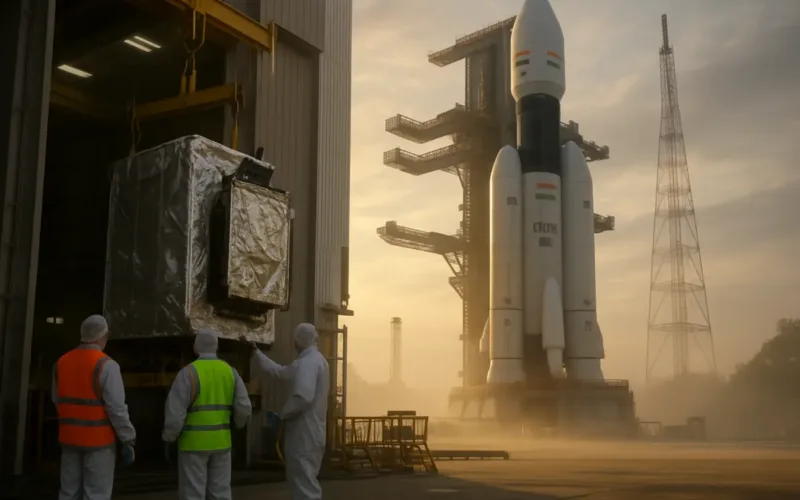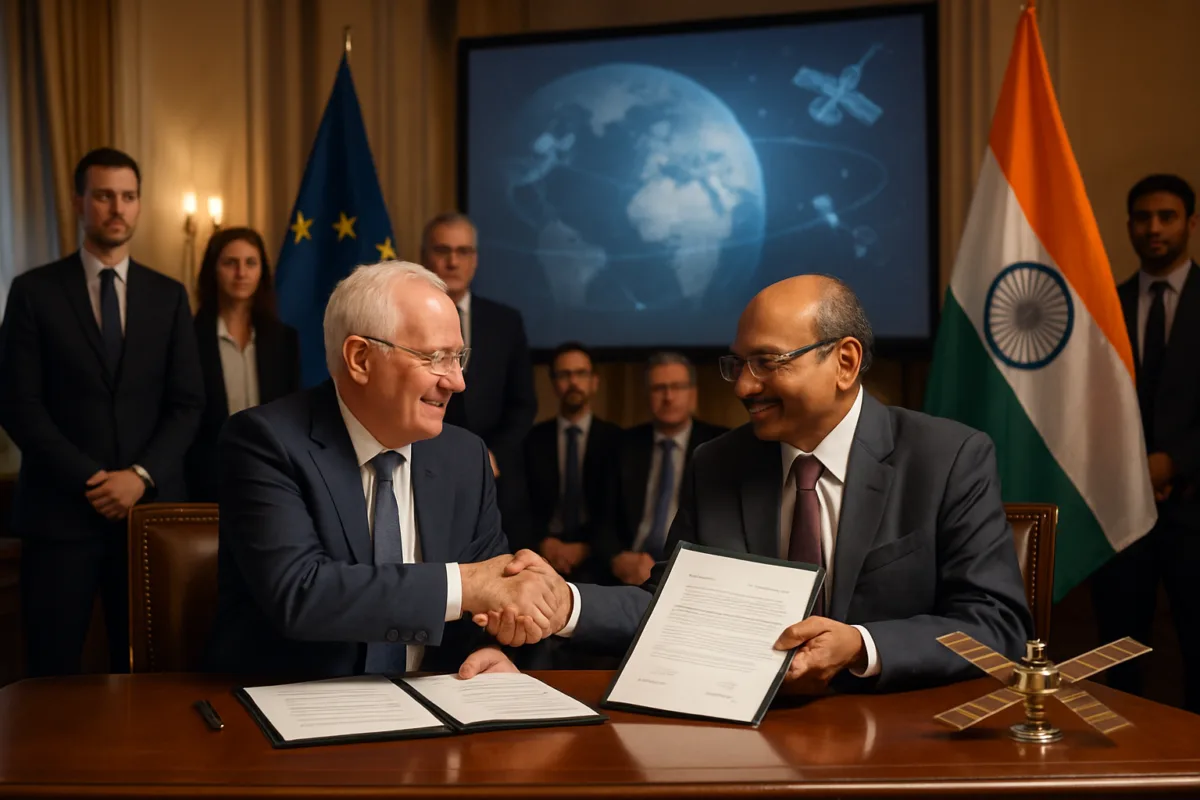
The ESA and ISRO Cooperative Agreement extension announced in Paris is more than a calendar change; it is a diplomatic and technical signal that two major space agencies intend to deepen ties across space weather, exploration, and sustainability. This exchange of letters, signed on the margins of the International Space Summit, keeps a proven framework alive while widening its scope — and that matters for operators, scientists, and policymakers alike.
Why the 2032 extension of the ESA and ISRO Cooperative Agreement matters
At first glance, an exchange of letters sounds like modest administrative housekeeping. However, the decision to extend cooperation to 8 January 2032 is consequential because it preserves continuity for data-sharing, mission support, and strategic alignment. Continuity reduces transaction costs and enables immediate technical exchanges without renegotiation, which is useful when dealing with fast-moving phenomena like space weather.
Moreover, the extension is strategic because it anticipates near-term shifts in both agencies’ priorities: India’s crewed programme is advancing, and Europe’s exploration commitments are evolving. Consequently, the agreement functions as an anticipatory governance tool that lowers barriers to future joint projects, even if it does not itself allocate new missions or budgets.
Space weather cooperation: an operational necessity
Including space weather explicitly within the agreement is the most operationally urgent change. Solar storms, ionospheric disturbances, and coronal mass ejections do not respect national borders; they affect communications, navigation systems, and satellite integrity globally. Therefore, arguing for stronger data-sharing protocols and joint forecasting is not merely idealistic — it is a pragmatic requirement for resilient space operations.
Furthermore, both ESA and ISRO already run complementary observational assets and services. Combining European space-weather services and India’s ionospheric monitoring networks would improve forecasting lead time and coverage. In short, the expanded scope should be translated into interoperable data pipelines and shared operational centres rather than left as a paper promise.
Human and robotic exploration: opportunity with caveats
Adding human and robotic exploration to the Cooperative Agreement is an important step because it aligns legal footing with a 2025 Joint Statement of Intent on crewed activities. That said, the agreement is an enabling framework, not a commitment to flights, payloads, or funding. This distinction matters: strategic intent must be paired with programmatic clarity to produce missions.
Therefore, a reasonable argument is that the agreement should be used to accelerate practical, low-risk collaborations first: shared astronaut training modules, life-support technology exchanges, and cooperative robotics demonstrations around lunar infrastructure. These steps build trust and technical interoperability without requiring a single large, politically fraught joint mission decision.
Sustainability of outer space activities: standards and practice
Space sustainability is the third new pillar and likely the most geopolitically resonant. Both ESA and ISRO operate in increasingly congested orbits, and both have an interest in improving debris mitigation, collision avoidance, and end-of-life practices. Including sustainability in the agreement creates a platform for harmonizing technical norms and presenting coordinated positions in multilateral fora.
However, harmonization requires specificity: shared standards for conjunction data messages, joint best-practice protocols for passivation and disposal, and mechanisms for real-time collision-avoidance coordination. Without these operational details, sustainability risks becoming another high-sounding commitment with limited day-to-day impact.
Governance mechanics: why the exchange of letters matters — and where it falls short
The form of the amendment — an exchange of letters — is procedural but meaningful. It is the lightest legal instrument for amending an in-force agreement, which keeps the original 2002 framework intact while extending the deadline and adding scope. The benefit is speed and administrative simplicity, which is advantageous when both parties want to maintain momentum.
On the other hand, the lightness of this instrument also exposes a vulnerability: because it is not a fresh treaty or a new funded programme, the extension lacks built-in enforcement mechanisms, budget lines, or mandatory deliverables. Consequently, the letter-based amendment is a necessary enabler, but not a sufficient guarantee of substantive cooperation.
ESA Council endorsement and procedural legitimacy
It is important to note that the extension followed ESA governance protocols, including Council approval at the 347th session in June 2026. This procedural step gave the broadened scope legitimacy within ESA’s member-state framework and prevented the arrangement from being an executive-only decision. That internal legitimacy is crucial if joint activities are to secure contributions from national programmes.
From framework to impact: concrete recommendations
If the extension is to be more than symbolic, both agencies — and their stakeholders — must translate the framework into operational projects. First, establish joint technical working groups with clear mandates, timelines, and deliverables for each of the three new areas: space weather, exploration, and sustainability. Working groups should include scientists, mission engineers, and legal experts to address technical and normative issues simultaneously.
Second, set measurable Key Performance Indicators (KPIs) such as data latency targets for space-weather alerts, cross-certification standards for life-support components, and debris mitigation compliance rates. KPIs make it possible to evaluate cooperation objectively and to justify national funding to domestic overseers and parliaments.
Funding pathways and industry engagement
Third, create funding pathways that incentivize joint proposals from industry and academia. Public-private partnerships and competitive calls for collaborative demonstrators would convert the enabling framework into tangible projects. This is essential because neither an exchange of letters nor a statement of intent can substitute for the financing that turns plans into hardware and software.
Fourth, involve the private sector early in planning for both robotic demonstration missions and operational space-weather services. Private operators often own the assets most vulnerable to space weather and stand to benefit immediately from improved forecasting and collision-avoidance practices.
What stakeholders should insist on next
Policymakers, satellite operators, and scientists should press for four specific actions. One: a timetable for delivering interoperable space-weather data products within 12–24 months. Two: a memorandum of understanding for astronaut training exchanges and robotics trials within 36 months. Three: a coordinated roadmap for debris mitigation standards to be presented jointly at relevant UN forums. Four: transparent reporting to ESA Council and ISRO governance bodies on progress against KPIs.
These demands are realistic and modest relative to the scale of the agencies involved; yet they would materially change outcomes by anchoring high-level intent in operational milestones. Moreover, they would demonstrate that transparent international cooperation can function effectively without waiting for sweeping treaties.
Balancing ambition with realism in international space cooperation
There is a natural tendency to read such diplomatic moves either as overhyped or underwhelming. The more sensible position is balanced: recognize the extension’s value as a low-friction enabler while demanding follow-through. Ambition matters, but it must be matched by programmatic clarity and resource commitments.
Consequently, the real test of this Cooperative Agreement’s worth will be the next set of actions: whether shared systems, joint tech demonstrations, and standardized operational protocols arrive within a few years. If they do, the letters signed in Paris will look prescient; if they do not, the agreement risks becoming another well-intentioned but inert document.
Implications for global space governance
Finally, there is an important systemic point: bilateral arrangements like this one can accelerate consensus-building in broader multilateral settings. By piloting cooperative technical standards and operational norms, ESA and ISRO can lead by example and influence the work of the UN Committee on the Peaceful Uses of Outer Space and other forums. Therefore, stakeholders should view this extension not as an isolated bilateral patch but as a potential catalyst for wider norm formation.
All of these points imply a practical imperative: use the time to codify and operationalize. That is how enabling frameworks become engines of progress, reducing risk for satellites, improving astronaut safety, and strengthening international norms that keep space accessible and sustainable for everyone.
The Paris letters that extended the agreement to 2032 represent an opportunity, not an outcome. Decision-makers should treat them as a call to action: set joint KPIs, fund demonstrators, formalize data-sharing pipelines, and engage industry partners. Those concrete steps will ensure that the extension delivers measurable benefits to operators, scientists, and citizens who depend increasingly on space-based services.

Dr. Morgan directed the Archives Program from 2014 to 2017, gaining extensive experience in research documentation, information management, and the preservation of scholarly resources. Throughout her career, she has worked closely with academic publications and research materials, developing expertise in evaluating scientific sources and communicating complex topics to broad audiences.
Her primary areas of specialization include scientific publishing, research communication, editorial review, and the translation of technical research into accessible educational content. She has contributed to projects involving space science, astronomy, environmental science, history, archaeology, and emerging scientific discoveries, always emphasizing accuracy, transparency, and the responsible presentation of evidence.
As Editorial Director of Muskurahat.us, Dr. Morgan leads the editorial review process for scientific articles, ensuring that content is based on reputable sources, peer-reviewed research whenever available, and publications from recognized universities, research institutions, and international scientific organizations.
She is committed to promoting scientific literacy through clear, engaging, and well-documented articles that help readers better understand scientific discoveries and their impact on society. Her editorial philosophy is founded on accuracy, intellectual integrity, independent journalism, and continuous learning as scientific knowledge evolves.
Through her work at Muskurahat.us, Dr. Morgan supports the publication of trustworthy scientific content that makes complex research accessible to readers around the world while maintaining rigorous editorial standards.