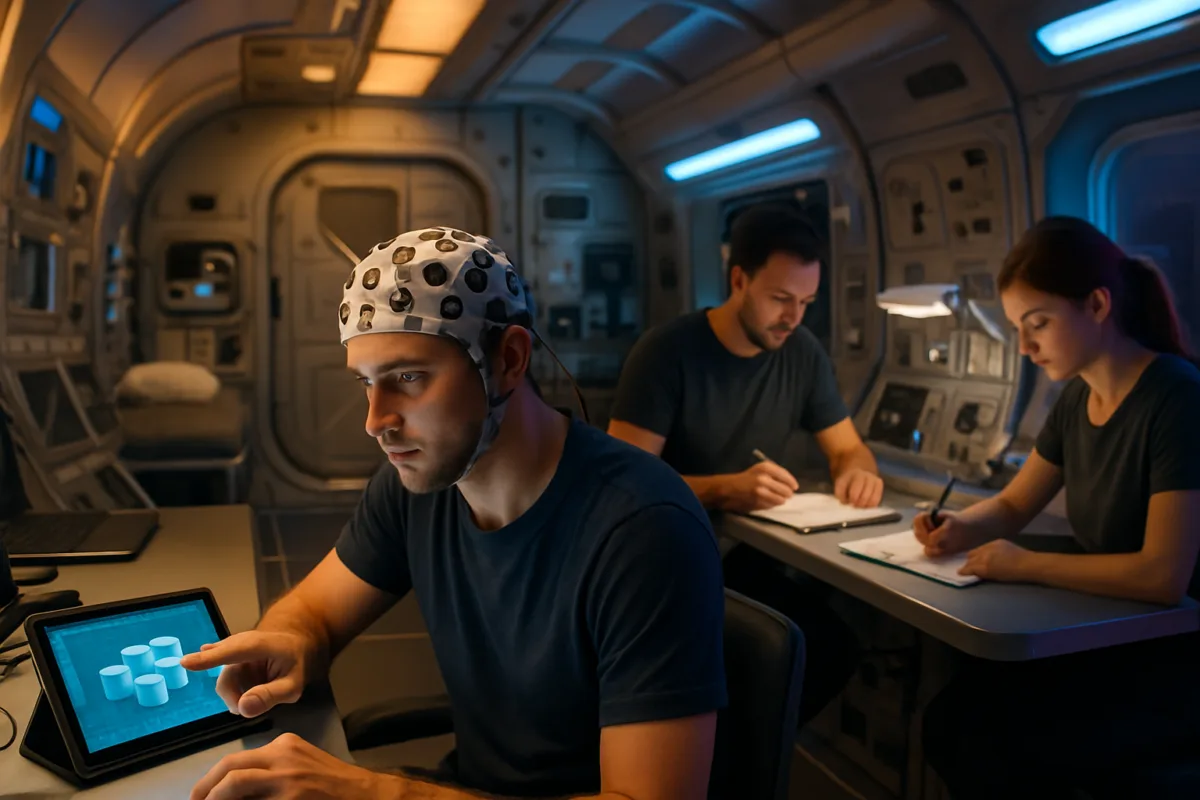
Dynamic lighting is more than a comfort feature; it can be an operational lever that improves critical thinking under fatigue. Recent controlled research in a simulated space station found that shifting spectra and intensity helped volunteers perform better on spatial memory, executive control, and risk-based decision tasks—even when those same volunteers did not report feeling more alert or in a better mood. This disconnect forces mission designers to decide which metrics deserve priority: subjective comfort or measurable task resilience.
Why cabin illumination deserves operational status on spacecraft
Lighting is one of the few habitat variables that engineers can alter daily without heavy hardware changes or complex procedures. Given constraints on mass, power, and crew time, the argument for treating cabin illumination as an actionable countermeasure is compelling. If a repositioned light spectrum can protect decision-making when crews are tired, it becomes a cheap and low-intrusion tool compared with pharmaceutical or large-scale schedule changes.
Moreover, transit missions and long-duration habitats will lack natural sunrise–sunset cues for months at a time. Therefore, relying solely on subjective comfort or standard brightness settings is short-sighted. Instead, we should evaluate lighting as a functional support system, judged by objective cognitive outputs as much as by crew self-report.
How the simulated space station study tested changing light and fatigue
The Beijing Jiaotong University and China Astronaut Research and Training Center study used a single-blind, within-subjects design that is robust for human factors work. Thirty participants experienced both static and dynamic light profiles across fatigue and non-fatigue sessions, enabling direct comparisons within the same brain and behavior context. That approach trims between-subject variability and makes the cognitive claims harder to dismiss as random noise.
Importantly, the experiment went beyond simple reaction-time measures. The battery included spatial memory probes, executive control tasks, and risk decision-making assessments. Those domains are operationally relevant: navigation and spatial awareness, task switching and inhibition under pressure, and maintaining prudent judgment when tired.
Transitional note: why study design matters
Because the authors segregated fatigue states, the findings are particularly relevant to mission timing and shift design. Therefore, the results have direct implications for when and how to deploy lighting interventions during a mission day. This is not a theoretical exercise; the methodology answers whether light can buttress performance when crews are already degraded by sleep loss or long shifts.
Performance gains versus subjective feelings: the key tension
Data showed selective cognitive improvement under dynamic light while participants’ self-reports of alertness and mood remained flat. This divergence is not a flaw in the study; it is the central operational insight. In practice, a crew member might not feel noticeably better while still making fewer errors or managing spatial tasks more accurately under an optimized light profile.
Accordingly, treating subjective surveys as the sole arbiter of lighting success is a policy mistake. If mission planners accept only mood-based validation, they risk overlooking interventions that safeguard mission-critical functions. Conversely, a lighting plan that only optimizes for self-reported comfort may fail to protect cognitive reliability during high-stakes operations.
Why the split between objective and subjective measures occurs
Several mechanisms can explain the split. Visual and attentional pathways can react rapidly to spectrum and intensity changes, producing immediate shifts in neural processing. In contrast, self-reported alertness and mood are slower, noisier, and influenced by expectations and cultural norms. In short, the brain’s operating mode can improve before conscious sensation catches up.
Additionally, different neural systems mediate task performance and mood. Dynamic lighting may predominantly affect attention networks and working memory circuitry while only weakly modulating limbic systems tied to emotional tone. For mission operations, supporting the control networks that enable safe, accurate action should be treated as a high priority.
EEG evidence: neural fingerprints of lighting effects
The study’s EEG results strengthen the behavioral claims. Dynamic light conditions suppressed low-frequency theta and alpha power—signals commonly associated with attention, mental effort, and fluctuating drowsiness. Such neural markers offer an objective bridge between the lighting environment and observed improvements on selected tasks.
Put differently, EEG provides convergent validity for the behavioral effects. Even when volunteers didn’t report feeling more alert, their brains registered a measurable shift in processing. That is precisely the kind of evidence mission planners should demand before committing to habitat design changes.
Transitional phrase: interpreting neural changes carefully
Of course, the presence of EEG shifts does not imply a single universal ‘better mode’ induced by light. The neurophysiological changes were task-relevant and selective. Therefore, the prudent implication is that lighting can nudge certain cognitive architectures rather than produce global uplift.
Policy implications for spacecraft design and operations
Given the findings, a simple policy shift is needed: evaluate cabin lighting by task-specific cognitive metrics, not by mood surveys alone. Lighting should be integrated into operational planning, used strategically where and when it protects key capabilities like spatial awareness and complex decision-making. This reframes illumination from an aesthetic choice to a mission-critical design element.
Furthermore, mission architects should avoid one-size-fits-all prescriptions. Different tasks and circadian phases will require distinct light patterns. A single static ‘comfort’ spectrum cannot be expected to deliver the nuanced support crews will need across watch schedules and mission phases.
Operationally feasible steps
First, implement adaptive lighting control systems that can shift spectra and intensity on demand. Second, pair lighting schedules with task rosters so cognitive support appears during known high-risk windows. Third, use onboard EEG or other biometrics during testing phases to verify neural engagement rather than relying only on subjective feedback.
These steps are incremental and implementable within current technology and mass budgets. They also create an evidence-based loop: measure, adjust, and validate—so lighting strategies improve with real mission data over time.
Counterarguments and cautionary notes
Critics may argue that lab-based analogs do not fully capture the complexity of true long-duration missions. That is a fair point. The study does not prove identical effects will emerge in orbit. However, the value here lies in operationally relevant signals—selective cognitive gains backed by neural data—that justify further in-situ trials.
Additionally, there is a risk of overfitting a particular light recipe to a specific task battery. To avoid that, lighting interventions should be modular, easily updated, and tested across varied tasks and crew populations. Robust engineering practice requires iterative validation, not a single-study mandate.
Practical recommendations for mission planners and researchers
Designers should prioritize integrated countermeasures: align lighting with schedule design, workload timing, and habitat layout. Start by identifying mission-critical tasks that suffer under fatigue and target lighting interventions to those windows. Next, set up objective performance metrics and neural monitoring during early missions or analogs to confirm efficacy.
Finally, plan for adaptability. Lighting control systems should allow rapid modification of spectra and timing based on incoming operational feedback. That flexibility turns cabin illumination from a static comfort feature into a dynamic tool that grows more effective through iterative use.
Accepting that people might not feel markedly different under dynamic lighting does not render the intervention useless. On the contrary, the study demonstrates that lighting can produce measurable cognitive resilience in ways that subjective scales miss. Treating illumination as an actionable, integrable countermeasure will help designers protect the precise capabilities on which mission safety depends.
For spacecraft planners and researchers, the imperative is clear: invest in task-focused lighting trials, corroborate objective performance with neural data, and embed adaptive illumination into operational workflows so that crews benefit from stealthy cognitive support even when they do not notice it themselves.

Dr. Morgan directed the Archives Program from 2014 to 2017, gaining extensive experience in research documentation, information management, and the preservation of scholarly resources. Throughout her career, she has worked closely with academic publications and research materials, developing expertise in evaluating scientific sources and communicating complex topics to broad audiences.
Her primary areas of specialization include scientific publishing, research communication, editorial review, and the translation of technical research into accessible educational content. She has contributed to projects involving space science, astronomy, environmental science, history, archaeology, and emerging scientific discoveries, always emphasizing accuracy, transparency, and the responsible presentation of evidence.
As Editorial Director of Muskurahat.us, Dr. Morgan leads the editorial review process for scientific articles, ensuring that content is based on reputable sources, peer-reviewed research whenever available, and publications from recognized universities, research institutions, and international scientific organizations.
She is committed to promoting scientific literacy through clear, engaging, and well-documented articles that help readers better understand scientific discoveries and their impact on society. Her editorial philosophy is founded on accuracy, intellectual integrity, independent journalism, and continuous learning as scientific knowledge evolves.
Through her work at Muskurahat.us, Dr. Morgan supports the publication of trustworthy scientific content that makes complex research accessible to readers around the world while maintaining rigorous editorial standards.