Deep sea exploration is not merely an exotic curiosity; it is an urgent scientific and policy priority that has been starved of investment and imagination for decades. While more than 600 people have flown into space since 1961, only 27 people had been documented as reaching Challenger Deep by July 2022. That disparity is not a natural law — it is a consequence of choices about funding, politics, and priorities.
Why the head count misleads: comparing space and the deep ocean
At first glance the comparison between astronauts and deep-sea explorers feels like apples and oranges. Space is a cold vacuum; the ocean is dense, crushing, and dark. Yet it is precisely this comparison that reveals a policy failure. More people have seen Earth from orbit than have stood nearly seven miles beneath the surface of the Pacific.
Moreover, the numerical imbalance is stark: fewer than three dozen documented human visits to Challenger Deep by mid-2022 versus hundreds of human spaceflights. These raw totals expose a deeper issue—societies prioritized the symbolic and geopolitical value of space over the practical and scientific value of the deep sea.
The engineering argument: why down is technically harder
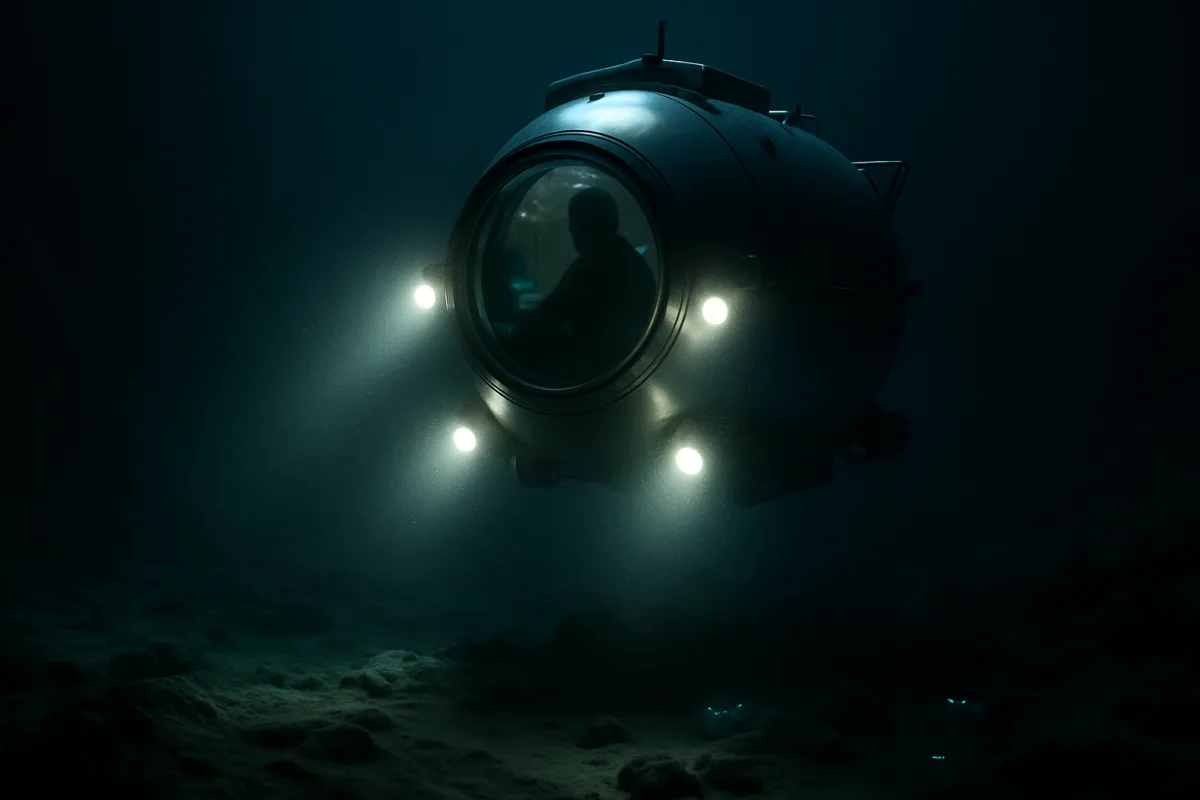
It is tempting to argue that fewer deep-sea visits reflect sheer difficulty. The physics are unforgiving: at nearly 6.83 miles down, Challenger Deep endures about 16,000 pounds per square inch of pressure, roughly a thousand times surface pressure. A submersible hull must resist this compressive force while allowing humans to survive in permanent darkness and near-freezing temperatures.
Still, labeling the task as merely unachievable ignores engineering progress. Jacques Piccard and Don Walsh reached the bottom in 1960, James Cameron returned solo in 2012, and Victor Vescovo made 15 record dives between 2019 and July 2022 using the DSV Limiting Factor. Technically, humans can get there; the bottleneck has not been physics alone.
Technological contrasts and solutions
The difference is that space travel largely solved one problem—maintaining internal pressure—while deep-sea engineering must prevent collapse under external pressure. That said, modern materials, computer-controlled buoyancy systems, and advances in uncrewed submersibles make scaling feasible. Therefore, the remaining barriers are largely financial and organizational, not purely technical.
Money, motive, and the Cold War legacy
Political motive created the space age. The Cold War turned orbit into a stage for national prestige and competition, recruiting vast public budgets. There was simply no equivalent geopolitical contest for the seafloor; no nation developed a mass public program to plant a flag at the bottom of the Mariana Trench.
Consequently, when exploration of Challenger Deep resumed in earnest it was driven by private funding. The Limiting Factor reportedly cost about $30 million — a large sum for an individual project but a rounding error compared to national space budgets. This difference in monetary scale explains much of the lopsided head count.
What we still haven’t seen: the vast unseen seafloor
Even more telling than the count of submersible visits is how little of the deep seafloor has actually been observed. A 2025 study in Science Advances, analyzing roughly 44,000 dive records from 120 countries since 1958, estimated that more than 99.999% of the deep seafloor has never been seen.
To put that in perspective, the portion of seabed humans have viewed up close is roughly the size of Rhode Island. Mapping via sonar is faster, but as of 2022 only about 23% of the global seafloor had been mapped in high resolution. Charting topography is not the same as understanding biology, geology, and human impacts at the seafloor.
Why seeing matters
Transitional evidence from this limited observation shows unique ecosystems, unknown species, and geological hazards that mapping alone cannot reveal. Consequently, a lack of direct observation creates blind spots in climate models, biodiversity assessments, and resource management policies.
Why the imbalance is dangerous for science and policy
Given accelerating threats — from climate change to proposed deep-sea mining — it is irresponsible to ignore the deep ocean. As Katy Croff Bell and colleagues argue, limited exploration becomes a critical problem for both science and policy. You cannot manage or protect what you have not examined.
Furthermore, decisions about resource extraction, environmental protection, and international governance will be shaped now. If baseline knowledge remains scant, powerful private interests could exploit the unknown in ways that are legally and ecologically irreversible.
Arguments for parity: why we should invest in deep ocean exploration now
There are moral, scientific, and pragmatic reasons to scale deep ocean exploration to match the ambition we devoted to space. First, the ocean regulates climate through carbon sequestration, heat uptake, and circulation. Lacking detailed observation of deep processes weakens our climate predictions.
Second, undiscovered biodiversity at depth might hold biochemical and ecological insights with pharmaceutical, technological, and conservation value. Third, preparedness for natural hazards — submarine landslides, methane release, or undersea earthquakes — depends on direct knowledge of seafloor conditions.
Economic and strategic returns
Finally, unlocking the deep responsibly can generate economic opportunities through marine science, sustainable fisheries management, and improved undersea infrastructure. Strategic advantages accrue to nations and companies that lead in deep-sea technologies, sensors, and data platforms.
How to shift policy: concrete steps to scale exploration
There is no single silver-bullet solution, but a combination of public funding, international coordination, and private innovation can accelerate progress. First, governments should substantially increase funding for targeted deep-sea science missions and for accelerating Seabed 2030’s mapping goals.
Second, incentives can spur private R&D in pressure-resistant hulls, autonomous vehicles, and in-situ sensors. For example, tax credits or matching grants for companies that develop open-data-capable submersibles would align commercial interests with public knowledge.
International governance and open data
Third, international agreements are necessary to govern exploration, data sharing, and extractive activities. A temporary moratorium on deep-sea mining until robust baselines exist would be prudent. Simultaneously, global mandates for open-access data from funded missions would democratize discovery and policy-making.
Operational changes that can deliver fast gains
Practically speaking, we should scale uncrewed autonomous systems to supplement crewed dives. Autonomous underwater vehicles (AUVs) and remotely operated vehicles (ROVs) can accumulate far more hours of observation at far lower marginal cost, seeding a global dataset that divers and submersibles can follow up on.
Moreover, investing in modular, standardized submersible components will reduce per-unit costs. Public fleets of shared deep-sea assets, like national research vessel programs, would lower the barrier to entry for researchers worldwide and ensure broader scientific coverage.
Engaging the public and building political will
Finally, narrative matters. Space captured the public imagination because governments framed it as a collective venture. The ocean needs similar storytelling—showcasing discovery, danger, and value to everyday life. Greater visibility will help build political will for funding.
In practice, this means televizing deep-sea missions, publishing accessible findings, and incorporating ocean literacy into education and public outreach.
There is a compelling case, therefore, to reframe exploration policy: not as a binary choice between space and sea, but as a rebalanced portfolio reflecting immediate societal stakes and long-term scientific opportunity.
If policymakers choose ambition, the path is clear: fund comprehensive mapping and in-situ observation, incentivize private innovation tied to open data, adopt cautious governance for resource extraction, and scale uncrewed systems to multiply human reach. These steps will transform a curiosity seldom visited into a frontier systematically understood and responsibly managed.
Across politics and technology, the choice is not merely about where we plant flags but about how we manage planetary risks and opportunities. Investing in deep sea exploration at the scale of space exploration is a feasible, measurable policy shift that would yield better climate models, more resilient coastal economies, and a wider scientific commons. Take action now by supporting accelerated mapping initiatives, demanding open access to mission data, and urging representatives to fund national deep-ocean research fleets; these are practical moves that translate ambition into results and ensure that the unseen majority of our planet finally receives the attention it deserves.

Dr. Morgan directed the Archives Program from 2014 to 2017, gaining extensive experience in research documentation, information management, and the preservation of scholarly resources. Throughout her career, she has worked closely with academic publications and research materials, developing expertise in evaluating scientific sources and communicating complex topics to broad audiences.
Her primary areas of specialization include scientific publishing, research communication, editorial review, and the translation of technical research into accessible educational content. She has contributed to projects involving space science, astronomy, environmental science, history, archaeology, and emerging scientific discoveries, always emphasizing accuracy, transparency, and the responsible presentation of evidence.
As Editorial Director of Muskurahat.us, Dr. Morgan leads the editorial review process for scientific articles, ensuring that content is based on reputable sources, peer-reviewed research whenever available, and publications from recognized universities, research institutions, and international scientific organizations.
She is committed to promoting scientific literacy through clear, engaging, and well-documented articles that help readers better understand scientific discoveries and their impact on society. Her editorial philosophy is founded on accuracy, intellectual integrity, independent journalism, and continuous learning as scientific knowledge evolves.
Through her work at Muskurahat.us, Dr. Morgan supports the publication of trustworthy scientific content that makes complex research accessible to readers around the world while maintaining rigorous editorial standards.