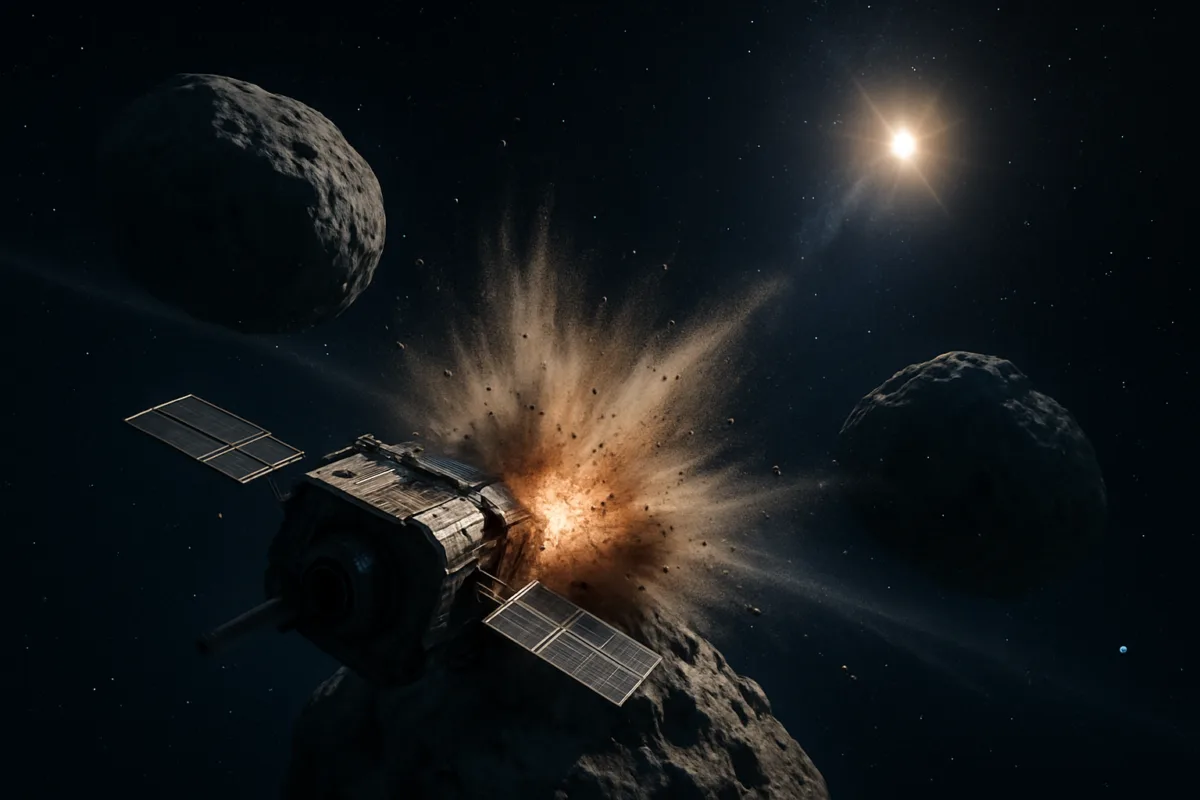
When NASA deliberately crashed a 570 kilogram spacecraft into a small asteroid moonlet 11 million kilometres away, many asked whether it was theatrical, wasteful, or even dangerous. The answer is none of those things. The Double Asteroid Redirection Test, or DART, was an argument in action: a carefully designed experiment to prove—or disprove—a simple principle that could one day protect billions of people. The result was unequivocal. DART changed an asteroid’s motion, exposed crucial unknowns, and made an urgent case for sustained, coordinated investment in planetary defense.
The experiment and its logic
DART’s logic was not science fiction; it was straightforward physics. A spacecraft traveling at high speed carries momentum. If that momentum is transferred to a hazardous asteroid with enough lead time, even a small change in velocity can mean the difference between impact and miss. NASA chose Dimorphos, the small moonlet of the binary system Didymos, because the system posed no threat to Earth. That safety permitted an unambiguous measurement: Dimorphos orbited Didymos every 11 hours and 55 minutes before impact, and any measurable change in that period would be a clear signal that kinetic impact works under real conditions.
Autonomy and execution
DART was not remote-controlled in the conventional sense. In its final approach it used its DRACO camera and autonomous navigation to identify Dimorphos against Didymos and steer into a tiny, fast-moving target. The spacecraft guided itself through the last 90,000 kilometres and struck at roughly 22,530 kilometres per hour. The impact destroyed the spacecraft by design. Success was defined not by survival, but by the measurable alteration of the asteroid’s orbit.
The results and why they matter
The outcome was more than symbolic. Two weeks after impact, ground-based observations revealed that Dimorphos’ orbital period had shortened by about 32 minutes. Subsequent analyses refined that number to roughly 33 minutes and 15 seconds, far surpassing NASA’s minimum success threshold of 73 seconds. The hit also transformed the moonlet’s apparent shape and produced a substantial ejecta plume. Together these results delivered three essential lessons: an autonomous kinetic impactor can change an asteroid’s motion; the physical structure of a target matters dramatically; and ejecta can amplify the deflection.
The ejecta multiplier
Perhaps the most provocative finding was the role of ejecta. When the spacecraft struck, rock and dust were blasted away. The escaping material carried momentum with it, producing a recoil effect that pushed Dimorphos further than the spacecraft’s direct momentum transfer alone would have achieved. NASA likened it to air escaping a balloon: the initial push matters, but what follows can amplify the effect. That insight is practical. In a real deflection scenario, target composition and how much material can be lofted will directly affect the efficacy of a kinetic impactor.
From theory to measurable solar change
DART’s influence even extended to the Didymos-Dimorphos pair’s motion around the Sun. A later report calculated a minute but measurable change in the system’s heliocentric orbit—about 0.15 seconds over a 770-day period. That number is tiny in the planetary scale, not a defense mechanism by itself, but symbolically powerful: humans have made a detectable alteration to a celestial body’s path around the Sun. That precision demonstrates the observational and computational maturity we can now bring to planetary defense.
What DART did not prove
DART answered an elemental question, but it did not solve the full problem of asteroid defense. Kinetic impact is a promising tool, not a universal panacea. The size, composition, internal structure, spin state, and approach vector of any threatened object matter enormously. Dimorphos appears to be a rubble pile—a loosely bound aggregate rather than a monolithic rock—and its response will differ from a dense metallic body. A kinetic strike that works on a rubble pile might be less effective on a solid iron asteroid, and vice versa. The amount of warning time is also critical: a gentle, precisely timed nudge decades before a potential impact is the ideal scenario; a last-minute collision is unlikely to succeed regardless of method.
Why follow-up missions are essential
Answers beg new questions. Europe’s Hera mission, planned to visit the Didymos system, will examine the DART impact site and the crater, measure the mass and density changes, and provide ground-truth for models built from remote observations. Without such follow-ups, our understanding remains incomplete. Ground-based telescopes demonstrated the orbital change; Hera will reveal the physical mechanism in detail. This sequence—performing a safe, observable impact, then sending a dedicated surveyor to study the aftermath—is the responsible way to turn a single test into operational capability.
Policy, funding, and the international dimension
The DART experiment is not just technical; it is political. Planetary defense is inherently global: an Earth-crossing object threatens everyone. Effective preparedness requires international coordination, shared observational networks, and agreed decision-making protocols. DART shows what is possible on a scientific and technical level, but translating that into policy requires sustained funding and diplomacy. Short-term enthusiasm around a dramatic event is not enough. The real question is whether governments can turn one demonstration into a long-term program of detection, testing, and contingency planning.
Invest in early detection
All deflection strategies hinge on early detection. Investing in infrared and optical survey telescopes, space-based detection platforms, and data-sharing protocols yields outsized returns. Discovering a hazardous object decades in advance converts an otherwise terrifying problem into a manageable engineering project. Conversely, if discovery lags, any mitigation technique becomes far less likely to succeed. DART’s success underscores the point: to buy time for a kinetic deflection, the world must prioritize the sensors and analysis pipelines that tell us an impact might be coming.
Prepare multiple tools, not a single answer
Critics will argue that DART proves only one technique and that we need other approaches. They are right. A robust defense portfolio should include kinetic impactors, enhanced tracking, potential gravity-tractor concepts, mitigation strategies tailored to composition and spin, and contingency planning that includes civil defense. Discussions of nuclear options are politically fraught and technically complex, but they cannot be dismissed from strategic planning. The right policy posture is to research, simulate, and if possible test a range of techniques so that the world is not forced into a single, possibly ineffective choice at the last minute.
Countering misinformation and public perception
DART also provided a lesson in science communication. Dramatic imagery—an accelerating spacecraft, a collision across millions of kilometres—tempts sensationalism. Some misinterpreted the mission as aggressive or dangerous. In reality, the experiment used a safe, benign target precisely to avoid creating the very risks alarmists feared. Scientists and policymakers must continue to frame such tests as rehearsals and investments in global safety, not spectacles or arms races. Clear, calm communication builds public trust, which in turn supports the funding and international cooperation necessary for future work.
From rehearsal to readiness
DART moved planetary defense from hypothetical modeling to demonstrated capability. That shift is profound because it turns a thought experiment into an engineering discipline with testable variables. But rehearsal is not readiness. The measured, scientific method now requires repetition, variation, and scrutiny. Different target types, impact angles, and mission architectures should be tested under controlled, international oversight. Each additional experiment reduces uncertainty and improves operational planning for a potential future crisis.
The plain truth is practical: DART was the prudent step. It proved the basic concept, revealed how complexity—like rubble-pile structure and ejecta dynamics—can change outcomes, and highlighted the need for a programmatic approach to planetary defense. The mission demonstrated competence, not complacency, and it should be followed by sustained investment in discovery, follow-up missions like Hera, diversified mitigation research, and an international governance framework that treats asteroid threats the way we treat pandemics or climate risks: global, coordinated, and preemptive. If an Earth-threatening object is ever found, we will be immeasurably better off for having rehearsed the response on a harmless target 11 million kilometres away, rather than testing the first attempt under the pressure of imminent catastrophe.

Dr. Morgan directed the Archives Program from 2014 to 2017, gaining extensive experience in research documentation, information management, and the preservation of scholarly resources. Throughout her career, she has worked closely with academic publications and research materials, developing expertise in evaluating scientific sources and communicating complex topics to broad audiences.
Her primary areas of specialization include scientific publishing, research communication, editorial review, and the translation of technical research into accessible educational content. She has contributed to projects involving space science, astronomy, environmental science, history, archaeology, and emerging scientific discoveries, always emphasizing accuracy, transparency, and the responsible presentation of evidence.
As Editorial Director of Muskurahat.us, Dr. Morgan leads the editorial review process for scientific articles, ensuring that content is based on reputable sources, peer-reviewed research whenever available, and publications from recognized universities, research institutions, and international scientific organizations.
She is committed to promoting scientific literacy through clear, engaging, and well-documented articles that help readers better understand scientific discoveries and their impact on society. Her editorial philosophy is founded on accuracy, intellectual integrity, independent journalism, and continuous learning as scientific knowledge evolves.
Through her work at Muskurahat.us, Dr. Morgan supports the publication of trustworthy scientific content that makes complex research accessible to readers around the world while maintaining rigorous editorial standards.