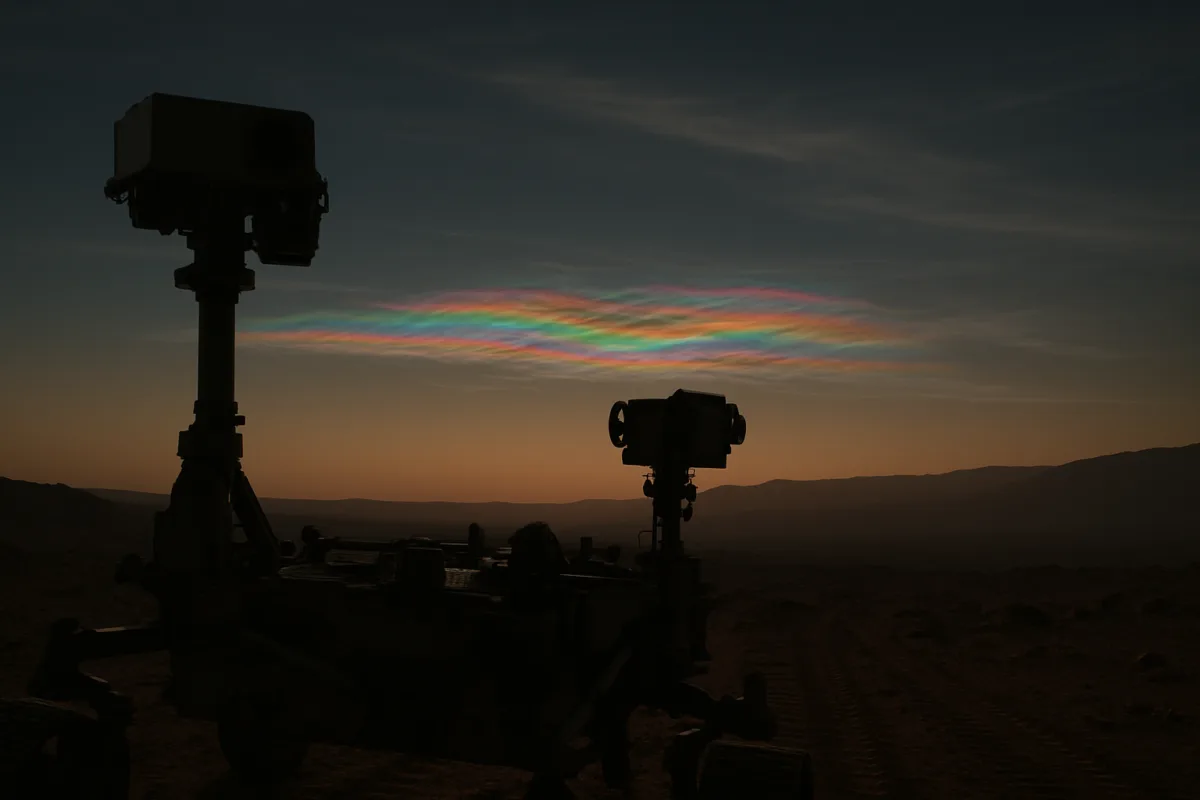
The sighting of Martian carbon dioxide clouds glowing red, green and blue after sunset is more than a pretty image; it challenges assumptions about what an alien sky can teach us. Captured by NASA’s Curiosity rover in Gale Crater, these frozen carbon dioxide clouds—dry ice suspended tens of miles above the surface—demonstrate a seasonal, repeatable atmospheric phenomenon that demands targeted scientific attention.
Why Martian carbon dioxide clouds deserve serious scientific attention
Some readers might dismiss colorful clouds as a novelty, but the physics behind these CO2 ice clouds is directly relevant to climate modeling and exploration planning. Because the clouds form when carbon dioxide crystallizes out of the thin Martian atmosphere at high altitude, they encode temperature gradients, vertical composition, and radiative behavior that models currently represent with large uncertainties.
Moreover, the iridescence and noctilucent timing are not accidental; they reveal crystal sizes and scattering behaviors that can refine microphysical parameterizations in atmospheric simulations. If we ignore this data, we risk building Martian climate and weather forecasts on incomplete or biased assumptions.
How Curiosity captured iridescent CO2 clouds over Gale Crater
On the evening of January 17, 2025, Curiosity pointed its mast-mounted camera skyward for sixteen minutes and recorded a display unlike any terrestrial cloud. These twilight, or noctilucent, clouds remained sunlit while the crater floor lay in shadow, producing the precise geometry needed for edge-on solar illumination.
The frozen carbon dioxide crystals were just the right size to diffract and scatter visible light, producing shifting colors—red, green and blue—depending on the viewing angle. At the same time, water-ice clouds were present at different altitudes and drifting in separate directions, underscoring the complexity of Martian atmospheric layering.
Repeatability matters: patterns across Mars years
Crucially, Curiosity’s team has now documented this event four years in a row during the same seasonal window in the southern hemisphere. That repetition transforms a photogenic moment into a reproducible dataset. It means the clouds are tied to Mars’ orbitally driven seasonal cycle rather than being random, transient flukes.
Consequently, this repeatability allows researchers to design targeted observations during the narrow twilight window when CO2 clouds are lit. Long-term monitoring therefore becomes not just desirable but inevitable if we want to move from anecdote to atmospheric science.
What the iridescence reveals about cloud microphysics
The mother-of-pearl effect seen in the Curiosity images is a direct clue about crystal size distribution. When particles approach the wavelength of visible light, diffraction and interference produce angular color separation—precisely the iridescence recorded by the rover.
Understanding crystal size and composition—CO2 ice versus water ice—affects radiative transfer estimates. This in turn influences modeled cooling rates, atmospheric stability, and the vertical transport of trace gases, which are central to debates about Mars’ climatic history and present dynamics.
Layering and opposing winds: a lesson in atmospheric complexity
Another notable detail is the presence of separate water-ice clouds moving in the opposite direction at different altitudes. This simultaneous coexistence of two cloud systems implies more dynamic vertical shear and layering than many simplistic models assume.
Therefore, any mission aiming to study Martian weather or to land humans must account for stratified wind regimes and transient high-altitude ice. Ignoring such complexity could produce operational surprises for entry, descent, and landing and for long-duration surface operations.
Why this matters for understanding Martian climate and habitability
Clouds are not merely visual phenomena; they are active components in a planet’s energy balance. Frozen CO2 clouds affect how sunlight is scattered and how infrared radiation is emitted, subtly altering local and possibly regional heating rates.
Moreover, mapping the exact altitudes and seasonal timing of CO2 condensation helps constrain how much carbon dioxide has circulated, been sequestered temporarily, or escaped to space over geological time. These constraints feed into larger narratives about Mars’ ability to retain an atmosphere and, by extension, the planet’s potential to have supported liquid water and habitable conditions in the past.
Arguments for prioritized follow-up observations
Given the reproducibility and scientific value, the case for dedicated twilight campaigns on Mars is compelling. Instruments optimized for high-dynamic-range twilight imaging and multi-spectral polarimetry could quantify crystal sizes, compositions, and optical depths far better than opportunistic captures.
Furthermore, orbital assets should be coordinated with surface assets like Curiosity to sample the same events from different perspectives. Such coordinated observations would reduce ambiguities about altitude and horizontal extent that plague single-point measurements.
Design implications for future missions
Future landers and rovers should include sky-imaging protocols and schedules that prioritize twilight windows, not only for dramatic photography but for systematic atmospheric science. Small, affordable instruments—wide-field imagers, polarimeters, and compact spectrometers—could yield disproportionate value when operated consistently over Mars seasons.
In addition, adaptive mission planning that allows instruments to be pointed for short intervals at unpredictable but repeatable events would boost scientific return at relatively low cost. This is an operational shift worth arguing for across mission teams.
Policy and research priorities driven by these findings
Policymakers and funding bodies should view these observations as proof that long-duration surface missions produce unexpected, high-value science beyond their original goals. The Curiosity example strengthens the argument for sustained presence and for funding operations that allow non-primary science activities when they yield clear returns.
Additionally, increased support for high-altitude Martian atmospheric studies—both orbital and in situ—should be prioritized. Improved atmospheric models informed by these CO2 cloud observations will provide better predictions for future human missions and for interpreting ancient climate signals preserved in surface geology.
Translational research opportunities
There are immediate avenues to translate these findings into models and instruments. For instance, laboratory experiments that simulate CO2 ice crystal formation under Mars-like pressures and temperatures can refine scattering models. Likewise, atmospheric retrieval algorithms can be adapted to incorporate iridescent scattering signatures.
Consequently, researchers working on terrestrial atmospheric optics, climate modeling, and planetary instrument design should be encouraged to collaborate across disciplines. The payoff is a tighter integration between observation and interpretation.
What staying power and long-term missions teach us
Curiosity’s thirteen-year tenure on Mars is itself an argument: persistence yields discovery. A rover designed primarily for geology has become a long-baseline atmospheric observatory by virtue of continuous presence. This demonstrates that the most transformative science often comes from instruments that remain patient and flexible.
Therefore, campaign planners should bake in longevity and routine flexibility as core mission requirements. The cost of a multi-year mission is high, but the alternative—snapshots that miss seasonal rhythms—yields far less insight into planetary systems that evolve on annual and multi-year cycles.
Ultimately, the iridescent CO2 clouds over Gale Crater are both a scientific opportunity and a policy lesson: value accrues with time, and surprising phenomena deserve deliberate follow-up rather than casual admiration.
To move forward, the community should prioritize coordinated twilight observations, fund targeted laboratory studies of CO2 ice optics, and design future surface and orbital instruments to capture high-altitude processes. Doing so will turn beautiful images into robust knowledge about Mars’ climate and its implications for future exploration, leaving us better prepared to interpret the planet’s past and to plan human ventures that must confront these atmospheric realities.

Dr. Morgan directed the Archives Program from 2014 to 2017, gaining extensive experience in research documentation, information management, and the preservation of scholarly resources. Throughout her career, she has worked closely with academic publications and research materials, developing expertise in evaluating scientific sources and communicating complex topics to broad audiences.
Her primary areas of specialization include scientific publishing, research communication, editorial review, and the translation of technical research into accessible educational content. She has contributed to projects involving space science, astronomy, environmental science, history, archaeology, and emerging scientific discoveries, always emphasizing accuracy, transparency, and the responsible presentation of evidence.
As Editorial Director of Muskurahat.us, Dr. Morgan leads the editorial review process for scientific articles, ensuring that content is based on reputable sources, peer-reviewed research whenever available, and publications from recognized universities, research institutions, and international scientific organizations.
She is committed to promoting scientific literacy through clear, engaging, and well-documented articles that help readers better understand scientific discoveries and their impact on society. Her editorial philosophy is founded on accuracy, intellectual integrity, independent journalism, and continuous learning as scientific knowledge evolves.
Through her work at Muskurahat.us, Dr. Morgan supports the publication of trustworthy scientific content that makes complex research accessible to readers around the world while maintaining rigorous editorial standards.