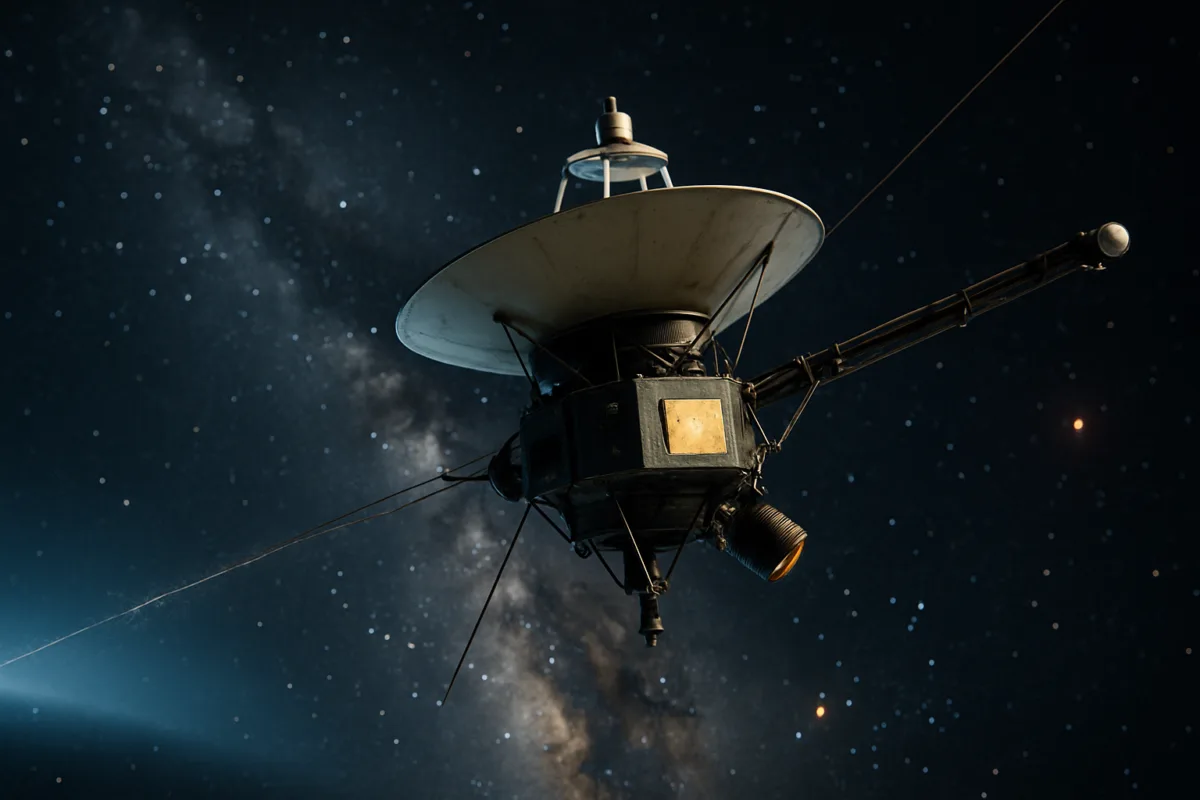
To call the Voyagers fast is factually correct but conceptually misleading. Voyager 1 travels at roughly 38,026.79 miles per hour, about 17 kilometers per second, or about 3.5 astronomical units per year. Voyager 2 moves at roughly 3.1 astronomical units per year. These numbers are impressive by earthly standards and even by planetary standards, yet they collapse into insignificance when confronted with interstellar distances. Arguing over whether the Voyagers are fast without acknowledging the scale of the galaxy is like debating whether a runner is fast while ignoring that the race is across an ocean.
The numbers that both dazzle and deceive
It is worth stating the figures plainly because the argument depends on them. Voyager 1, according to NASA, cruises at about 17 kilometers per second relative to the Sun. That equates to roughly 3.5 astronomical units per year, where one astronomical unit is the average Earth-Sun distance. Voyager 2 is slightly slower, at approximately 3.1 astronomical units per year. Compare that to the Parker Solar Probe, which reaches velocities as high as about 430,000 miles per hour during close solar passes. On a human scale, these are staggering speeds. On a cosmic scale, they are fractional.
Proxima Centauri and the tyranny of light years
Proxima Centauri, the nearest star to our Sun, sits about 4.25 light-years away. Light, the universal speed standard, crosses that gap in a little over four years. At Voyager 1s current speed, a direct voyage to Proxima would take over 73,000 years. That calculation is hypothetical because neither Voyager is aimed at Proxima, but it is a revealing thought experiment. It exposes the disconnect between human intuitions about speed and the reality of galactic distances. The Voyagers are not slow; space is simply unimaginably large.
Why framing matters in public imagination and policy
Labeling the Voyagers as fast feeds a narrative of human mastery over space, which serves public relations and inspires wonder. But framing them as proof that we can reach the stars with existing technology is misleading. If governments, funders, or the public take that leap, resources could be misallocated. Ambition must be rooted in sober perspective: the Voyagers are triumphs of engineering and philosophy, not models for interstellar transit. Celebrating them should not obscure the need for radical innovation if humanity truly intends to traverse the interstellar void within a timescale meaningful to our species.
The cost of conflating wonder with feasibility
There is a cultural cost when inspiring artifacts become mistaken for roadmaps. The Voyagers teach humility: they will continue coasting long after their radioisotope power supplies die, and NASA engineers are already turning off heaters and instruments to conserve energy. They lose about four watts per year and will almost certainly fall silent long before their predicted encounters with distant stars. Voyager 1 is projected to pass within roughly 1.6 to 1.7 light-years of the red dwarf Gliese 445 in about 40,272 years, but by then it will be a dark, inert object. This is poignant and valuable as symbolic achievement, but it is not a practical template for deliberate interstellar missions.
Fast is relative: three lenses to assess velocity
To move the debate beyond slogans, we need three evaluative lenses: physical, temporal, and political. The physical lens asks what the numbers mean in units of space. The temporal lens asks what they mean in human timescales of decision making and stewardship. The political lens asks how narratives of capability influence funding, strategy, and public support.
Physical lens
Under the physical lens, the Voyagers exemplify a limit imposed by current propulsion methods and the energy budgets available to long-duration probes. Chemical rockets and gravity assists were superb for escaping the solar system, but they are inadequate for bridging interstellar distances in realistic mission times. Even high-speed solar probes attain impressive instantaneous velocities by diving deep into the Sun’s gravity well, but sustaining such velocities outward is another challenge entirely.
Temporal lens
From the standpoint of human history, 73,000 years is an almost incomprehensible duration. Civilizations rise and fall, languages change, and ecosystems transform on such timescales. Launching missions that require tens of thousands of years to reach their targets shifts the burden of continuity to unknown future cultures. It also shifts the ethical calculus of exploration: who should bear the cost of missions whose rewards will be realized by distant descendants or alien civilizations that may not even exist?
Political lens
Politically, the Voyagers are diplomatic and cultural ambassadors. They carry golden records intended to speak for humanity, symbolizing our curiosity and openness. But policy decisions driven by symbolic victories rather than strategic feasibility risk misdirection. If the public believes star travel is imminent because Voyager 1 is ‘fast,’ it might dampen support for research into genuinely transformative technologies like fusion drives, laser sails, or interstellar precursor missions designed to map and communicate, rather than merely drift.
What the Voyagers should teach us about the future of interstellar ambitions
The proper lesson of the Voyagers is twofold. First, we celebrate human ingenuity in devising machines that will outlive their makers and drift into the galaxy carrying human artifacts. Second, we recognize that achieving practical interstellar travel requires a technological leap, not incremental improvements. If the aim is to reach nearby stars within centuries rather than millennia, propulsion concepts that currently rest on whiteboards must be matured: fusion or antimatter propulsion, directed-energy sails, breakthrough beamed-energy approaches, or entirely new physics if any are discoverable.
Investment priorities
Investment should be balanced. Continue to fund robotic probes, long-term monitoring, and stewardship of interplanetary space, because these deliver immediate scientific return and preserve operational expertise. Simultaneously, create sustained funding pathways for high-risk, high-reward research into propulsion, materials, and autonomy required for true interstellar missions. The alternative is to accept a future in which humanity’s physical reach remains stubbornly solar-centric while our cultural narratives pretend otherwise.
Technology triage
Triage is needed: prioritize technologies that scale. Directed-energy propulsion, for instance, leverages external energy sources to accelerate lightweight payloads to a significant fraction of light speed. If successful, it would upend the math that condemns Voyager-like probes to tens of thousands of years. Fusion propulsion offers another pathway, promising high specific impulse if practical systems can be engineered to operate reliably for extended durations. Each option faces formidable engineering and economic obstacles, but they are the kinds of obstacles that, unlike century-spanning journeys, admit pathways to resolution within institutional timescales.
Why the Voyagers remain indispensable even as we argue for bolder goals
Arguing that the Voyagers are not a model for interstellar colonization does not diminish their importance. They are vital for scientific, cultural, and philosophical reasons. They map the heliosphere, provide data on the interstellar medium, and act as time capsules of Earth. The moral is not that the Voyagers are a failed technology; rather, they are powerful reminders that our engineering triumphs must be matched by intellectual honesty about what those triumphs achieve.
To insist otherwise is to fall into a double mistake: overclaiming what current craft can accomplish, and underinvesting in the research needed to change the reality those craft reveal. The Voyagers show us both the poetry of human curiosity and the arithmetic of cosmic scale. Recognizing both is the only sane basis for setting priorities about where to invest, how to inspire, and what kinds of missions to champion next.
Ultimately, the most useful way to frame the Voyagers is as both a mirror and a map. The mirror reflects our capacity for design, endurance, and symbolic action. The map shows the contours of an uncomfortable truth: space is vaster than our intuition allows, and achieving interstellar mobility within meaningful human timescales will require commitment to audacious, expensive, and sustained research. If we can hold these tensions simultaneously, we will honor the Voyagers truthfully and build a roadmap that might one day let future explorers arrive at nearby suns in lifetimes rather than epochs.

Dr. Morgan directed the Archives Program from 2014 to 2017, gaining extensive experience in research documentation, information management, and the preservation of scholarly resources. Throughout her career, she has worked closely with academic publications and research materials, developing expertise in evaluating scientific sources and communicating complex topics to broad audiences.
Her primary areas of specialization include scientific publishing, research communication, editorial review, and the translation of technical research into accessible educational content. She has contributed to projects involving space science, astronomy, environmental science, history, archaeology, and emerging scientific discoveries, always emphasizing accuracy, transparency, and the responsible presentation of evidence.
As Editorial Director of Muskurahat.us, Dr. Morgan leads the editorial review process for scientific articles, ensuring that content is based on reputable sources, peer-reviewed research whenever available, and publications from recognized universities, research institutions, and international scientific organizations.
She is committed to promoting scientific literacy through clear, engaging, and well-documented articles that help readers better understand scientific discoveries and their impact on society. Her editorial philosophy is founded on accuracy, intellectual integrity, independent journalism, and continuous learning as scientific knowledge evolves.
Through her work at Muskurahat.us, Dr. Morgan supports the publication of trustworthy scientific content that makes complex research accessible to readers around the world while maintaining rigorous editorial standards.