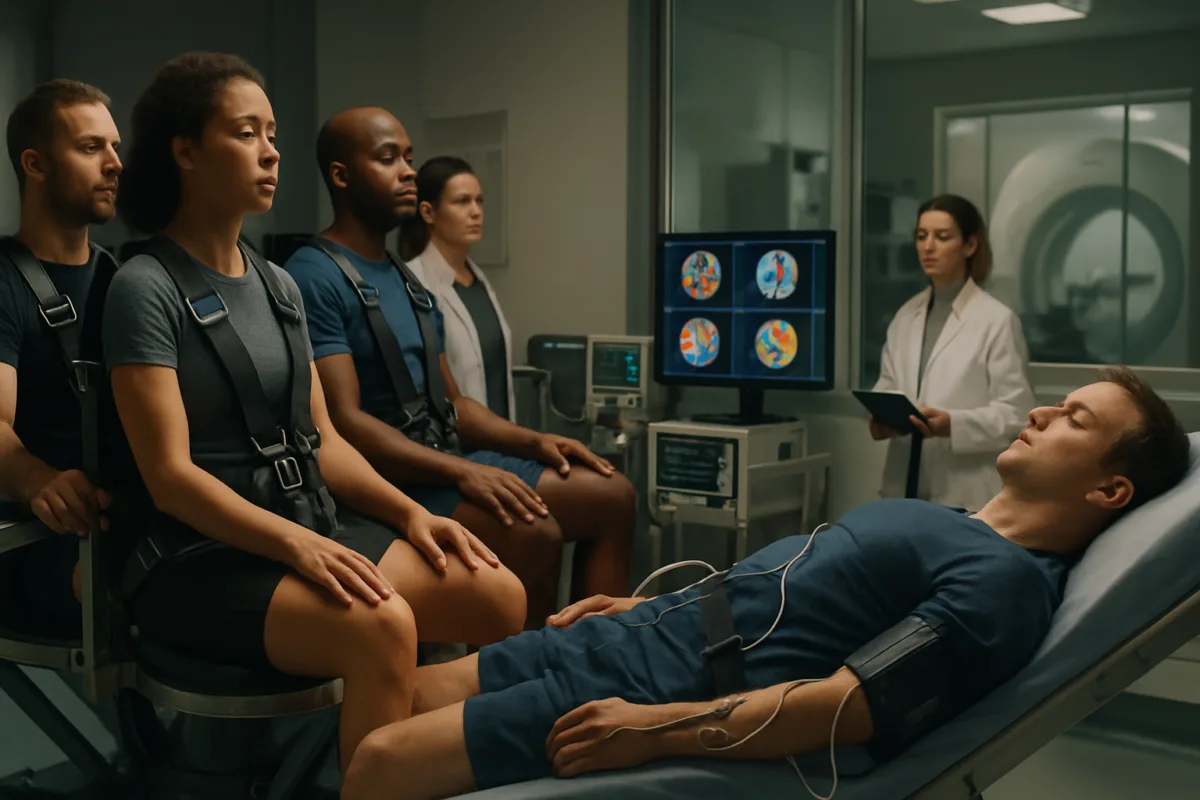
Artificial gravity promised as a single, elegant fix for many of spaceflight’s physiological ills now faces a sharper test: did a daily 30-minute centrifuge actually reduce the brain’s extra workload during a 60-day head-down bed-rest analog? The short answer from the Frontiers in Neurology 2025 report is no — at least not for the cognitive tasks researchers measured — and that conclusion should change how we design countermeasures for long-duration missions.
Why this artificial gravity study matters for spaceflight countermeasures
Any serious plan for crewed missions to Mars or lunar habitats treats artificial gravity as an alluring multipurpose shield. Engineers hope a single routine could protect circulation, balance, muscles, bones and cognitive function simultaneously. However, the new head-down bed-rest study highlights a crucial counterargument: one dose of centrifugation per day may not meaningfully lower the brain’s neural workload during demanding tasks.
Moreover, the study’s narrow design — 16 centrifuged volunteers and eight untreated controls followed across baseline, 60 days of strict head-down tilt and recovery — gives the comparison real force. By scanning the same individuals repeatedly, the team reduced confounds from individual variability. Therefore, the finding that treated and control groups showed similar brain activation shifts is difficult to dismiss as noise.
How the experiment tested centrifugation during head-down bed rest
The head-down tilt model is a well-established microgravity analog that simulates fluid shifts, unloading and postural changes. In this protocol, half of the study’s 24 participants experienced daily centrifugation sessions on a short-arm centrifuge, either as one continuous 30-minute spin or as short bouts totaling 30 minutes. The other half remained in identical bed-rest conditions without any centrifugation.
Transitionally, it matters that the researchers used tasks with proven sensitivity in astronaut and analog research. Participants performed a cognitive-motor dual task — combining visual monitoring with fast motor responses — and a spatial working memory task inside an MRI scanner. Those paradigms had previously revealed brain and performance changes in similar settings, giving this study strong construct validity.
What the brain scans actually showed during bed rest
Across both tasks, head-down bed rest produced clear changes in brain activation. During the dual-task condition, neural activity increased broadly across attention, motor planning and sensory areas. Spatial working memory scans similarly showed evolving patterns of activation over the confinement period.
However, crucially, the treated group did not diverge from the controls in the main activation measures. In plain language, the brain adapted to the head-down environment, but the daily centrifuge routine did not produce a measurable reduction in the neural adjustments required to perform these tasks. This is not to say centrifugation had no biological effects elsewhere, but for these cognitive endpoints, its impact was limited.
Interpreting similar activation: compensation, cost, and caveats
One must be cautious: more activation is not inherently bad, and less activation is not inherently good. In prolonged adaptation contexts, heightened task-related activity often signals compensatory recruitment — the brain working harder to preserve performance. Indeed, in this study participants who showed larger increases in activation tended to maintain motor accuracy better late in bed rest, which the authors interpreted as compensatory.
That pattern matters because unchanged behavioral accuracy can mask a hidden neural cost. Astronauts may continue to perform correctly while their brains consume extra resources, potentially reducing resilience under more complex or prolonged demands. Therefore, similar performance between centrifuged volunteers and controls should not be read as a validation of the centrifuge as a cognitive countermeasure.
Limitations that temper strong claims
Nevertheless, the experiment’s design imposes constraints on generalization. It tested one schedule (30 minutes per day), one centrifuge type (short-arm), and one analog environment (head-down tilt). The authors reasonably note that different dosing, timing, or longer exposure could produce other outcomes. Additionally, other analyses from the same campaign found benefits for orthostatic tolerance and some sensory connectivity changes, indicating the centrifuge was biologically active even if it failed to reduce cognitive neural workload in these tasks.
Why this finding should change mission planning assumptions
Practically speaking, the study undermines any assumption that artificial gravity, implemented as a brief daily spin, will be a universal remedy. Mission planners cannot rely on a single countermeasure to protect every physiological system simultaneously. The brain appears harder to ‘‘solve’’ than muscles or cardiovascular reflexes in at least some dosing regimens.
Consequently, a multimodal approach becomes not optional but necessary. Rather than betting on centrifugation alone, planners should consider integrated prescriptions that combine mechanical loading, targeted exercise, sensory training, sleep optimization, and possibly pharmacology. In addition, individualized protocols that account for preflight cognitive state, susceptibility to orthostatic intolerance, and mission phase may be needed.
Research steps that would make the next claims stronger
To move beyond ambiguity, the field needs carefully controlled trials that vary centrifuge dose, duration and timing. For instance, comparing longer continuous spins (e.g., 60 minutes), multiple shorter sessions daily, or exposure timed around cognitive-demand periods could reveal dose–response relationships. Likewise, pairing centrifugation with cognitive training or vestibular rehabilitation may amplify benefits, which single-intervention trials would miss.
Moreover, future studies should expand behavioral measures beyond accuracy, incorporating reaction time variability, dual-task interference, sustained attention metrics, and stress reactivity. Multimodal brain monitoring — combining fMRI, EEG, and wearable physiology — would deliver a richer picture of neural workload and recovery dynamics. Such data would allow researchers to detect whether preserved performance accompanies hidden neural strain.
Policy implications and messaging to the public
Headlines that trumpet artificial gravity as a cure-all overreach the evidence. The 2025 study’s central claim is narrower: a 30-minute daily centrifuge did not reduce the brain’s extra workload on two specific cognitive tasks in a head-down bed-rest analog. Responsible communication should reflect that nuance so policymakers and funders make informed decisions about where to allocate scarce research resources.
For agencies planning long missions, this nuance implies a portfolio approach. Fund small-to-medium trials that test combinations of countermeasures, and incorporate neural workload endpoints early in the evaluation pipeline. Doing so will identify strategies that reduce both peripheral deconditioning and central neural cost, which is the ultimate goal for safe, resilient crews.
How researchers and mission designers can act now
First, expand countermeasure testing beyond single-component trials. Design factorial experiments that cross centrifugation dose with exercise modalities and cognitive training to discover synergistic effects. Second, standardize neural workload measures across studies so results accumulate comparably, including dual-task paradigms and portable neurophysiological markers.
Third, prioritize individualized dosing experiments. Some crew members may need longer or more frequent centrifugation, while others might benefit more from vestibular or strength training. Finally, translate analog findings into short-duration inflight tests on the ISS or Artemis-class missions to validate which regimens scale safely and effectively in true microgravity.
Ultimately, the AGBRESA study is a useful corrective: it narrows our expectations for a single, daily centrifuge session and redirects attention toward multifaceted solutions. Mission planners and researchers who heed that lesson are likelier to produce countermeasure recipes that reduce neural workload as well as peripheral deconditioning, enhancing crew performance and safety on the long voyages ahead.

Dr. Morgan directed the Archives Program from 2014 to 2017, gaining extensive experience in research documentation, information management, and the preservation of scholarly resources. Throughout her career, she has worked closely with academic publications and research materials, developing expertise in evaluating scientific sources and communicating complex topics to broad audiences.
Her primary areas of specialization include scientific publishing, research communication, editorial review, and the translation of technical research into accessible educational content. She has contributed to projects involving space science, astronomy, environmental science, history, archaeology, and emerging scientific discoveries, always emphasizing accuracy, transparency, and the responsible presentation of evidence.
As Editorial Director of Muskurahat.us, Dr. Morgan leads the editorial review process for scientific articles, ensuring that content is based on reputable sources, peer-reviewed research whenever available, and publications from recognized universities, research institutions, and international scientific organizations.
She is committed to promoting scientific literacy through clear, engaging, and well-documented articles that help readers better understand scientific discoveries and their impact on society. Her editorial philosophy is founded on accuracy, intellectual integrity, independent journalism, and continuous learning as scientific knowledge evolves.
Through her work at Muskurahat.us, Dr. Morgan supports the publication of trustworthy scientific content that makes complex research accessible to readers around the world while maintaining rigorous editorial standards.