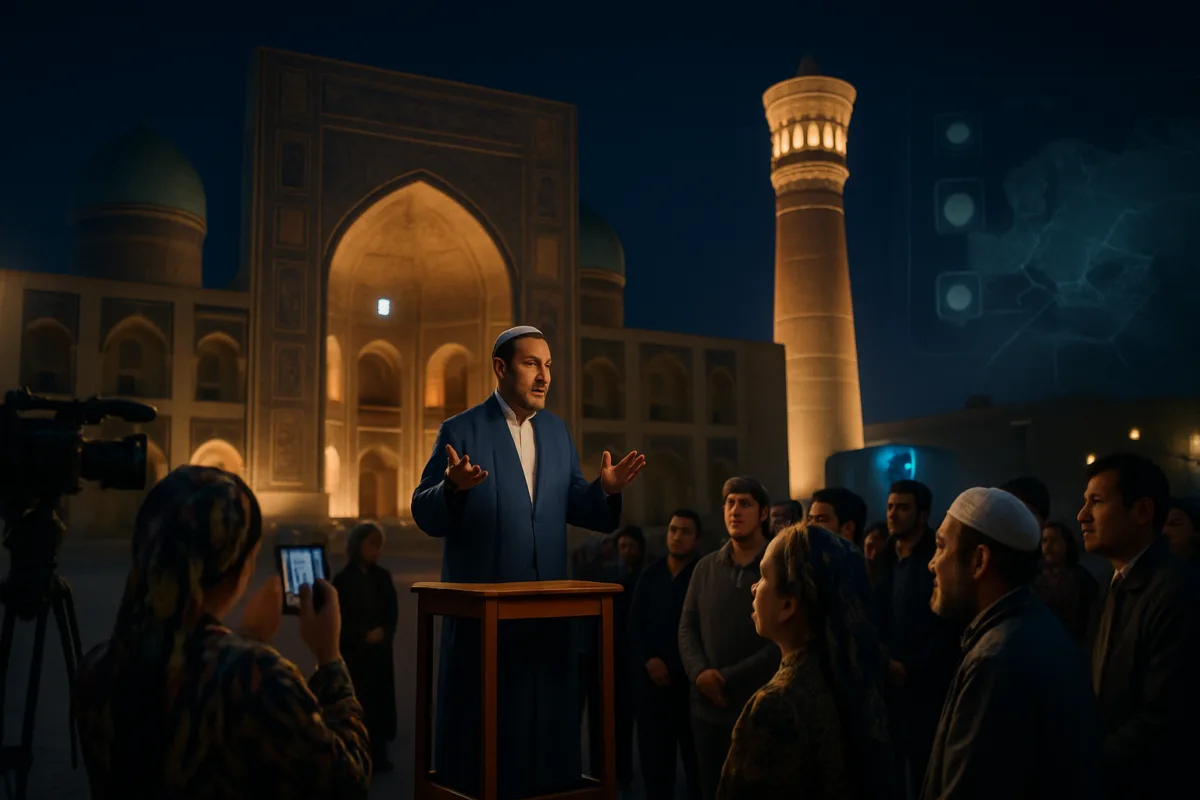
Uzbekistan’s recent pivot toward tolerating—and at times elevating—ultraconservative religious voices is not a harmless cultural recalibration. It is a strategic decision with palpable geopolitical and domestic consequences. By allowing politicized Islam to flourish under the banner of “New Uzbekistan,” President Shavkat Mirziyoyev’s government has chosen a short-term mechanism for bolstering legitimacy that risks constraining foreign policy, alienating key partners, and undermining the very stability it seeks to project.
Why the tone of religion in Uzbekistan matters beyond its mosques
The revival of Islam across Central Asia is a broader phenomenon, but Uzbekistan’s case is distinct because the state has moved from strict repression toward selective indulgence. This change does not occur in a vacuum. Uzbekistan sits at the crossroads of competing regional influences—Russia’s security footprint, Iran’s religious soft power, and Afghanistan’s volatile spillover effects—while courting relationships with Western capitals that prize secular stability and counterterrorism cooperation. When domestic discourse increasingly frames the United States and Israel as existential adversaries, or when public figures openly traffic in antisemitic tropes, the costs of that rhetoric quickly become diplomatic liabilities.
From repression to reward: the political economy of tolerated Islamism
Mirziyoyev’s early reforms—releasing prisoners, easing social controls, repatriating citizens from Syrian camps—earned him genuine international credit. But the doctrine underpinning those reforms appears transactional. Where Islam Karimov responded to perceived threats with blanket persecution to neutralize organized radicalism, Mirziyoyev has sought to convert religious authority into a political asset. The elevation of imams and ideologues who once faced exile under Karimov signals a deliberate recalibration: reward public religiosity that can be marshaled in support of state narratives, while punishing liberal critics who might undermine the administration’s image.
This bargain is not merely rhetorical. Figures like Komil Rabbimov and Abror Abduazimov (Abror Mukhtor Ali) exemplify the new elite of politicized clerics whose platforms are treated as extensions of state media. Rabbimov’s conspiratorial framing of Israel and the United States as existential threats and his celebration of geopolitically hostile actors are not peripheral opinions when they are amplified by official channels. When a government allows a cleric with millions of followers to teach that English education breeds spies, it is shaping a civic culture that is suspicious of international engagement and skeptical of Western partners.
The selective tolerance of dissent
Any government manages dissent; few do so in as asymmetric a fashion as modern Tashkent. Critics and journalists who investigate corruption or challenge local officials have been arrested and imprisoned on criminal charges that carry lengthy sentences. Bloggers and investigative reporters face legal reprisals that effectively narrow civic space for scrutiny. Meanwhile, public figures who promote a conservative social order or target minority communities are often left unchecked. This creates an uneven ecosystem in which the regime curates which voices strengthen its hand and which must be silenced.
Regional ripple effects and the risk of entanglement
Accepting politicized Islam domestically is not a neutral choice for a country surrounded by actors with competing religious and strategic agendas. Iran can bankroll religious scholarship and media networks that align with its worldview; Russia can exploit conservative narratives to justify security interventions; Afghanistan’s Taliban victory has already exported an emboldened Islamist ethos northward. Uzbekistan’s permissive posture risks making it a battleground for these external influences and reduces Tashkent’s strategic autonomy.
Diplomacy under strain: relations with the United States and Israel
Uzbekistan’s enhanced public profile in Washington has been deliberate and lucrative—investment pledges, public relations efforts, and strategic courtesies have opened doors in the United States. But the ideological climate cultivated at home could undercut those gains. When prominent clerics and cultural figures amplify antisemitic rhetoric or frame the United States as an instrument of a “Jewish world order,” U.S. policymakers face domestic and geopolitical pressure that will complicate bilateral cooperation. The transactional charm offensive cannot indefinitely paper over clashes in values and narratives that run directly counter to core American and Israeli policy interests.
Cross-border security and soft power vulnerabilities
Allowing radical or conspiratorial teachings to circulate unchallenged also creates security vulnerabilities. The legacy of sending fighters abroad in the Karimov era demonstrates how easily marginalization can morph into militancy. Mirziyoyev’s approach—permitting certain clerics and influencers to mobilize sentiment while repatriating others selectively—may reduce immediate domestic conflict, but it risks normalizing narratives that could inspire transnational flows of ideology, recruitment, or informal alliances with unsavory external actors.
Political calculation or strategic blind spot?
Defenders of the current approach argue that Hayot Yangi (New Uzbekistan) requires cultural recalibration: that the people have demanded a more prominent role for religion in public life and that stability depends on harvesting that sentiment. Yet this thesis underestimates the long-term externalities of embedding political capital in religious figures whose loyalties and worldviews do not necessarily align with state interests. The episode in which a Taliban official publicly derided Uzbek piety—whether misreported or authentic—served as a chastening reminder that ideological alliances are slippery. The mass reception of Taliban delegates in Samarkand and the celebrity politics surrounding figures like Yulduz Usmonova illuminate how popular religiosity can be deployed instrumentally by domestic or foreign actors alike.
Moreover, the regime’s oscillation between corrective personnel moves and broader permissiveness reveals an absence of coherent strategy. Demoting one imam here, removing another there, does not equate to a policy that reins in politicized religiosity; it signals reactive management rather than proactive governance. Mirziyoyev’s emphasis on stability and modernization—economic reform, foreign investment, and infrastructure—requires a social compact that reconciles religious revival with pluralism and rule of law. Without clear guardrails, the bargain with politicized clerics risks curtailing the liberalizing trends the president touts.
What responsible policy looks like
If Tashkent seeks to sustain foreign partnerships while acknowledging domestic religiosity, it must pursue three simultaneous tracks. First, establish transparent legal and institutional standards that apply equally to clerics and secular critics alike—no selective enforcement. Second, invest in religious education that emphasizes civic responsibility, pluralism, and peaceful coexistence; state-backed initiatives should promote religious literacy without turning into propaganda instruments. Third, engage regional partners in a dialogue to prevent external actors from weaponizing religious networks for geopolitical ends.
These measures require political courage. They challenge powerful domestic constituencies and complicate short-term calculations about social control. But failing to act risks a far greater cost: a society in which xenophobic and conspiratorial framings become normalized, narrowing the range of acceptable foreign partners and limiting Uzbekistan’s strategic options in an increasingly polarized world.
The broader stakes for Central Asia
Uzbekistan’s choices will reverberate across Central Asia. Neighboring capitals watch Tashkent for cues on how to manage religious revival while preserving state control. Kazakhstan’s decision to curb extremist preachers and Kazakhstan’s public interventions to prevent dangerous sermonic influence demonstrate an alternative model—one that mixes firm oversight with civil society engagement. Tajikistan’s heavy-handed security approach offers a second cautionary tale: repression can fuel underground extremism. Uzbekistan currently stands between these poles, and its path will likely shape regional norms around religion, civil liberties, and statecraft.
For external powers—particularly the United States and European partners—the policy dilemma is acute. Realpolitik encourages continued engagement with Mirziyoyev’s government given its strategic importance and reformist rhetoric. But uncritical engagement risks legitimizing a regime that tolerates ideologies inimical to pluralistic governance and international cooperation. Conditionality, candid diplomacy, and support for independent media and civil society can help recalibrate Uzbek policies without abandoning the gains of recent years.
The risk now is that short-term political gain will calcify into long-term constraint. If the Uzbek state continues to treat politicized Islam as a utility rather than a public good to be cultivated responsibly, it will shrink the space for pluralism, complicate vital partnerships, and open channels for external influence that undermine sovereignty. Mirziyoyev’s legacy could yet be one of genuine reform and greater openness, but that outcome requires a willingness to prioritize coherent, principle-driven governance over opportunistic alliances with voices whose loyalties lie elsewhere.

Dr. Morgan directed the Archives Program from 2014 to 2017, gaining extensive experience in research documentation, information management, and the preservation of scholarly resources. Throughout her career, she has worked closely with academic publications and research materials, developing expertise in evaluating scientific sources and communicating complex topics to broad audiences.
Her primary areas of specialization include scientific publishing, research communication, editorial review, and the translation of technical research into accessible educational content. She has contributed to projects involving space science, astronomy, environmental science, history, archaeology, and emerging scientific discoveries, always emphasizing accuracy, transparency, and the responsible presentation of evidence.
As Editorial Director of Muskurahat.us, Dr. Morgan leads the editorial review process for scientific articles, ensuring that content is based on reputable sources, peer-reviewed research whenever available, and publications from recognized universities, research institutions, and international scientific organizations.
She is committed to promoting scientific literacy through clear, engaging, and well-documented articles that help readers better understand scientific discoveries and their impact on society. Her editorial philosophy is founded on accuracy, intellectual integrity, independent journalism, and continuous learning as scientific knowledge evolves.
Through her work at Muskurahat.us, Dr. Morgan supports the publication of trustworthy scientific content that makes complex research accessible to readers around the world while maintaining rigorous editorial standards.