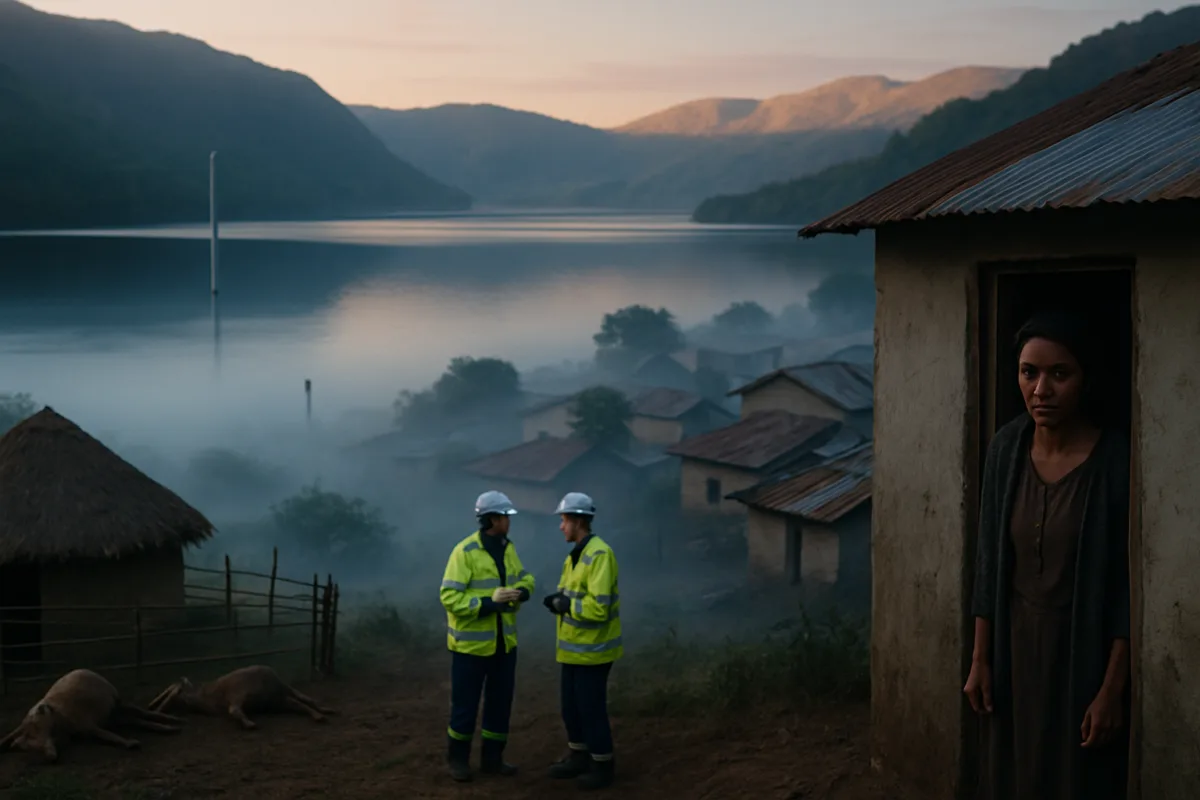
The night Lake Nyos released a deadly cloud of carbon dioxide in 1986 is not a parable about geology; it is an indictment of how societies recognize and prioritize risk. More than 1,700 people and thousands of animals died in their sleep, and the lake itself betrayed no visible signs of menace. That absence of spectacle is the central problem: the most dangerous threats often arrive without noise, and our institutions, funding priorities, and even our imaginations are poorly suited to detect and mitigate them until the bodies tell their story.
The anatomy of a silent disaster
Lake Nyos sits in the crater of a dormant volcano in Cameroon. For years volcanic gases seeped into its deepest waters, dissolving like carbonation in a sealed bottle. On the night of August 21, 1986, a trigger—possibly a landslide or a sudden cooling—caused deep, gas-laden water to rise and depressurize. Dissolved carbon dioxide exsolved explosively, forming a dense, ground-hugging cloud that rolled down the valley at highway speeds. Invisible and odorless in the dark, the cloud displaced breathable air and suffocated sleeping villagers and livestock in their homes.
Why this case should unsettle planners
Only three lakes on Earth are known to have this capacity for so-called limnic eruptions: Lake Nyos, Lake Monoun, and the much larger Lake Kivu. That scarcity could lull policymakers into complacency, but the sheer scale of risk at Kivu—where roughly two million people live along the shoreline—changes the calculus. The Nyos disaster demonstrates not only a rare physical process but a failure in hazard perception: the danger was packaged in a form our senses and bureaucracies did not treat as dangerous.
Visible versus invisible hazards: a bias with deadly consequences
Governments and agencies are better at responding to flamboyant calamities. Earthquakes collapse buildings; storms leave obvious wreckage; wildfires paint smoke in the sky. These threats produce visual and tactile cues that mobilize attention, resources, and emotional urgency. Silent hazards—subterranean gas accumulation, groundwater contamination, airborne toxic plumes that leave no immediate mark—compete badly in the marketplace of risk.
The politics of perception
Political systems allocate scarce resources to problems that are perceptible, politically salient, or already headline-makers. A lake that looks like any other lake, a calm surface in a green valley, simply does not appear on most risk registers. Even after scientists identified the mechanism at Nyos, it took years of lobbying and international cooperation to implement a fix: long degassing pipes that let deep, CO2-rich water vent slowly at the surface. The technical solution existed; the social will and funding took too long.
Why cost objections fall short
Opponents of expensive mitigation measures often frame decisions as a trade-off between upfront costs and uncertain benefits. But that calculus frequently ignores low-probability, high-consequence events—and the moral weight of preventable loss of life. When mitigation retrofits are measured against human lives, disrupted communities, and long-term economic loss, the argument against investment becomes untenable. Preventing another limnic tragedy is not a matter of fiscal luxury; it’s a question of basic prudence.
Equity and the geography of attention
The distribution of attention—and therefore funding—tends to track geopolitical and economic power. Lake Nyos affected rural Cameroonians whose concerns were not at the top of many national or international agendas. The anecdote of generosity toward scientists in the aftermath, where survivors worried about researchers despite having lost everything, should shame global institutions: the people most exposed to the danger were least able to command resources to fix it.
Lake Kivu as a test case
Lake Kivu is the risk that keeps risk managers awake, and for good reason. It contains vastly more dissolved gas than Nyos and cradles the shores of densely populated cities. A degassing plan for Kivu is technically feasible but politically and logistically complex. Investments there are not merely local safety measures; they are global responsibilities. The longer policymakers delay, the harder and costlier it becomes to implement preventive infrastructure and community preparedness.
What a rational, ethical approach to invisible hazards should look like
If Lake Nyos teaches us anything beyond the specifics of limnic eruptions, it is that hazard management must evolve to account for risks that do not announce themselves. That requires three interlocking shifts: better science and monitoring, redesigned funding mechanisms that prioritize low-visibility but high-impact dangers, and community-centered resilience planning.
Science and monitoring: invest before tragedy
Limnic systems can be monitored. Gas content, temperature profiles, and stratification dynamics provide measurable indicators of rising risk. Early detection technologies—subsurface sensors, autonomous buoy networks, remote sensing algorithms—can flag dangerous buildups long before they reach a tipping point. Funding agencies should support long-term observational programs in identified hotspots, because episodic, crisis-driven science arrives when it’s already too late.
Funding frameworks: overcome short political horizons
Short political cycles and annual budgets bias decisions toward visible, immediate problems. We need financing mechanisms that target low-probability, catastrophic risks: dedicated international funds, public–private risk pools, and multilateral investments that treat preventive mitigation as public infrastructure. The degassing pipes at Nyos worked, but only after protracted delays and international coordination. For larger systems like Kivu, we must frontload investment rather than retrofitting after loss.
Community resilience: local knowledge and agency
Technological fixes alone are insufficient. Communities living beside hazardous lakes must be partners, not passive beneficiaries, in risk reduction. That means transparent communication about unknowns, participatory planning for evacuation or monitoring, and economic alternatives that reduce exposure (for instance, relocating critical infrastructure away from the lowest-lying peril zones). Building trust is a social mitigation that pays dividends when the next crisis threatens.
Anticipating counterarguments
Some will argue that rare events like limnic eruptions are not worth the price of intensive monitoring and mitigation, or that resources are better spent on more frequent hazards. That perspective misunderstands both probability and human values. Low-frequency does not mean low-impact—one limnic event can erase an entire town. Moreover, investments in monitoring and community resilience often have co-benefits: improved water management, better emergency communication systems, and enhanced scientific capacity that serve other agendas.
Technological limits are not absolutes
It is true that science moves with uncertainty. But uncertainty is not an excuse for inaction; it is a reason to build redundancy into systems. Early-warning networks need not be perfect to save lives. Simple gas monitors, paired with community protocols and evacuation plans, would have made a lifesaving difference in 1986. The success of degassing pipes shows that interventions can be both practical and effective.
From tragedy to policy: concrete steps forward
First, map hidden hazards globally. Satellite surveys, geological records, and indigenous knowledge can identify lakes and basins with limnic potential. Second, create dedicated international financing for low-visibility catastrophic risk mitigation, modeled on climate finance but targeted to geohazards. Third, prioritize projects that combine engineered solutions—like controlled degassing—with social investments in community preparedness and alternative livelihoods. Fourth, fund long-term monitoring programs with open data so scientists worldwide can contribute to early detection and modeling.
None of these recommendations are radical. They are pragmatic, affordable when compared to the cost of lives lost, displacement, and lost economic productivity. They embody a simple premise: prevention is morally and economically preferable to response, especially when the hazard is silent.
Lake Nyos should not be remembered merely as an eerie chapter in natural history; it should be treated as a case study in institutional neglect and an urgent call to recalibrate our risk priorities. We can no longer afford to let peaceable landscapes and quiet nights lull us into inattention. If humanity is serious about protecting vulnerable communities, we must listen for the risks that do not shout, fund the science that illuminates them, and operationalize solutions before another silent catastrophe writes the lesson in blood and loss.

Dr. Morgan directed the Archives Program from 2014 to 2017, gaining extensive experience in research documentation, information management, and the preservation of scholarly resources. Throughout her career, she has worked closely with academic publications and research materials, developing expertise in evaluating scientific sources and communicating complex topics to broad audiences.
Her primary areas of specialization include scientific publishing, research communication, editorial review, and the translation of technical research into accessible educational content. She has contributed to projects involving space science, astronomy, environmental science, history, archaeology, and emerging scientific discoveries, always emphasizing accuracy, transparency, and the responsible presentation of evidence.
As Editorial Director of Muskurahat.us, Dr. Morgan leads the editorial review process for scientific articles, ensuring that content is based on reputable sources, peer-reviewed research whenever available, and publications from recognized universities, research institutions, and international scientific organizations.
She is committed to promoting scientific literacy through clear, engaging, and well-documented articles that help readers better understand scientific discoveries and their impact on society. Her editorial philosophy is founded on accuracy, intellectual integrity, independent journalism, and continuous learning as scientific knowledge evolves.
Through her work at Muskurahat.us, Dr. Morgan supports the publication of trustworthy scientific content that makes complex research accessible to readers around the world while maintaining rigorous editorial standards.