In July 1969, two very different approaches to lunar ambition converged above the same gray horizon: one human and theatrical, the other robotic and clandestine. While Neil Armstrong and Buzz Aldrin made footprints in the Sea of Tranquility, a Soviet sample-return vehicle, Luna 15, was executing a tightly choreographed sequence of orbital manoeuvres and descent attempts in hopes of scooping a prize of its own. Reconstructing that parallel race as a sequence of decisions, operations and systems offers insight into how timing, autonomy, and risk trade-offs shape outcomes in high-stakes space missions.
The strategic context: why Luna 15 mattered
When trying to understand Luna 15’s mission, start with the political and programmatic incentives that defined its schedule. The Soviet lunar program had already conceded the visible triumph of crewed landing when Apollo 11’s launch was imminent, but the Soviets still had opportunities to log technical firsts. A robotic sample return—landing, collecting, and launching an ascent stage to return lunar regolith to Earth without humans—would have been a prestigious win. The schedule therefore prioritized speed and a narrow window: Luna 15 launched on 13 July 1969, just three days before Apollo 11, which set up a race where a small, quick-return machine could potentially deliver the first lunar soil to Earth even as humans walked on the surface.
Design choices driven by schedule
The decision to sprint the mission constrained everything that followed: orbital insertion parameters, reconnaissance cadence, autonomous guidance sophistication and the descent profile. Unlike crewed missions that could afford broader margins, a robotic mission seeking fast return needed to limit mission phases and automate decision-making. That meant more reliance on preprogrammed sequences, rapid ground-loop uploads, and confidence in on-board sensors for terminal guidance and hazard detection. Those design priorities shaped risk acceptance — a higher tolerance for bold actions in exchange for the chance of a headline-grabbing result.
Orbital choreography: insertion, reconnaissance, and site selection
The mission entered a critical phase after lunar orbit insertion. Luna 15 settled into a series of orbits over the lunar surface, completing dozens of passes while controllers studied potential landing zones. Over 52 orbits — and 86 communication sessions — the spacecraft varied altitude and inclination to map terrain and accumulate the data needed to select a target.
Reconnaissance as a process
Reconnaissance for an automated lander is not merely about imagery collection. It involves iterative assessment: updating terrain models, simulating descent profiles, recalibrating sensors against expected reflectance and radar returns, and checking fuel margins. Controllers performed these assessments in a compressed timeline. Each orbit permitted small refinements to the descent corridor and timing, but as the number of orbits increased against a finite launch window for return, decision pressure grew. The mission exemplified the tension between data-driven caution and the strategic imperative to act quickly.
Cross-program coordination
An unusual facet of this reconnaissance period was international coordination. Luna 15’s presence near Apollo 11 prompted real concerns about possible orbital intersections. To avoid interference NASA received orbital elements from the Soviet side — reportedly passed via Frank Borman — so both sides could be confident the two missions would not physically conflict. That act of sharing orbital mechanics data highlights how flight safety concerns can compel cooperation even amid geopolitical rivalry. Operationally, it reduced the risk that a descent attempt would coincide with the astronauts’ ascent, but it did not alter Luna 15’s internal timeline.
The descent sequence: step-by-step mechanics and points of failure
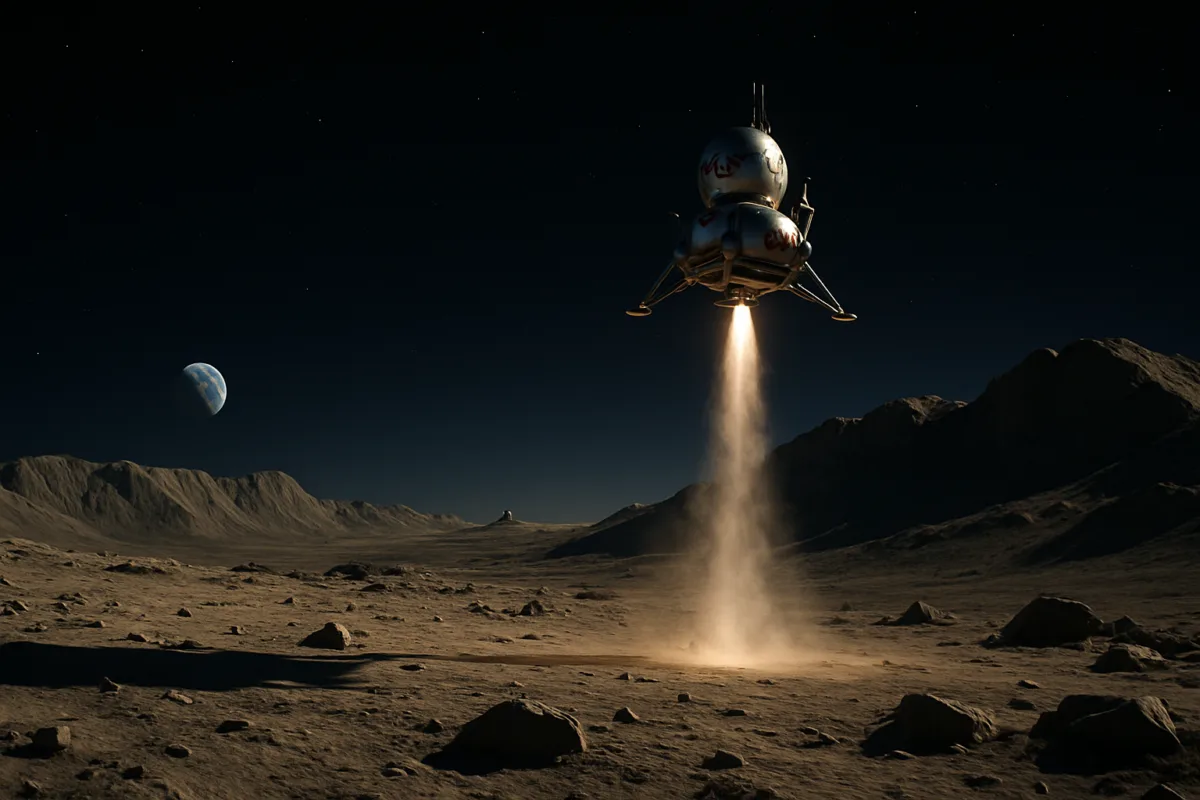
Descending from orbit to a soft touchdown on an airless body requires a tightly timed sequence of burns, sensor transitions and control loops. In Luna 15’s case, the descent timeline on 21 July 1969 shows a textbook sequence executed until the final seconds. At 15:47 UTC the main retrorocket fired to drop the spacecraft out of its lunar orbit toward Mare Crisium. Instruments then handed control from orbital-state estimation to terminal guidance, radar altimetry should have begun feeding range and closure-rate data, and the automated hazard-avoidance logic was to steer the final approach.
Telemetry loss and altitude ambiguity
Four minutes after the retrorocket burn Luna 15’s transmissions ceased, at an estimated altitude near three kilometres. Several technical hypotheses explain such a sudden loss: antenna misalignment during attitude adjustments, a critical hardware failure induced by vibration or thermal shock, or an impact with rising terrain that destroyed the communications link. The mission’s calculated impact point — roughly 550 kilometres from the Apollo 11 site and likely on the flank of a mountain — suggests that terrain undulations and a possible mismatch between onboard terrain models and actual elevation profiles contributed to the failure.
Navigation and sensor limitations
Navigation during terminal descent relies on accurate knowledge of the lunar gravity field, initial orbit determination, sensor calibration and the fidelity of onboard terrain references. In an era when lunar topographic data were limited, margin for error was thin. Autonomy helps by enabling rapid corrective actions, but autonomy depends on the accuracy of the inputs. If the radar altimeter misinterpreted echoes due to slope or roughness, or if the velocity solution lagged sensor updates, the guidance commands sent the lander toward higher ground. The flight path complexity required split-second decisions; without human-in-the-loop flexibility, a single systematic bias could be fatal.
Risk trade-offs: why Luna 15 took chances
Assessing the mission as a process highlights why Luna 15’s planners accepted elevated risk. Managers faced a decision tree: delay for more mapping and safer landing architecture or press for a fast attempt with narrower margins. Political pressure and the tight Apollo window skewed decisions toward the latter. A successful sample return would have offered a tangible achievement to balance the symbolic victory of a crewed landing. The paradox, of course, is that the more tightly one compresses the decision timeline, the more the mission’s success depends on the absence of low-probability but high-consequence anomalies.
The human factor in robotic missions
Even fully automated missions have human-influenced parameters: site selection, abort thresholds, descent profiles and fuel reserves. Controllers must decide when to accept more conservative trajectories or when to push for marginal gains. In Luna 15’s case, those human choices were embedded in the software and commands executed during the descent. The lesson here is that autonomy does not remove the human dimension; it merely shifts where humans exert influence — toward prior planning and risk tolerance rather than last-second intervention.
What was lost, and what the follow-up proved
The abrupt crash erased the immediate possibility of the Soviets returning the first lunar sample to Earth in July 1969. But it did not disprove the method. The approach was technically sound and, critically, salvageable. A year later, in September 1970, Luna 16 successfully completed a robotic sample-return mission: it touched down, collected a small core of lunar soil, and returned a capsule safely to Earth. Luna 16 validated the concept Luna 15 had attempted and refined the processes of landing site reconnaissance, terminal guidance and ascent staging under planetary constraints.
From failure to iterative improvement
Viewed as a process, Luna 15 is a case study in iterative system engineering. The failure identified weak links — terrain modelling fidelity, terminal sensor interpretation, and the need for more robust communications during high-dynamic phases — and Luna 16 addressed them. This cycle of launch, test, analysis and redesign is central to aerospace progress. Failures are data-rich events that, when analyzed dispassionately, accelerate maturation more rapidly than routine successes.
Historical reinterpretation
Finally, the story reframes how we remember the lunar race. The public memory fixates on the dramatic moment of a human footprint; but concurrently, automated systems contested symbolic milestones in quieter orbits above the Moon. Recognizing that parallel contest enriches the narrative and underscores that space achievement is a multilayered process, integrating human presence with robotic persistence.
Thinking through Luna 15 as a sequence of choices and technical transitions clarifies the mission’s logic and its vulnerabilities. Its launch, orbital reconnaissance, descent choreography and abrupt loss exemplify how schedule pressure, sensor limitations and topographic uncertainty combine to define mission outcomes. The subsequent success of Luna 16 completes a process story: an experiment pushed too close to the edge, learned from, and then executed successfully once those lessons were integrated. That arc — risk, failure, learning, and eventual mastery — is as much a part of the Moon’s history as the footprints left in the dust.

Dr. Morgan directed the Archives Program from 2014 to 2017, gaining extensive experience in research documentation, information management, and the preservation of scholarly resources. Throughout her career, she has worked closely with academic publications and research materials, developing expertise in evaluating scientific sources and communicating complex topics to broad audiences.
Her primary areas of specialization include scientific publishing, research communication, editorial review, and the translation of technical research into accessible educational content. She has contributed to projects involving space science, astronomy, environmental science, history, archaeology, and emerging scientific discoveries, always emphasizing accuracy, transparency, and the responsible presentation of evidence.
As Editorial Director of Muskurahat.us, Dr. Morgan leads the editorial review process for scientific articles, ensuring that content is based on reputable sources, peer-reviewed research whenever available, and publications from recognized universities, research institutions, and international scientific organizations.
She is committed to promoting scientific literacy through clear, engaging, and well-documented articles that help readers better understand scientific discoveries and their impact on society. Her editorial philosophy is founded on accuracy, intellectual integrity, independent journalism, and continuous learning as scientific knowledge evolves.
Through her work at Muskurahat.us, Dr. Morgan supports the publication of trustworthy scientific content that makes complex research accessible to readers around the world while maintaining rigorous editorial standards.