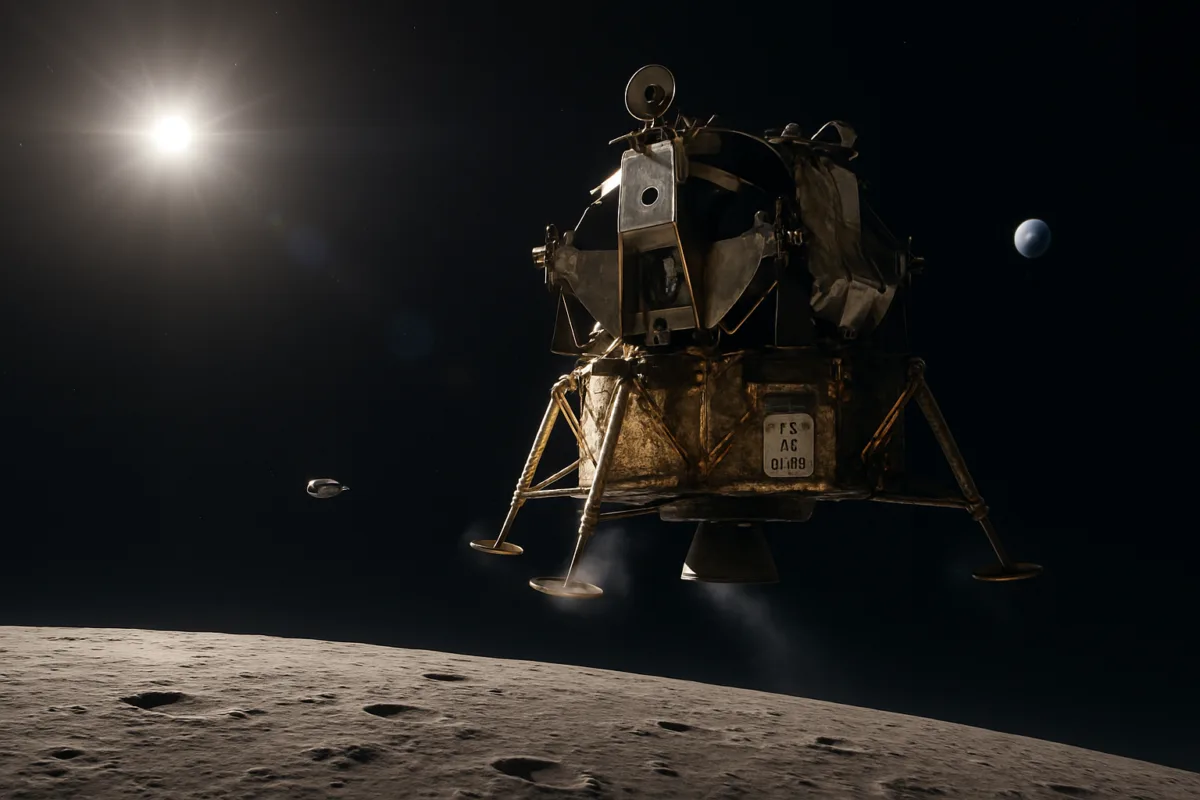
In May 1969, two men in a lunar module called Snoopy descended to within 14.4 kilometres of the Moon and then, after a careful rehearsal of landing procedures, fired the ascent engine until the fuel ran out. The ignition was deliberate, the outcome planned: Snoopy would not return to Earth. Instead it left the Moon behind and turned into an object orbiting the Sun — a somber, singular relic of a mission that proved the thesis of human lunar landing without actually touching down.
Why Apollo 10 Was a Rehearsal, Not a Landing
Apollo 10 was never meant to plant a flag. Its role was explicit and narrow: validate the sequence of operations that a landing mission would need to execute, while leaving the actual touchdown for the next flight. Launching on 18 May 1969, the mission carried commander Thomas Stafford, command module pilot John Young and lunar module pilot Eugene Cernan. Charlie Brown, the command and service module, would carry the trio to and from Earth. Snoopy, the lunar module, would perform as if preparing to land — minus the final descent — then rejoin its partner in orbit.
The close pass that made the Moon feel real
NASA’s records stress how close that rehearsal got. Snoopy dipped to roughly 47,000 feet above the lunar surface — approximately 14.4 kilometres — a depth at which instruments, windows and human sight converted the Moon from an abstract destination to a tangible environment. At that altitude the surface was no longer a distant target on a navigation chart: it was a terrain with features, slopes and shadows that would define the final margins of a landing attempt.
Testing every link in the chain
The mission was a stress test of navigation, radar, crew timing and the choreography of rendezvous. Stafford and Cernan undocked, flew the descent profile to a near-landing low pass, jettisoned the descent stage, ignited the ascent stage and practiced the maneuvers that would later allow a crew to return from the lunar surface. John Young in Charlie Brown remained the anchor point for rendezvous and rescue, ready to receive his crewmates after their independent flight. The purpose was industrial and rigorous: prove the sequence, expose weaknesses, give the next crew the confidence to try the whole thing.
The unexpected wobble and the success of a rehearsal
Rehearsals are useful because they reveal the imperfect edges of a plan. During staging — the moment the descent stage was jettisoned and the ascent stage assumed control — Stafford and Cernan experienced an unexpected motion. It was brief, but precisely the kind of anomaly a rehearsal ought to produce before the stakes rose to the level of actual lunar touchdown with no backup in orbit. The crew recovered control, completed the rendezvous with Young, and transferred back into Charlie Brown after about eight hours of independent flight in the lunar module.
From crewed spacecraft to artifact
What followed is a transition that reads like a changing of forms: Snoopy stopped being a vehicle that carried people and became an object to be managed. After docking, when the two astronauts had returned to the command module, residual internal pressure reportedly pushed Snoopy away faster than expected. Controllers then used the remaining ascent engine propellant to perform a deliberate burn — to depletion — designed to move Snoopy out of lunar orbit and into heliocentric space. The decision was practical, not poetic: dispose of a craft that had served its mission and could become a navigational hazard if left uncontrolled in lunar orbit.
Technical honesty: burning to depletion
NASA’s phrase “to fuel depletion” is technocratic and precise, but it carries a blunt human image: a last, finite combustion that emptied the tanks and changed Snoopy’s fate. By using the residual propellant to alter its trajectory, engineers created a maritime analogy in celestial terms: instead of stranding the vehicle on the Moon or crashing it back into lunar terrain, they pushed it into the broader current of the Solar System. The ascent stage, once the intimate space of two astronauts working at 14.4 kilometres above the regolith, became a small, empty spacecraft drifting in an orbit around the Sun.
The dichotomy of two artifacts
Apollo 10 left two distinct kinds of evidence. Charlie Brown would splash down on 26 May 1969 and join the visible, visitable history of Apollo missions: a command module preserved in museums, mission photos, taped transcripts and human memory. Snoopy, by contrast, became an artifact without a room, an object whose whereabouts would be determined by orbital mechanics rather than display cases. One returned to Earth; the other vanished into heliocentric orbit as a reminder that spacecraft are tools to be used and then managed, not trophies to be kept when their primary job is done.
The human story inside the procedures
It’s easy to reduce Apollo missions to checklists and telemetry, but the human dimension makes Apollo 10 resonate. Stafford, Young and Cernan were not merely testers of boxes and engines; they were protagonists in a drama of restraint. They adhered to the mission boundary that forbade landing. That discipline preserved Apollo 11’s role as the first true landing, while delivering the operational confidence and procedural validation that made that feat possible. The astronauts’ ability to accept and perform under those limits — to fly right up to an almost-landing and then return without breaking protocol — speaks to a culture of trust and mission design that characterized the program.
Engineering over sentiment
There is a certain cold clarity in the decision to send Snoopy into a solar orbit. Spacecraft are engineered for tasks, and once those tasks are complete they become items to manage. Leaving the ascent stage in lunar orbit or crashing it into the Moon might have created short-term data points or debris; returning it to Earth was impractical. The chosen disposal burn was a clean answer to a pragmatic question: how do you remove a serviceable-but-unneeded piece of hardware from a sensitive operational environment? The answer: move it into an orbit where it is less likely to be a problem.
What Snoopy’s fate tells us about space policy and legacy
Snoopy’s transformation from crewed spacecraft to heliocentric orphan raises questions that feel contemporary: how do we treat human-made objects in space, what counts as heritage, and who owns the story of objects no museum can house? Space policy today increasingly grapples with long-term stewardship: debris mitigation, planetary protection and the cultural designation of historically significant hardware. Snoopy sits at the intersection of those issues — a case study in disposal practice and an emblem of the messy afterlife of mission hardware.
Tracking an object in the flow of the Solar System
Unlike components left on the lunar surface or command modules returned to Earth, an object placed in heliocentric orbit is difficult to catalog and even harder to monitor continuously. Its future position depends on the precise details of the disposal burn, solar radiation pressure, gravitational perturbations and decades of small influences. That uncertainty turns Snoopy into a kind of archaeology in motion: an artifact whose traces are mathematical and probabilistic rather than physical and visitable.
Legacy beyond the museum
There is a paradoxical dignity in that fate. Snoopy, propelled until the propellant was gone, became a quiet testament to a task completed. It did not return with a plaque or a ribbon; it drifted into the heliocentric background as evidence of a rehearsal that had made one of humanity’s greatest achievements possible. While museums preserve hardware and plaster history on walls, other kinds of legacy persist in trajectories and in the way engineering choices ripple into long-term outcomes. Snoopy’s path is one of those ripples.
Looking back at Apollo 10, the mission’s success was not measured in footprints but in confidence. The rehearsal validated the chain of events that allowed Apollo 11 to land and return; it revealed small problems while they were still survivable; and it delivered two different kinds of evidence — one tangible and displayable, the other cast loose into heliocentric space. In that choice and in the quiet image of a crewed ascent stage continuing on without its occupants, we are reminded that exploration often leaves both a museum and an invisible wake, and that the practical choices made on the pad can become the long stories we tell about our first tentative steps off Earth.

Dr. Morgan directed the Archives Program from 2014 to 2017, gaining extensive experience in research documentation, information management, and the preservation of scholarly resources. Throughout her career, she has worked closely with academic publications and research materials, developing expertise in evaluating scientific sources and communicating complex topics to broad audiences.
Her primary areas of specialization include scientific publishing, research communication, editorial review, and the translation of technical research into accessible educational content. She has contributed to projects involving space science, astronomy, environmental science, history, archaeology, and emerging scientific discoveries, always emphasizing accuracy, transparency, and the responsible presentation of evidence.
As Editorial Director of Muskurahat.us, Dr. Morgan leads the editorial review process for scientific articles, ensuring that content is based on reputable sources, peer-reviewed research whenever available, and publications from recognized universities, research institutions, and international scientific organizations.
She is committed to promoting scientific literacy through clear, engaging, and well-documented articles that help readers better understand scientific discoveries and their impact on society. Her editorial philosophy is founded on accuracy, intellectual integrity, independent journalism, and continuous learning as scientific knowledge evolves.
Through her work at Muskurahat.us, Dr. Morgan supports the publication of trustworthy scientific content that makes complex research accessible to readers around the world while maintaining rigorous editorial standards.