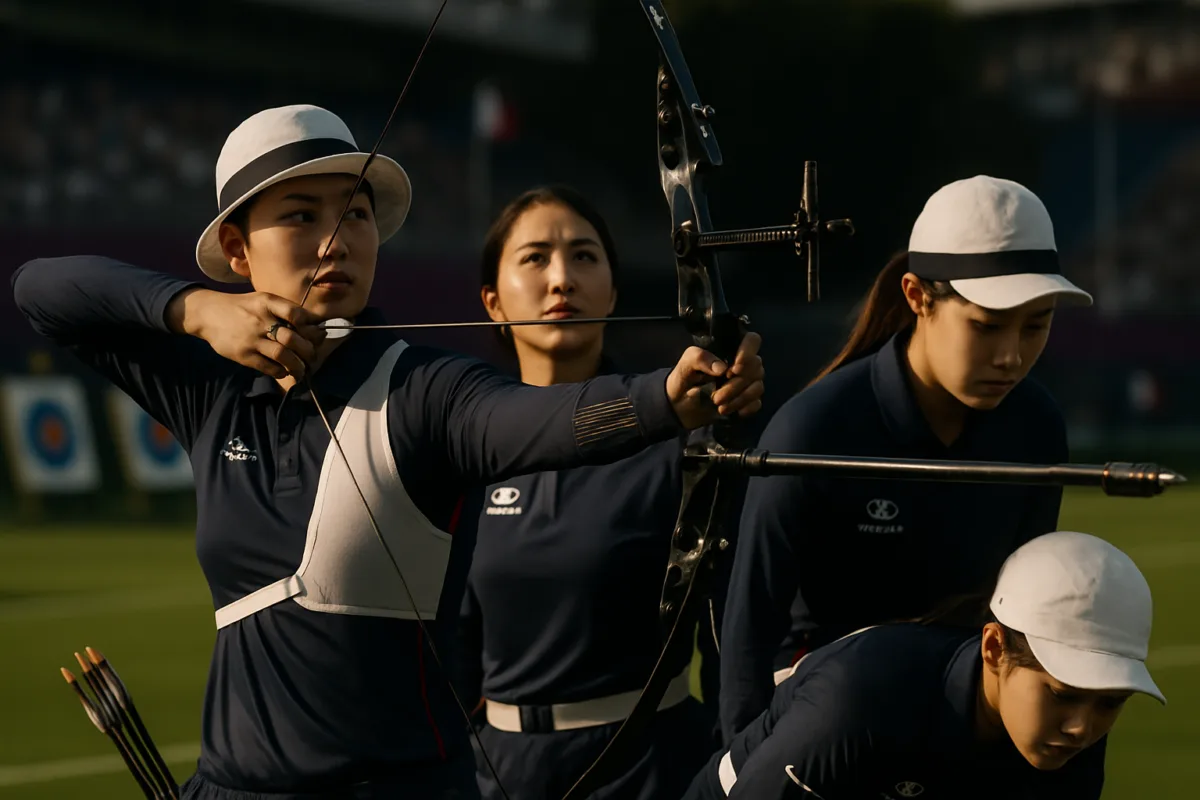
South Korea’s women’s team archery sweep at the Olympics reads like a piece of sporting folklore: since the event’s Olympic debut at Seoul 1988, the same nation has climbed to the top of the podium every single time. By Paris 2024 that streak reached ten consecutive golds, a run that spans generations, revolutions in technique and technology, and an evolving global field that has narrowed the margins to millimetres. That sequence is not merely the product of gifted individuals but the visible outcome of a system, a culture, and a collective psychology that repeatedly manufactures champions.
The anatomy of dominance: scouting, selection and structure
To understand a four-decade streak you have to look less like a fan and more like an analyst. South Korea’s approach begins where many sporting legacies start: with early talent identification. Schools remain fertile hunting grounds, where basic skills are spotted and promising young athletes are channelled into specialised coaching. From an estimated 900 archers in elementary settings, the system funnels participants through middle and high school to about 150 at university club level. Each stage filters athletes not only by raw talent but by performance under pressure, discipline, and consistency.
That funnel is institutionalised. Yearly selection trials, intense domestic competition and a culture that rewards incremental excellence mean the pool of elite archers is deep. Corporations such as Hyundai Motor Group provide long-term financial backing that stabilises coaching programmes, facilities and opportunities for international competition. This infrastructure removes many of the uncertainties most national programmes face—funding gaps, inconsistent talent pathways, and patchy coaching—which allows a relentless focus on performance and refinement.
From club to podium: how pipeline produces Olympic teams
The movement from a school archer to an Olympic team member is brutal in its selectivity. Athletes routinely navigate multilevel selection processes that replicate the tension and stakes of international competition. For competitors like Kang Chae-young and past champions such as Ki Bo-bae, the domestic gauntlet is as consequential as any Olympic final. Repetition of high-stakes selection means that athletes arrive at the international stage having already been stress-tested many times over.
That repetition serves another function: it prevents overreliance on a single star cohort. Because the domestic competition is so fierce, new talent is consistently prepared to replace outgoing champions. In contrast to models where a small group of elite athletes carry a programme for years, South Korea’s system spreads responsibility across a rotating cast. When three first-time Olympians—Lim Si-hyeon, Nam Su-hyeon and Jeon Hun-young—stood on the Paris line in 2024, they carried a legacy rather than a dynasty of specific teammates.
The psychology of a streak: avoiding the loss
Winning repeatedly is not merely about maximizing the probability of success. There is a distinct psychological burden in being the steward of a streak that predates you. The players who inherit such records face unique mental terrain: the fear of becoming the one who broke the run, the weight of national expectation, and a public narrative that imagines failure as a kind of betrayal. South Korea’s selection and training culture helps diffuse that burden into the process itself, so responsibility is shared across generations rather than concentrated on a few veterans.
In Paris, that mental calculus came into acute focus. The final against China went to a shoot-off—a pure, razor-edge contest where a few millimetres decide destiny. Jeon Hun-young’s description of the moment reveals the minimalist cognitive strategy elite performers use: try not to think too much, trust in training, and translate repetition into calm. Such mental habits are drilled in the same way technical skills are honed; the difference is they are about containing the psychological weight of a legacy rather than adding to it.
Technique, technology and tiny margins
High-performance sport is as much an engineering problem as a talent one. Over decades the Korean system has refined technique—stance, release, sighting and equipment calibration—while integrating sports science into recovery, nutrition and biomechanics. The result is a near-industrial perfection: form that can be reproduced under pressure and equipment tuned to remove as much variability as possible.
Yet even with near-perfect systems the margins in modern archery are infinitesimal. At Paris the match was decided via judge review and a shoot-off, not by a comfortable aggregate margin. That closeness speaks to global improvements; countries that once lagged are now within a single arrow’s difference. The arms race is no longer just domestically driven but international, as training methods, analytics and access to elite coaching spread.
Comparisons in Olympic context
Ten consecutive Olympic golds in a single event is an exceptional feat, though not the absolute record in Olympic history. The United States’ run of 16 consecutive men’s pole vaults from 1896 to 1968 and China’s modern dominance in table tennis—32 of 37 golds since 1988—are other astonishing streaks. What sets South Korea’s women’s team archery apart is its unbroken continuity: there has never been a break, across multiple eras, equipment changes and geopolitical shifts.
Where those other streaks sometimes rested on early establishment advantages or periods where competition was limited, Korea’s archery supremacy has been continually tested by an increasingly competitive world. This creates a special credibility: the country has not merely benefited from a sufficiently weak field for a time, it has actively out-evolved opponents who were closing the gap.
What closing margins mean for future editions
The narrowing margins visible in Paris imply that sustaining the streak to Los Angeles 2028 will be more about psychological continuity and adaptability than about building an ever-bigger talent funnel. The system that produced ten titles is robust, but the next three champions must blend technical skill, calm under pressure and an ability to respond to new tactical trends—rapid match analytics, different arrow materials, or opponents’ emergent strategies. The unpredictability of sport means every cycle brings new variables; dominance requires persistent improvement, not historical complacency.
Rivals are incentivised to study Korea’s playbook closely. As training methods globalise and knowledge exchanges increase—through coaching clinics, joint training camps, and video analysis—the historical edge of proprietary methods narrows. The good news for archery fans is that this makes each final far more compelling: the outcome increasingly rests on how well a team synthesises decades of national wisdom with the latest innovations and mental conditioning.
Leadership, sponsorship and long-term thinking
Corporate sponsorship has tethered South Korea’s programme to long-term strategic planning. Stabilised funding from conglomerates such as Hyundai enables multi-year athlete development plans, investments in high-quality facilities and international competition exposure that smaller programmes struggle to match. This financial backbone permits risk-taking in coaching and the patient development of athletes who may not peak until they face Olympic pressure.
Leadership within the sport—federation administrators, influential coaches and former champions—also play a quiet but crucial role. Their decisions about how trials are run, how to manage public expectations and how to support athletes through transitions define the conditions under which success is possible. When those decisions prioritise depth over short-term star power, a programme is better placed to regenerate champions consistently.
Lessons for other sports and nations
There are broader lessons here for any sport seeking sustained excellence. Early talent identification matters, but it must be matched to long-term athlete development; selection mechanisms should test athletes under pressure and reward consistency; and a funding model that allows patience and stability is invaluable. Perhaps most critically, a culture that normalises elite expectations—so that pressure is metabolised rather than feared—creates an environment where the best repeatedly emerge.
Yet these elements aren’t a universal formula. Cultural factors, national priorities and sporting histories differ. What works in South Korea—where archery has deep social and institutional roots—may need adaptation elsewhere. The core idea remains: dynasty-level results require building ecosystems, not chasing single-event glory.
Watching three first-time Olympians clinch a tenth straight gold in Paris reminded global audiences that dynasties are living things. They are sustained not by nostalgia but by continuous reinvention: refining technique, supporting athletes holistically, adapting to rivals, and, perhaps above all, creating cultures where the weight of expectation is shared and converted into a quiet focus. As opponents close the gap and every arrow grows more consequential, the streak will not simply survive on history; it will continue because each new generation finds a way to make greatness feel ordinary.

Dr. Morgan directed the Archives Program from 2014 to 2017, gaining extensive experience in research documentation, information management, and the preservation of scholarly resources. Throughout her career, she has worked closely with academic publications and research materials, developing expertise in evaluating scientific sources and communicating complex topics to broad audiences.
Her primary areas of specialization include scientific publishing, research communication, editorial review, and the translation of technical research into accessible educational content. She has contributed to projects involving space science, astronomy, environmental science, history, archaeology, and emerging scientific discoveries, always emphasizing accuracy, transparency, and the responsible presentation of evidence.
As Editorial Director of Muskurahat.us, Dr. Morgan leads the editorial review process for scientific articles, ensuring that content is based on reputable sources, peer-reviewed research whenever available, and publications from recognized universities, research institutions, and international scientific organizations.
She is committed to promoting scientific literacy through clear, engaging, and well-documented articles that help readers better understand scientific discoveries and their impact on society. Her editorial philosophy is founded on accuracy, intellectual integrity, independent journalism, and continuous learning as scientific knowledge evolves.
Through her work at Muskurahat.us, Dr. Morgan supports the publication of trustworthy scientific content that makes complex research accessible to readers around the world while maintaining rigorous editorial standards.