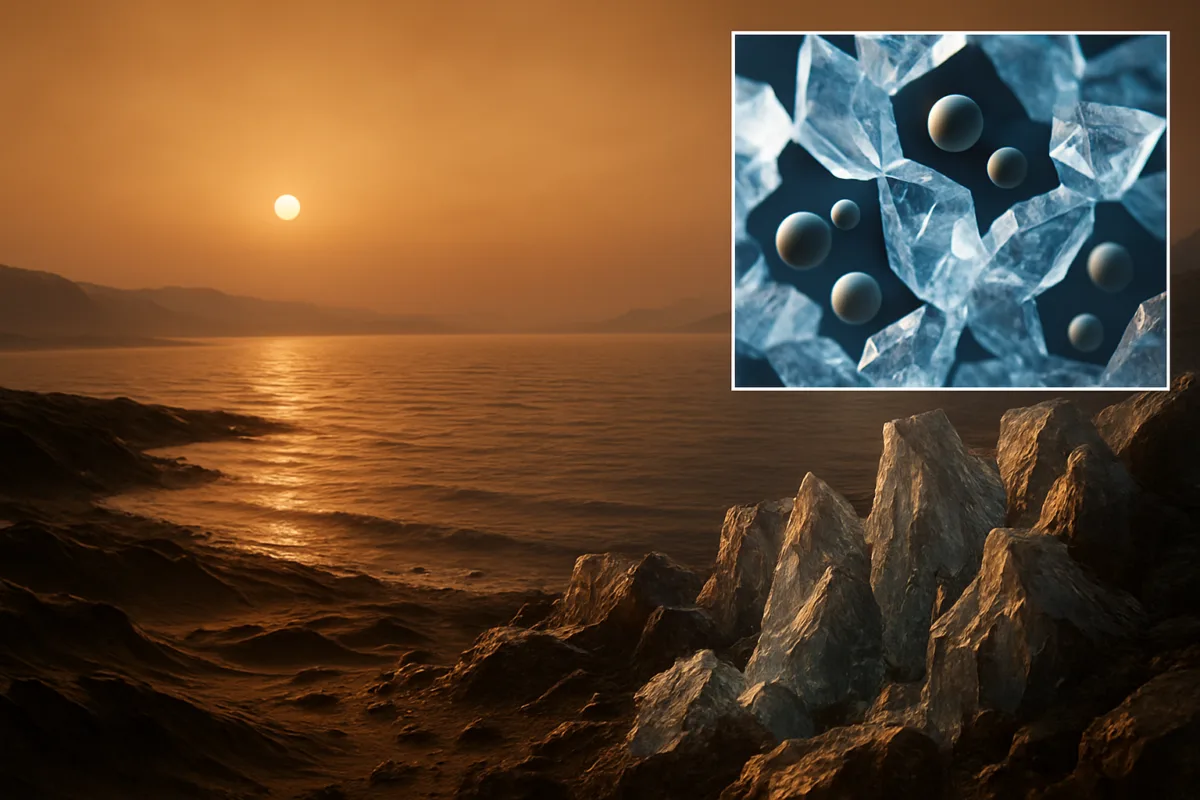
Titan’s chemistry is not merely exotic; it is a direct challenge to a rule many scientists teach in introductory chemistry: ‘like dissolves like.’ Recent laboratory and computational work shows that at roughly 90 kelvin (about minus 183 degrees Celsius) molecules that should repel each other — a highly polar compound like hydrogen cyanide and nonpolar hydrocarbons such as methane and ethane — can instead coexist inside the same solid architecture. This observation is not a curiosity to be filed under trivia. It forces a re-evaluation of how we model surface processes, transport, and prebiotic potential on frigid worlds, and it demands a disciplined, skeptical approach to claims that such chemistry implies anything about life.
A chemical rule under scrutiny
The maxim ‘like dissolves like’ captures a convenient rule of thumb for room-temperature chemistry: polar solvents dissolve polar solutes and nonpolar solvents dissolve nonpolar solutes because of complementary intermolecular forces. That guidance has governed expectations about mixtures from everyday oil-and-water separations to solvent selection in the laboratory. But rules built for one regime can fail in another. Titan’s surface temperature and composition put it in a regime where thermal energy is low, molecular motion is slow, and crystal lattices are dominant players. Under these conditions, the energetic barriers that normally enforce separation can be overcome by structural accommodation: hydrocarbon molecules can occupy voids in a hydrogen-cyanide crystal lattice, forming co-crystalline or solid-solution phases rather than remaining segregated.
The experiment and the computational story
The combination of laboratory spectroscopy at NASA’s Jet Propulsion Laboratory and large-scale modelling by Martin Rahm’s group at Chalmers University turned a surprising spectral signature into an interpretable structural hypothesis. In the lab, researchers cooled mixtures of hydrogen cyanide with methane and ethane to cryogenic temperatures comparable to Titan’s surface and subjected them to laser spectroscopy. The spectral fingerprints indicated more than a simple physical mixture: something in the solid structure had changed. Theoretical simulations then explored crystal packing possibilities and found stable configurations in which nonpolar hydrocarbons inserted into the HCN crystal lattice. The result is not a warm, homogeneous solution; it is a structural coupling that dissolves our intuitive division between polar and nonpolar chemistry at low temperature.
Temperature as a decisive parameter
The key variable is thermal energy. At 90 kelvin, molecular vibrations and translational motion are greatly suppressed. The penalty for keeping disparate molecules adjacent or lodged in a lattice can be lower than the structural stabilization gained by the lattice configuration itself. van der Waals forces, steric accommodation, and entropic considerations in the solid state can cooperate to favor mixed solids that would be thermodynamically unfavorable at higher temperatures. This is not metaphysics; it is standard statistical mechanics shifting the balance of forces. The upshot is that chemical rules tuned to Earth’s ambient conditions lose authority when extrapolated blindly to cryogenic environments.
Why this matters for Titan’s landscape and cycles
At stake is more than an abstract correction to textbook lore. Titan hosts a methane-ethane hydrological cycle analogous in architecture to Earth’s water cycle: atmosphere, clouds, rain, rivers and seas. It also produces a suite of organic molecules including hydrogen cyanide through atmospheric photochemistry. If HCN and hydrocarbons can co-crystallize, then the fate of aerosols, surface deposits and shoreline sediments changes. Mixed crystalline materials can have different solubilities in liquid methane/ethane, different mechanical strengths, altered abrasion properties, and distinct responses to thermal and mechanical cycling. Over geological time, those differences could change erosion rates, sediment transport, and even the morphology of dunes and shorelines.
Geology with a twist
Consider two simple scenarios. In one, HCN forms pure crystals that sit as discrete grains on a beach of hydrocarbon sand. In the other, HCN forms a mixed crystal in which methane or ethane molecules occupy lattice sites. The second case could produce a composite grain that is more soluble in liquid hydrocarbons or, conversely, more resistant to fragmentation depending on how the co-crystal affects bond strengths and fracture toughness. Those differences scale up: they affect how quickly organic-rich deposits are buried, how long reactive species remain exposed at the surface, and which molecular inventories are likely to be concentrated at landing sites that missions like Dragonfly will explore.
Prebiotic chemistry: promise and restraint
Hydrogen cyanide has an infamous reputation as a versatile prebiotic feedstock because it can contribute to pathways leading to amino acids and nucleobase precursors under some conditions. It is tempting to read the new co-crystallization finding as a hint of tantalizing chemistry on Titan. But the correct scientific posture is more cautious. A molecule trapped in a crystal lattice is not as freely available for reaction as a molecule dissolved in a solvent. Co-crystallization may sequester HCN from liquid-phase chemistry, delaying or preventing the kinds of solution-phase reactions prebiotic chemists often imagine. Alternatively, lattice inclusion could preserve HCN against rapid destruction, creating reservoirs that could become reactive only under episodic events such as impact heating or local geothermal activity. Both possibilities are consequential; neither alone establishes a path to life.
Why caution trumps hype
Public fascination with alien life is a useful driver for funding and interest, but it can distort the interpretation of incremental findings. The reported mixing behavior is a chemistry result with planetary relevance, not evidence of biology. That distinction matters for how scientists communicate and for how mission planners allocate scarce resources. Overstating the astrobiological implications risks eroding public trust when subsequent work clarifies limits and nuances. A responsible argument recognizes the novelty and importance of the finding while grounding expectations in the constraints imposed by physics, kinetics and planetary context.
How to frame scientific messages
A better narrative emphasizes three points: first, that known physical laws still apply but their relative influence shifts with environment; second, that this result expands the inventory of plausible solid-phase materials on Titan and similar worlds; and third, that the implications for prebiotic chemistry are subtle and conditional. This framing keeps the door open to exciting possibilities without converting a single laboratory observation into an overreaching claim. It also points to productive follow-up work rather than idle speculation.
Practical consequences for missions and models
The next decade of Titan exploration — including NASA’s Dragonfly rotorcraft mission — should treat this finding as a hypothesis to be tested in situ. Remote and in-situ measurements can search for spectroscopic signatures consistent with co-crystalline phases, measure mechanical properties of surface samples, and examine how organic deposits respond to liquid exposure. Models of Titan’s surface evolution should incorporate the possibility of mixed solids when estimating erosion, sediment transport, and landscape evolution. Laboratory analog studies should broaden the parameter space to include mixed-phase behavior across temperatures, pressures, compositions and irradiation histories that mimic Titan’s environment.
Priorities for follow-up
Key experiments include: systematic spectroscopy of HCN-hydrocarbon mixtures across a temperature gradient to determine formation thresholds; mechanical testing of co-crystalline aggregates to measure strength and fracture modes; irradiation and charged-particle exposure to assess stability under Titan-like atmospheric conditions; and long-duration diffusion studies to evaluate whether hydrocarbons can migrate into or out of HCN lattices on geologic timescales. On the computational side, free-energy calculations and kinetics modelling will illuminate whether observed structures are metastable curiosities or long-lived constituents of Titan’s surface.
The new result should therefore be read as an invitation. It asks planetary scientists to update models, mission teams to refine measurement plans, and laboratory chemists to expand the cryogenic repertoire. It does not authorize hyperbolic statements about alien seas suddenly becoming ‘Earth-like’ or ‘teeming with the chemistry of life.’ Instead, it sharpens our understanding of where molecules go in cold environments and how that distribution shapes chemical availability over time. That refinement is exactly the kind of intellectual discipline that will make future discoveries on Titan more meaningful, whether those discoveries illuminate the mechanics of icy landscapes or the deep questions about life’s ingredients in the cosmos.

Dr. Morgan directed the Archives Program from 2014 to 2017, gaining extensive experience in research documentation, information management, and the preservation of scholarly resources. Throughout her career, she has worked closely with academic publications and research materials, developing expertise in evaluating scientific sources and communicating complex topics to broad audiences.
Her primary areas of specialization include scientific publishing, research communication, editorial review, and the translation of technical research into accessible educational content. She has contributed to projects involving space science, astronomy, environmental science, history, archaeology, and emerging scientific discoveries, always emphasizing accuracy, transparency, and the responsible presentation of evidence.
As Editorial Director of Muskurahat.us, Dr. Morgan leads the editorial review process for scientific articles, ensuring that content is based on reputable sources, peer-reviewed research whenever available, and publications from recognized universities, research institutions, and international scientific organizations.
She is committed to promoting scientific literacy through clear, engaging, and well-documented articles that help readers better understand scientific discoveries and their impact on society. Her editorial philosophy is founded on accuracy, intellectual integrity, independent journalism, and continuous learning as scientific knowledge evolves.
Through her work at Muskurahat.us, Dr. Morgan supports the publication of trustworthy scientific content that makes complex research accessible to readers around the world while maintaining rigorous editorial standards.